







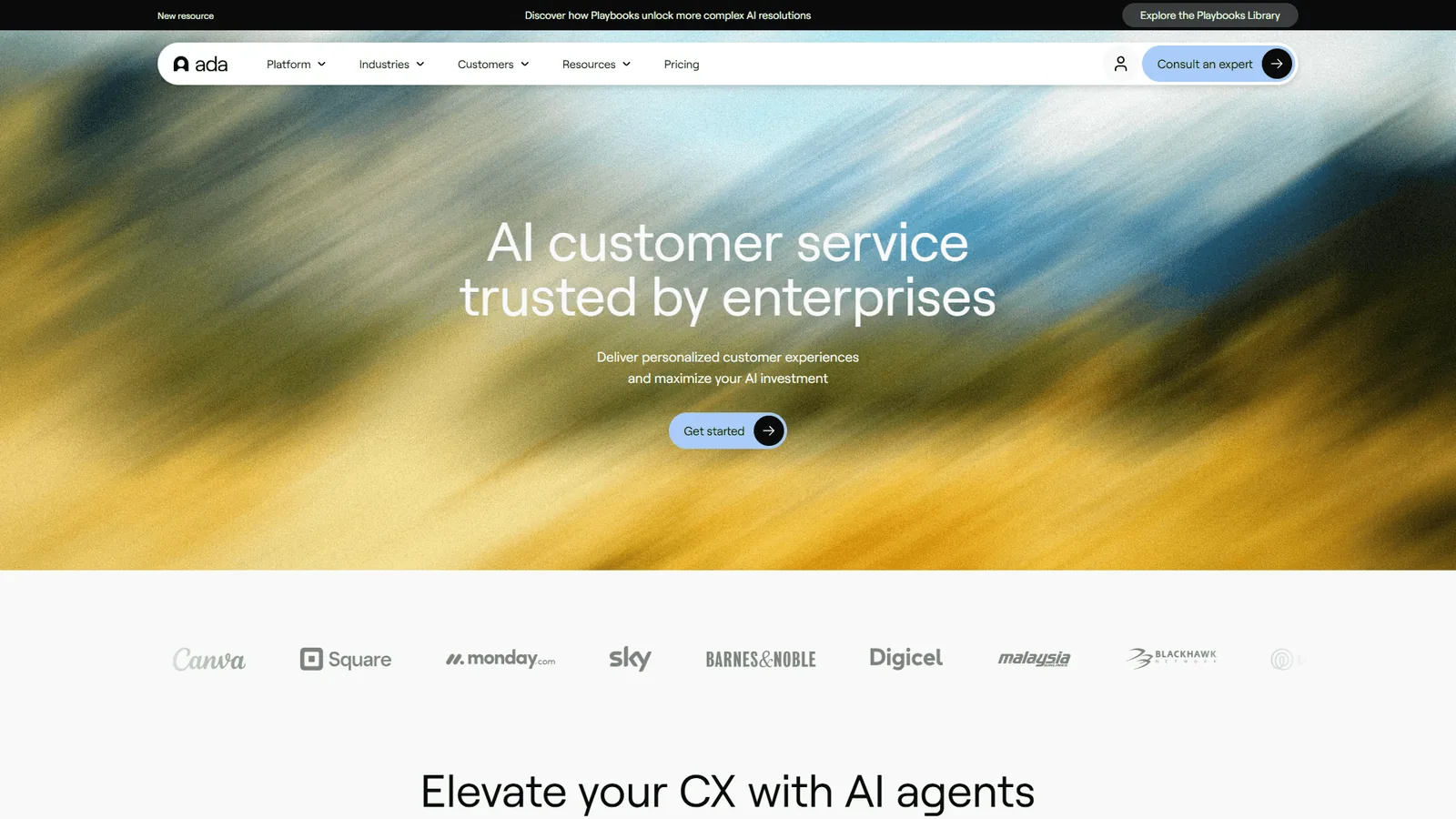
Ada (ada.cx) has built a strong reputation as an enterprise AI chatbot platform, promising to automate customer service conversations at scale without requiring constant human intervention. Its no-code builder, multilingual support, and deep integration capabilities have made it popular with large support teams. But Ada’s enterprise-first positioning - combined with pricing that is only available on request - means a lot of businesses find themselves looking for alternatives that are more transparent, more affordable, or better suited to their specific workflow.
In this 2026 guide to Ada competitors, we cover the four most capable alternatives: Intercom, Zendesk, Tidio, and LiveChat. Each takes a distinct approach to AI-powered customer service, and each is better suited to a different type of business.
Comparison Table: Ada Competitors at a Glance
Ada Competitors are platforms operating in the same market as Ada, each targeting slightly different workflows or team sizes. Understanding where each competitor has an edge helps you evaluate whether Ada is still the right fit or if a switch makes sense.
| Tool | Best For | Starting Price | Free Tier |
|---|---|---|---|
| Ada | Enterprise AI automation | Custom pricing | No |
| Intercom | SaaS teams scaling with AI | $39/mo per seat | No (14-day trial) |
| Zendesk | Enterprise omnichannel support | $19/mo per agent | No (14-day trial) |
| Tidio | SMBs and ecommerce | Free / $29/mo | Yes |
| LiveChat | Real-time chat-first teams | $24/mo per agent | No (14-day trial) |
Ada does not publicly list pricing. If you are comparing on cost alone, every tool in this list provides more pricing transparency upfront.
What Is Ada and Who Is It Built For?
Ada is an AI-first customer service platform designed for enterprise teams that want to automate a significant portion of customer interactions. Visit the Ada website for a full feature overview. Its core product is a no-code chatbot builder that pulls from your knowledge base to handle common questions - returns, account issues, product FAQs - without agent involvement.
Key capabilities include multilingual support across 50+ languages, proactive messaging that triggers conversations based on user behavior, and integrations with CRM platforms and helpdesk tools. Ada’s AI is designed to handle end-to-end resolution rather than just gathering information before routing to a human.
Where Ada falls short for many teams is accessibility. The platform is built for enterprise procurement cycles, meaning pricing requires a sales conversation and contracts tend to be annual. There is no self-serve onboarding, no free trial, and limited public documentation on what a typical deployment costs. Teams under 50 people or with modest support volumes often find Ada is more platform than they need.
Limitations and who it’s not for: Ada’s biggest drawbacks are opaque custom pricing, mandatory annual contracts, and a sales-led onboarding process that can stretch 4-8 weeks before go-live. Skip Ada if you need transparent self-serve pricing, a free trial, or a deployment timeline measured in days. Small teams under 20 agents and bootstrapped startups will find Ada’s enterprise positioning a poor fit.
Intercom
Intercom began as a conversational messaging platform and has evolved into a full AI-first customer service suite. Its Fin AI Agent is the headline feature - a trained AI that resolves queries across chat, email, voice, and social channels at $0.99 per resolution.
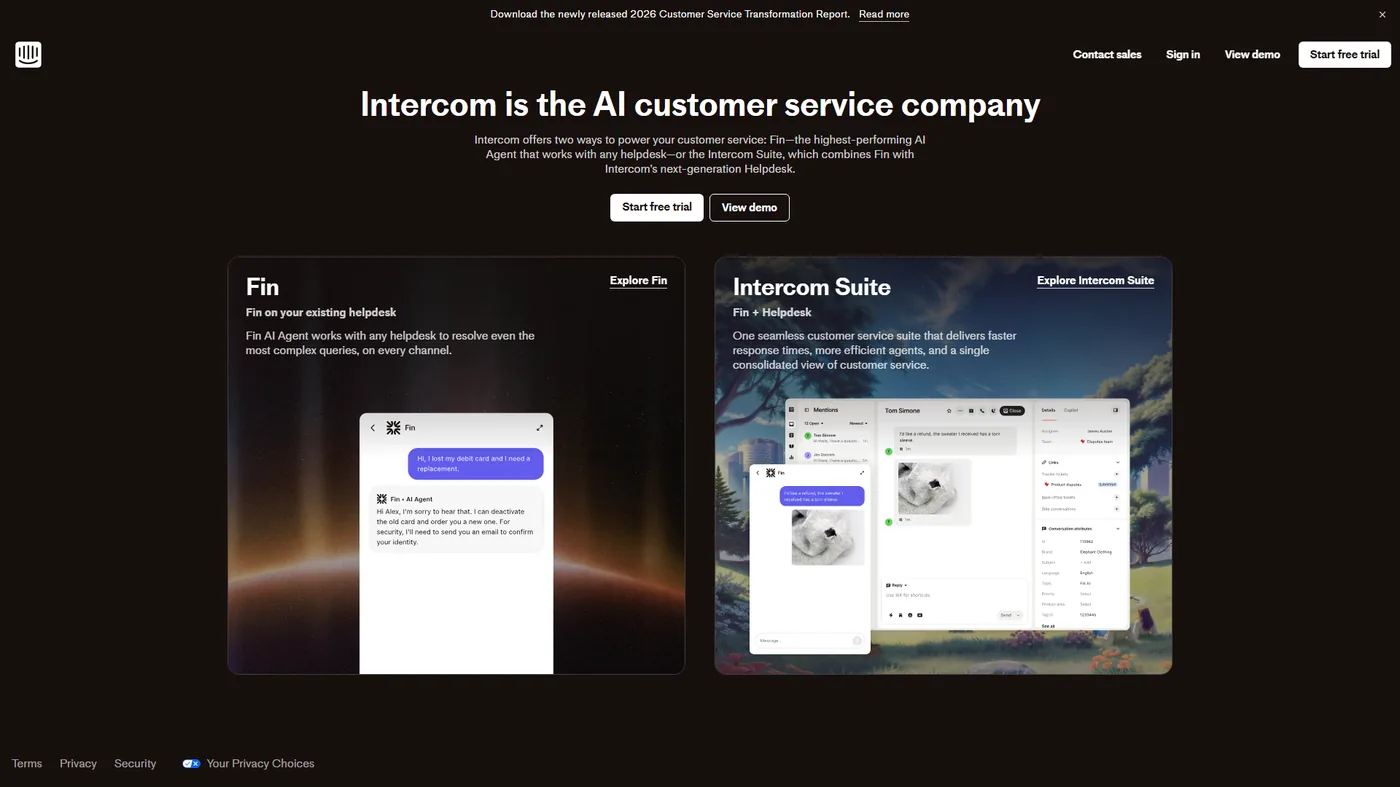
What makes Intercom distinct from Ada is that it combines AI automation with a full agent inbox, so human handoff is native to the platform rather than a bolt-on. Fin handles routine queries; agents handle complexity. The unified inbox pulls in conversations from chat, email, SMS, Slack, Discord, and social media.
Intercom’s pricing is seat-based, starting at $39 per seat per month (or $29 billed annually). Fin AI usage is charged separately at $0.99 per resolution - a transparent pay-for-what-you-use model that Ada’s custom pricing cannot match. The 14-day free trial gives enough time to see real automation rates before committing.
Where Intercom wins over Ada: Transparent pricing, self-serve onboarding, stronger voice AI (Fin Voice), and image recognition (Fin Vision). Better suited to SaaS teams that want conversational engagement alongside automation.
Where Ada has the edge: Ada’s no-code builder is often cited as more accessible for non-technical teams building complex flows. For very large enterprise deployments with dedicated implementation teams, Ada’s custom approach can offer deeper tailoring.
Best for: SaaS companies and growing support teams that want AI automation with transparent pricing and a strong unified inbox.
Limitations and who it’s not for: Intercom’s per-resolution Fin pricing becomes unpredictable at high ticket volumes - viral spikes can blow monthly budgets. The platform also lacks Zendesk’s depth of compliance certifications on lower tiers, and its omnichannel coverage is weaker for voice and social. Skip Intercom if your finance team needs forecastable monthly costs or you run a regulated industry with strict audit-log requirements.
Zendesk is the most established name in customer support software and has undergone a significant AI transformation with its Resolution Platform. Agentic AI agents powered by GPT-5 can autonomously resolve up to 80% of support tickets without human intervention - Zendesk’s direct answer to the automation claims that Ada has long made.
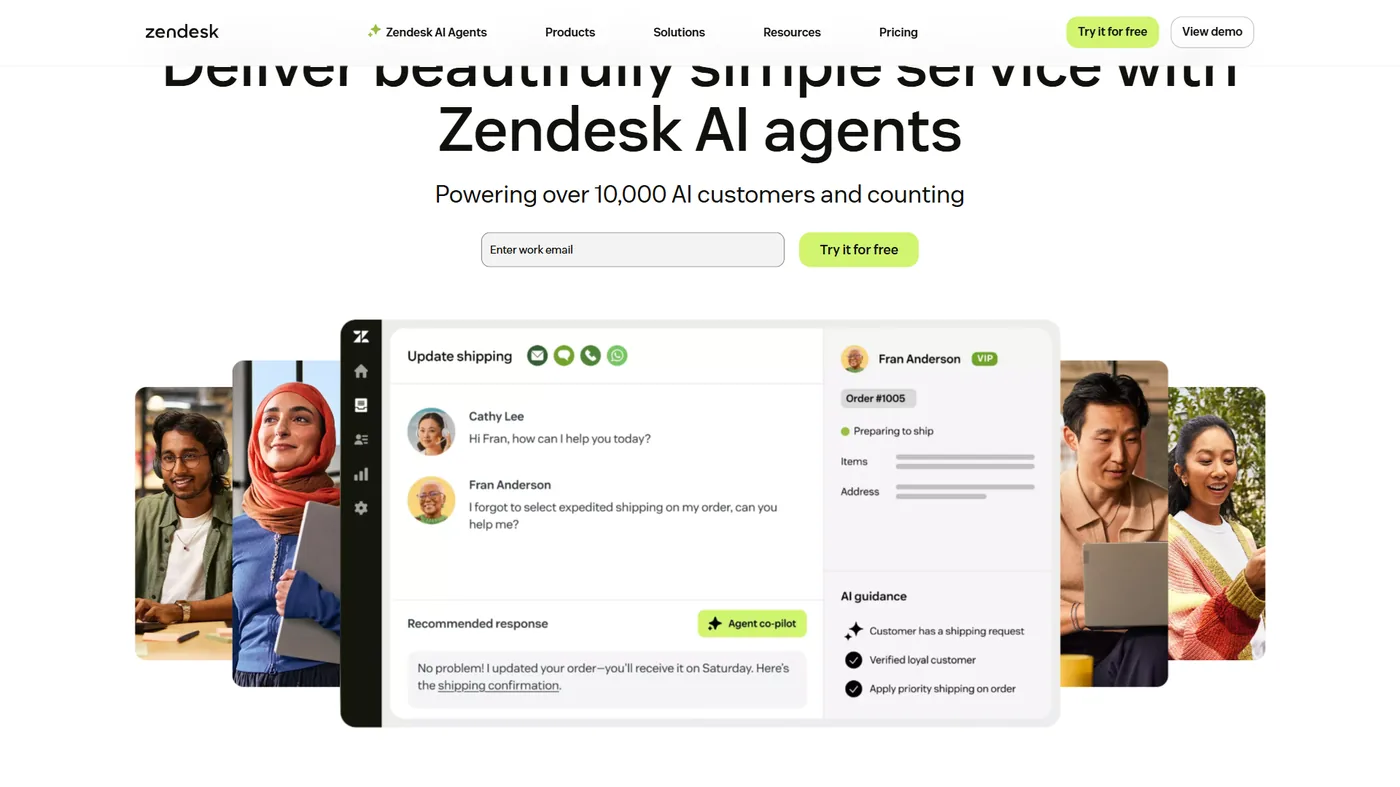
Zendesk’s biggest advantage over Ada in this space is its breadth. Where Ada focuses on AI chatbot automation, Zendesk provides a complete support stack: ticketing, voice, email automation, live chat, analytics, and AI agents - all under one roof. The 2,000+ integration library means it connects to virtually any existing business tool.
Pricing is more visible than Ada’s, though still complex across six tiers. Suite Team starts at $69 per month per agent (or $55 billed annually) and includes omnichannel support with Essential AI agents. The full agentic AI capabilities with GPT-5 reasoning require the Enterprise Plus tier, which is custom priced.
Where Zendesk wins over Ada: Unmatched integration ecosystem, mature ticketing infrastructure, compliance certifications (HIPAA, SOC 2) available without bespoke enterprise contracts, and voice AI on lower tiers than Ada typically offers.
Where Ada has the edge: Ada’s chatbot builder is considered faster to deploy for teams that only need self-service automation and do not need the full support stack Zendesk provides.
Best for: Enterprise and mid-market teams managing high ticket volumes across multiple channels, especially those already invested in tools like Salesforce, Shopify, or Jira.
Limitations and who it’s not for: Zendesk’s biggest drawbacks are configuration complexity (Suite Professional and Enterprise often need 2-4 weeks to set up properly) and the steep jump between tiers - the GPT-5 Agentic AI features sit behind a custom-quote Enterprise Plus contract. Skip Zendesk if you need to be live in a day, your team is under 5 agents, or you want a polished chat-first UX over a ticket-centric workspace.
Tidio targets a completely different market than Ada. Where Ada is built for enterprise procurement, Tidio is built for small and midsize businesses that need to get AI-powered customer service running quickly and affordably. Its Lyro AI agent - powered by Claude - achieves a reported 67% automation rate for common inquiries.
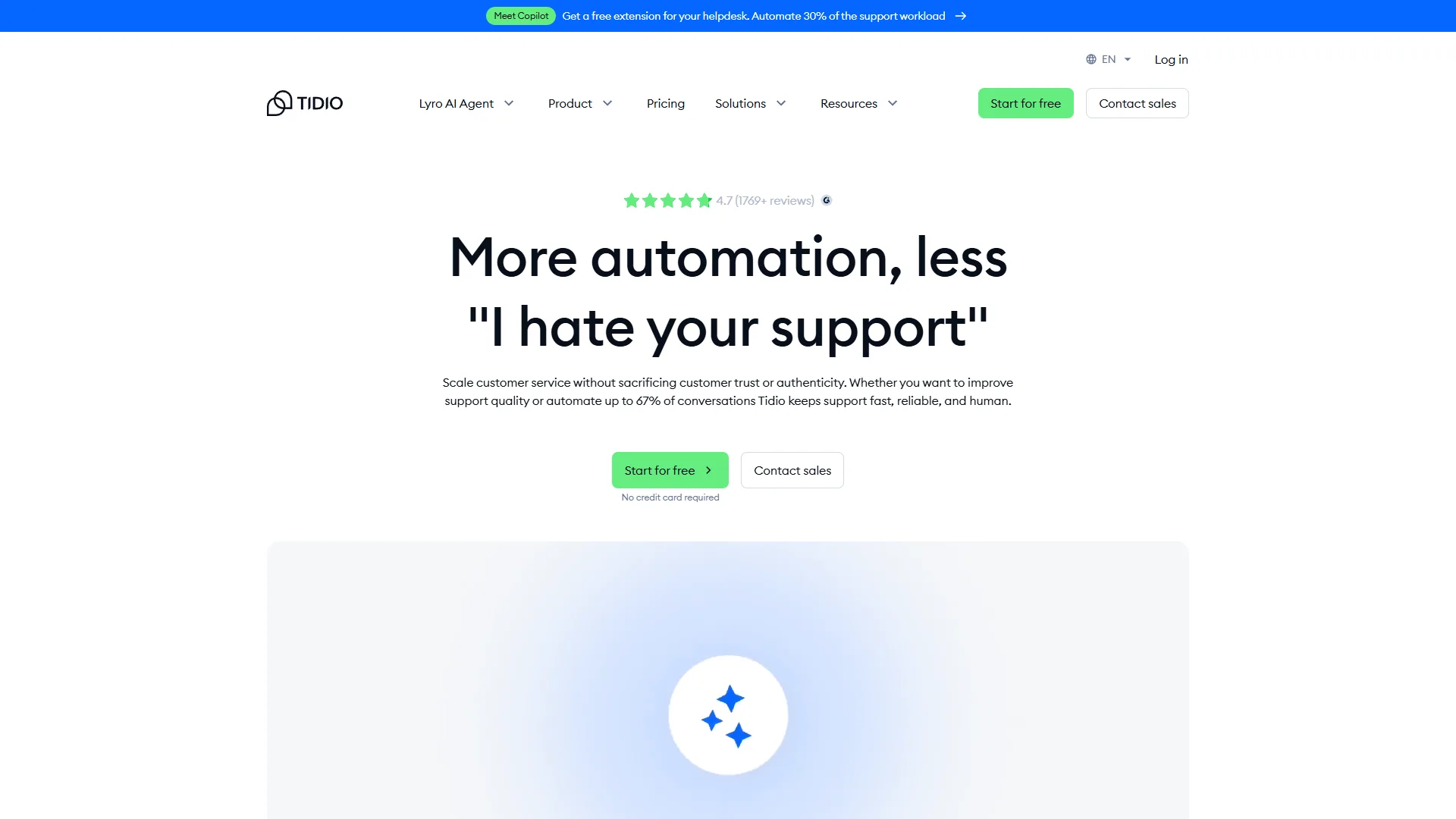
The free tier is the most immediate differentiator from Ada. Tidio’s free plan supports 50 conversations per month across 3 operators - enough for a small business to validate whether the platform fits before spending anything. The Starter plan at $29 per month and the Lyro AI add-on at $39 per month mean a fully capable AI support setup costs around $68 monthly, making it accessible to businesses Ada would never serve.
Tidio also excels at ecommerce. Its Shopify integration is native and deep, surfacing customer order history and cart data directly in the chat interface. WordPress and WooCommerce setups take less than five minutes to configure.
The tradeoffs are real: Tidio caps operators at 10 on all plans below Premium ($2,999/month), the ticketing system is basic compared to Zendesk, and the conversation limits on lower tiers can feel restrictive as volume grows.
Where Tidio wins over Ada: Accessible free tier, transparent self-serve pricing, fast time to value, strong ecommerce integrations. Far less friction for teams not ready for an enterprise procurement process.
Where Ada has the edge: Ada handles enterprise deployment at scale, supports more complex conversation flows, and suits teams that need dedicated implementation support.
Best for: Ecommerce stores and SMBs under 50 employees that need AI automation without enterprise contracts or implementation overhead.
Limitations and who it’s not for: Tidio’s drawbacks include a hard 10-operator cap below the $2,999/month Premium tier, a basic ticketing system that does not scale to mid-market complexity, and conversation limits that bite as volume grows. Skip Tidio if you run a 20+ agent support org, need granular role-based permissions, or expect to scale past 5,000 monthly conversations on a budget plan.
LiveChat is one of the oldest and most refined chat platforms on the market, trusted by over 35,000 businesses across customer support and sales. It is not an AI-first platform in the same way Ada or Intercom are, but its AI chatbot capabilities handle up to 80% of routine inquiries, and its 200+ integration library makes it exceptionally easy to fit into an existing stack.
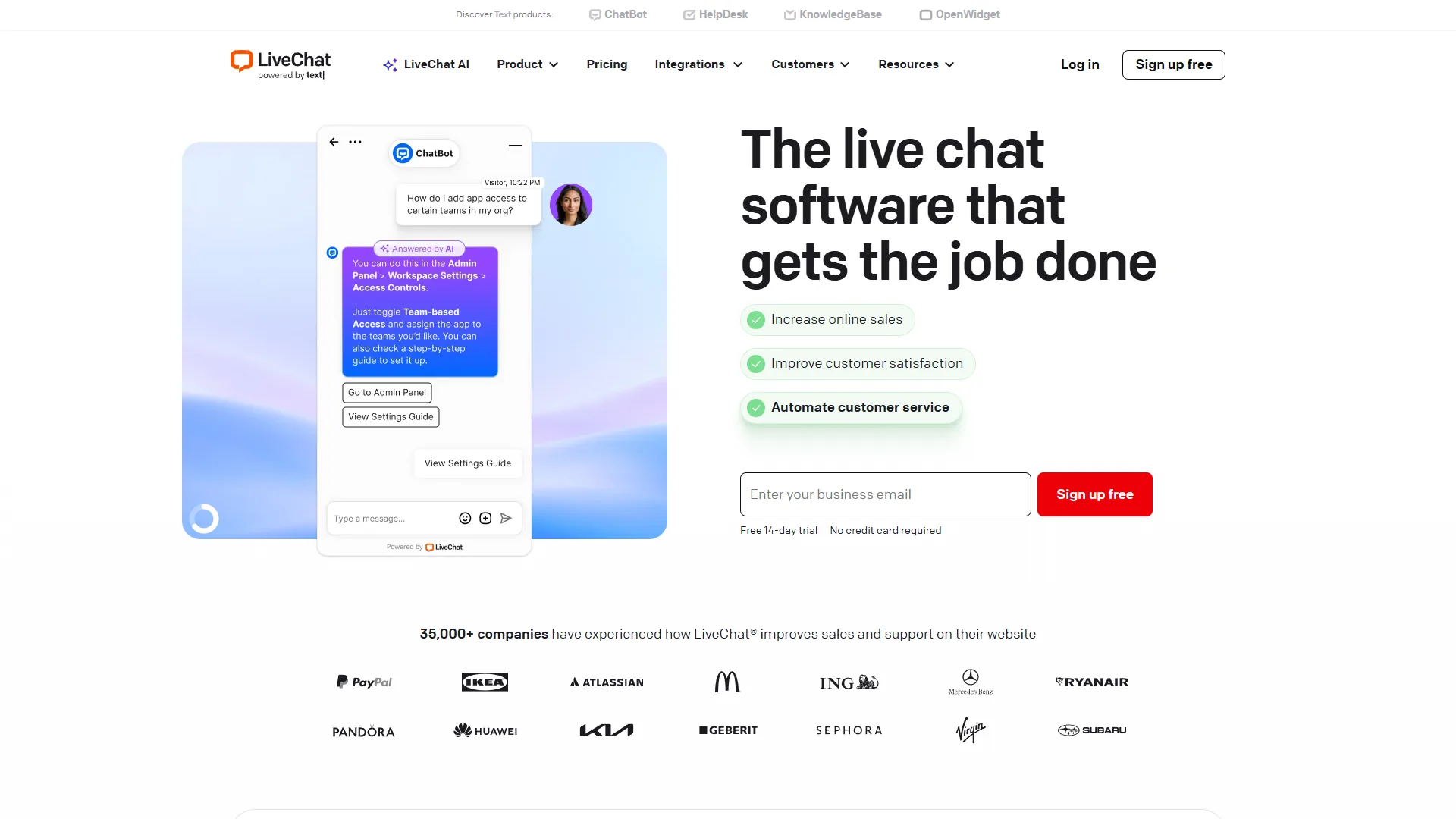
LiveChat’s core strength is the quality of the live chat experience itself. The widget is among the most polished in the market, with real-time typing preview, canned responses, file sharing, and proactive chat triggers. It handles the agent-facing side of customer support better than most dedicated AI chatbot platforms.
Pricing starts at $24 per agent per month (billed annually) on the Starter plan. Unlike Ada, all pricing tiers are publicly listed and there is a 14-day free trial. The Business plan at $69 per agent per month adds geolocation routing, staffing predictions, and Apple Messages support. Enterprise tier includes HIPAA compliance and white labeling at custom pricing.
The caveat with LiveChat versus Ada is that LiveChat is fundamentally a human-first platform with AI assistance, whereas Ada is AI-first. If your priority is maximizing automation rates and minimizing agent involvement, Ada or Intercom will outperform LiveChat. If your priority is a high-quality agent experience supplemented by automation, LiveChat delivers.
Where LiveChat wins over Ada: Polished chat widget, transparent pricing, 200+ integrations, and a proven track record since 2002. No sales conversation required to start.
Where Ada has the edge: Ada is designed for significantly higher automation rates and is better suited to teams wanting AI to handle end-to-end resolution rather than assist human agents.
Best for: Support and sales teams prioritizing real-time chat quality, e-commerce businesses, and organizations that need 200+ integrations without complex setup.
Limitations and who it’s not for: LiveChat is fundamentally a human-first platform with AI assistance bolted on - if you want to maximize automation rates and minimize agent involvement, its limitations show. The chatbot capabilities trail Ada and Intercom, voice support is weaker, and there is no per-resolution AI pricing model. Skip LiveChat if your priority is high AI deflection rates, omnichannel voice, or autonomous ticket resolution at scale.
Which Tool Fits Your Use Case
When evaluating the best Ada competitors, the right choice depends on where your business sits on two axes: company size and automation priority.
Choose Intercom if you run a SaaS business or growing support team that wants Fin AI’s transparent per-resolution pricing, voice and image AI capabilities, and a unified inbox across all channels. It is the closest functional equivalent to Ada at a more accessible price point.
Choose Zendesk if you run an enterprise or mid-market business with high ticket volume, complex workflows, and a large integration ecosystem. Its 2,000+ integrations and omnichannel coverage are unmatched, and the agentic AI on higher tiers rivals Ada’s automation claims.
Choose Tidio if you run a small or midsize business, especially in ecommerce, and need AI automation without enterprise pricing or procurement overhead. The free tier and self-serve setup make it the lowest barrier to entry in this comparison. For a deeper look at chat-first options, see our best live chat software guide.
Choose LiveChat if live chat quality and agent experience are your first priority, and AI automation is a supplement rather than the core strategy. Its integration library and proven reliability make it a low-risk choice for teams moving away from basic chat tools.
If Ada’s enterprise approach is what attracted you - custom AI flows, multilingual automation, and high-volume resolution - Intercom and Zendesk are the two closest alternatives. If you are primarily looking for a more accessible option with clearer pricing, Tidio and LiveChat offer significantly lower barriers to getting started.
The Bottom Line
Ada is a capable enterprise platform, but its custom pricing and sales-led procurement process make it inaccessible for most businesses. The four Ada competitors covered here - Intercom, Zendesk, Tidio, and LiveChat - provide genuine alternatives across different price points and use cases.
- Intercom - AI-first customer service with Fin’s transparent $0.99/resolution pricing and a true unified inbox across all channels.
- Zendesk - The enterprise omnichannel platform with 2,000+ integrations, mature ticketing, and agentic AI for high-volume teams.
- Tidio - The best-value AI support platform for ecommerce and SMBs, with a free tier and Lyro AI achieving 67% automation.
- LiveChat - A polished, proven chat platform with 200+ integrations and AI automation for support and sales teams.
All four offer free trials or free tiers, which Ada does not. That alone makes starting your evaluation easier.
FAQ
Q: Who does ADA compete with?
Ada competes with Intercom, Zendesk, Tidio, and LiveChat. Each takes a distinct approach to AI-powered customer service, and each is better suited to a different type of business. This 2026 guide to Ada competitors covers these four most capable alternatives across the AI-powered customer service market.
Q: What companies are leading in agentic AI?
Ada is an AI-first customer service platform designed for enterprise teams that want to automate customer interactions. Its core product is a no-code chatbot builder that pulls from your knowledge base to handle common questions - returns, account issues, product FAQs - without agent involvement. Intercom and Zendesk also lead in agentic AI customer service.
Q: What is ADA similar to?
Ada is similar to Intercom, Zendesk, Tidio, and LiveChat. Ada Competitors are platforms operating in the same market as Ada, each targeting slightly different workflows or team sizes. Understanding where each competitor has an edge helps you evaluate whether Ada is still the right fit or if a switch makes sense.
Q: Why do businesses look for Ada alternatives?
Ada’s enterprise-first positioning, combined with pricing that is only available on request, means a lot of businesses find themselves looking for alternatives that are more transparent, more affordable, or better suited to their specific workflow. The platform is built for enterprise procurement cycles, meaning pricing requires a sales conversation and contracts tend to be annual.
Related Reading
- LiveChat Alternatives: Best Customer Support Tools
- Help Scout Alternatives: Best Customer Support Tools
- Intercom - AI-first customer service with Fin’s per-resolution pricing
- Zendesk - Enterprise omnichannel support with 2,000+ integrations
- Tidio - Affordable AI chat for SMBs and ecommerce
- LiveChat - Polished real-time chat with 200+ integrations
- Ada - Enterprise AI chatbot platform
- Best Customer Support Software 2026: Full Comparison
- Best Live Chat Software 2026: Complete Comparison Guide