



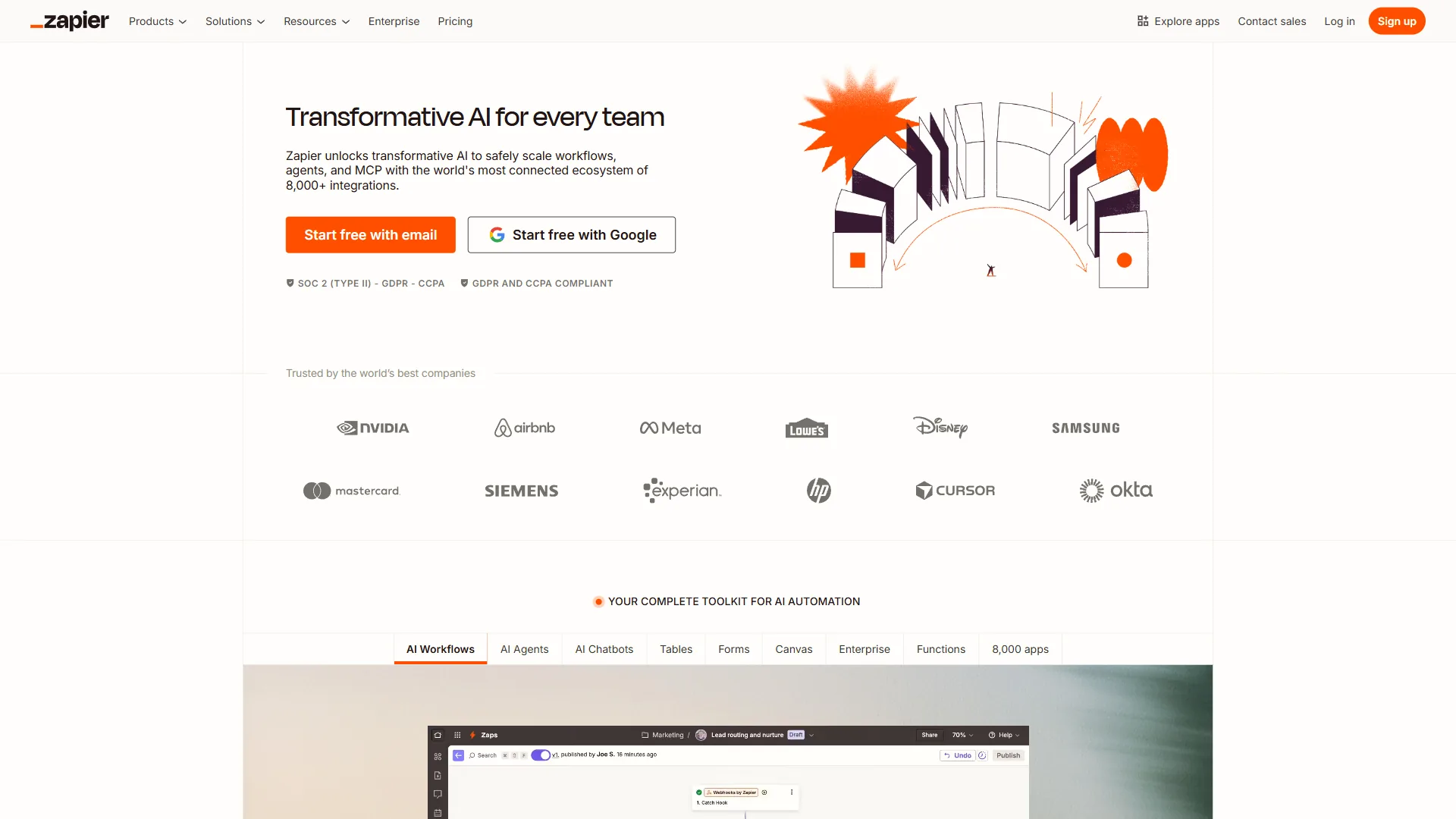
The best Zapier alternatives in 2026 are Make at $10.59 per month for 300,000 operations, n8n free when self-hosted with unlimited executions, and Activepieces at $25 per month for unlimited tasks - each beating Zapier’s $29.99 plan for 750 tasks on a specific dimension.
Zapier still earns its place as the most widely used automation platform - 7,000-plus integrations and a trigger-action interface anyone can learn in minutes. But defaults are not always optimal. Costs scale quickly, the free tier caps at 100 tasks, and there is no self-hosting option.
This guide ranks five zapier alternatives I’ve tested in 2026 on pricing, task limits, and AI features. Our analysis draws on each vendor’s current pricing documentation and independent research rather than sponsored placement. AI Productivity may earn a commission from links on this page; our rankings are editorially independent.
Why People Leave Zapier
Teams leave Zapier for three concrete reasons: per-task pricing that scales poorly above 1,000 monthly runs, a free tier capped at 100 tasks and two-step Zaps, and a linear editor that struggles with branching, parallel paths, or error handling. These friction points surface in nearly every Independent Spy’s Review of the category.
Pricing That Scales Poorly
Zapier’s Professional plan costs $29.99 per month for 750 tasks - roughly $0.04 per task. Make offers 300,000 operations on its Core plan at $10.59 per month - $0.000035 per operation. A team running 10,000 automations per month pays $73 on Zapier’s scaled Professional plan versus $10.59 on Make Core - a 6-7x gap.
Task Limits and the Free Tier Gap
Zapier’s free tier caps at 100 tasks per month with two-step Zaps - enough to test, not run production. Make’s free tier includes 1,000 operations per month with multi-step scenarios. Activepieces offers 1,000 tasks free, then unlimited tasks on every paid plan starting at $25 per month.
Linear Workflows Hit a Ceiling
Zapier’s trigger-action chain handles simple automations well but struggles with conditional branching, parallel paths, or error handling. Make and n8n render the workflow as a flowchart, making debugging easier.
Quick Picks: Zapier Alternatives at a Glance
Here is how the five leading zapier alternatives compare on the metrics that drive most purchasing decisions:
| Feature | Zapier | Make | n8n | Activepieces | Power Automate | IFTTT |
|---|---|---|---|---|---|---|
| Free Tier | 100 tasks/mo | 1,000 ops/mo | Unlimited (self-hosted) | 1,000 tasks/mo | Included with M365 | 2 applets |
| Starting Price | $29.99/mo | $10.59/mo | Free / EUR 24/mo cloud | $25/mo | $15/user/mo | $3.49/mo |
| Paid Task Limit | 750+ tasks/mo | Up to 300K ops/mo | 2,500 exec/mo (cloud) | Unlimited | Varies by license | Unlimited |
| Integrations | 7,000+ | 2,000+ | 400+ | 400+ | 900+ | 800+ |
| Workflow Style | Linear chain | Visual flowchart | Visual + code | Drag-and-drop | Visual + templates | Simple triggers |
| Self-Hosting | No | No | Yes | Yes | No | No |
| AI Features | Zapier Agents, multi-model AI | Make AI Agents, Maia AI | AI agent workflows | Native AI agents, MCP | Copilot, AI Builder | Limited |
| Open Source | No | No | Fair-code | Yes (MIT) | No | No |
| Best For | Simplicity, breadth | Complex logic, cost | Developers, privacy | Unlimited tasks, budget | Microsoft shops | Personal automations |
Methodology: Is There Anything Better Than Zapier?
Yes - several platforms beat Zapier decisively on specific dimensions, though no single tool wins on every axis. We analyzed each vendor’s current pricing pages and public docs to draw the conclusions below.
- Cost at scale - Make wins. The gap widens with volume.
- Developer control - n8n wins. Self-hosting plus JavaScript and Python code nodes.
- Unlimited task budgets - Activepieces wins. Every paid plan includes unlimited executions.
- Microsoft ecosystems - Power Automate wins. Native SharePoint, Teams, Outlook, and Dynamics 365 integration.
- Simplicity and integration breadth - Zapier still wins. 7,000-plus integrations remain unmatched.
1. Make - Best Zapier Alternative for Cost and Visual Workflows
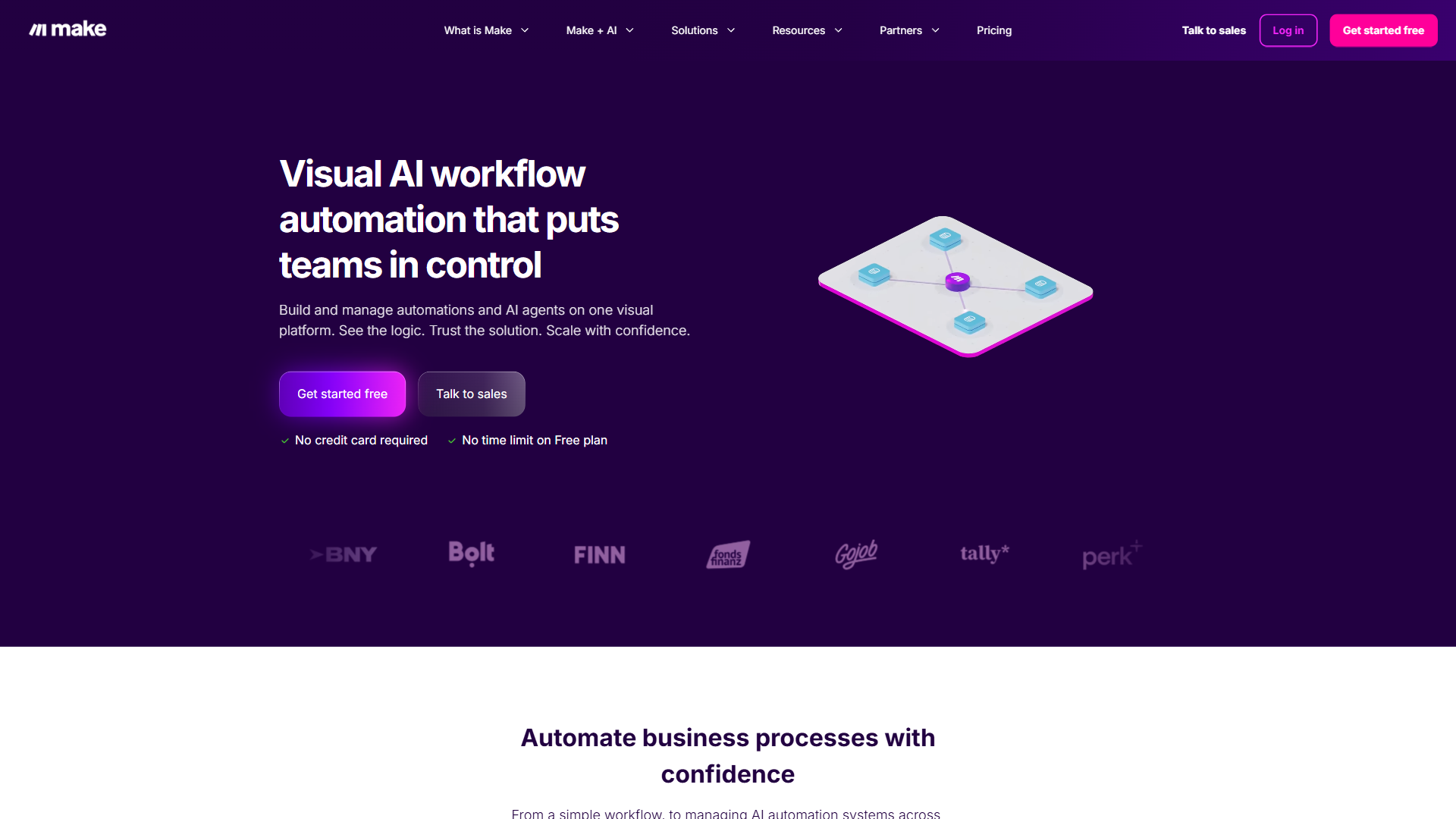
Make is the strongest all-around Zapier alternative - a visual flowchart editor, 60-70% cost savings at scale, and AI scenario generation via Maia. It is the first platform most teams should evaluate.
Pricing Breakdown
| Plan | Monthly | Annual | Operations/Month |
|---|---|---|---|
| Free | $0 | $0 | 1,000 |
| Core | $10.59 | $9/mo | Up to 300,000 |
| Pro | $18.82 | $16/mo | Up to 8,000,000 |
| Teams | $34.12 | $29/mo | Pooled |
| Enterprise | Custom | Custom | Custom |
Make Core at $10.59 per month delivers 300,000 operations; Zapier Professional at $29.99 delivers 750 tasks - a 60-70% cost advantage. Make’s flowchart editor, demonstrated in their scenarios documentation, shows the full automation as a connected diagram with routers, aggregators, and error handlers. Make AI Agents and the Maia natural-language assistant generate scenario structures from prompts. The free tier covers 1,000 operations per month with unlimited users.
Limitations: Make’s 2,000-plus apps trail Zapier’s 7,000-plus; expect 4-8 hours to get comfortable with modules and routing.
Best for: Teams running high-volume automations. Anyone spending $50+ per month on Zapier should test Make first.
2. n8n - Best Zapier Alternative for Self-Hosting and Developers
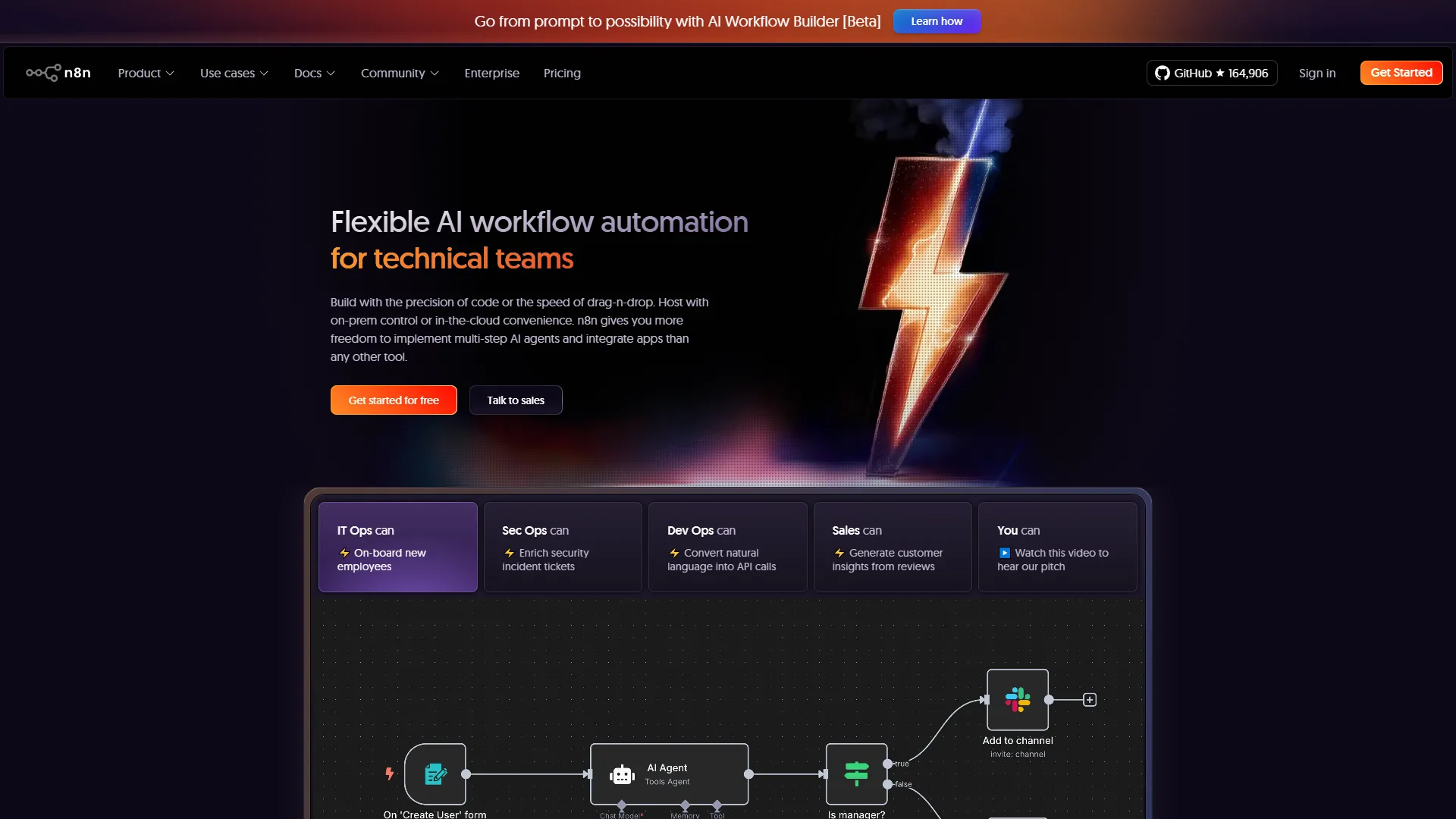
n8n is the Open Source Zapier Alternative for developers - a fair-code platform you can self-host for free with unlimited executions, workflows, and users. The only cost is your own server, typically $5-20 per month on a VPS.
Pricing Breakdown
| Plan | Price | Executions/Month |
|---|---|---|
| Community (Self-Hosted) | Free | Unlimited |
| Starter (Cloud) | EUR 24/mo | 2,500 |
| Pro (Cloud) | EUR 60/mo | 10,000 |
| Enterprise | Custom | Custom |
The Community edition is genuinely free - full feature access, 400-plus integrations, JavaScript and Python code nodes, AI agent workflows. Self-hosting requires Docker. Deploy n8n behind your own firewall for full data sovereignty - critical for organizations bound by HIPAA or GDPR; Zapier and Make are cloud-only. n8n supports multi-step AI chains via LangChain integration, connecting to OpenAI, Anthropic Claude, and local LLMs. Over 181,000 GitHub stars. The zapier-vs-make comparison covers similar visual-builder differences.
Limitations: 400-plus native nodes trail Zapier’s 7,000-plus. Cloud n8n (EUR 24 per month for 2,500 executions) is pricier per execution than Make.
Best for: Technical teams. Organizations with data sovereignty requirements. Developers wanting unlimited executions at minimal cost.
3. Activepieces - Best Zapier Alternative for Unlimited Tasks on a Budget
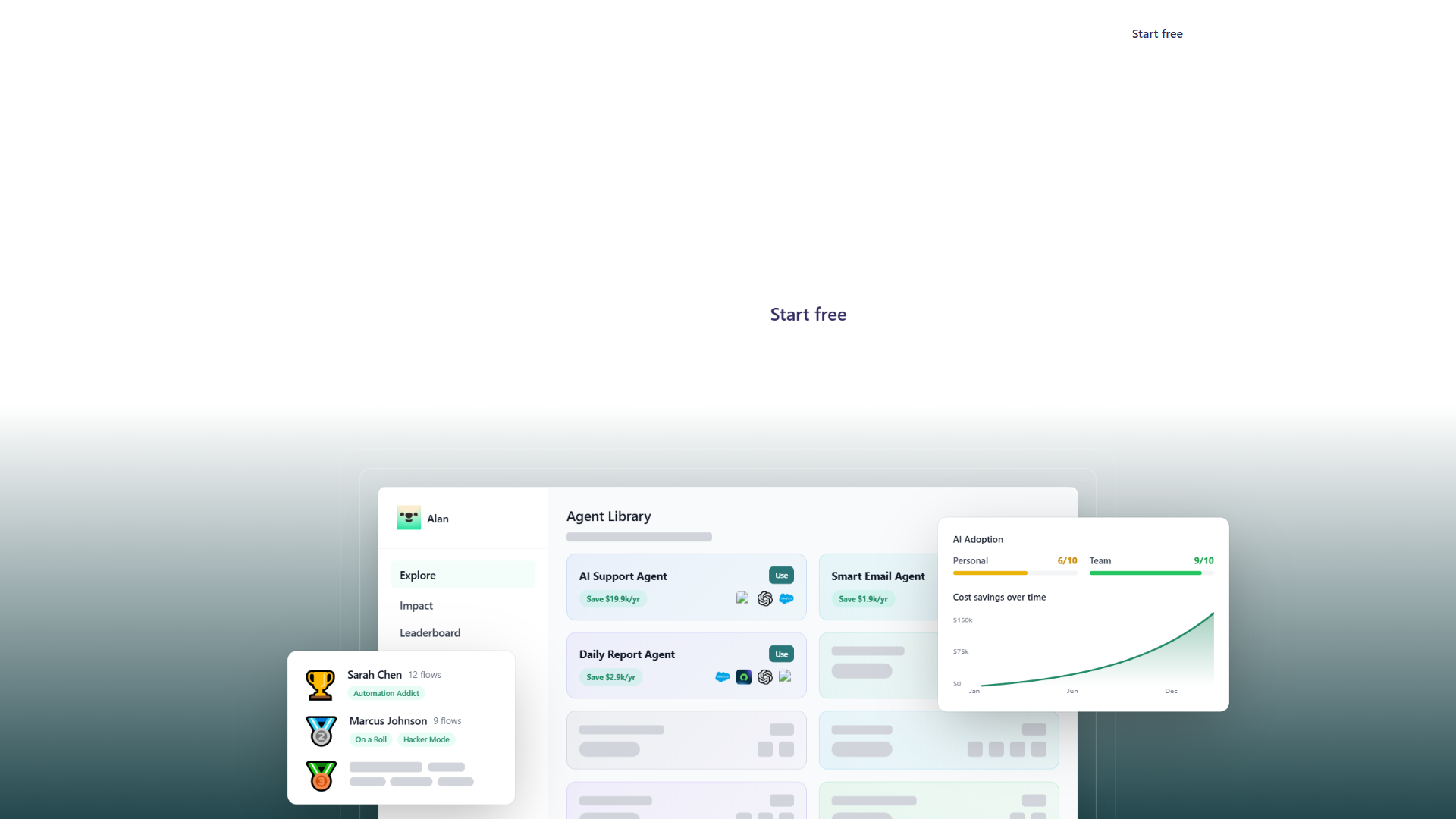
Activepieces directly challenges Zapier’s per-task pricing with unlimited task executions on every paid plan, starting at $25 per month. Founded 2022 and described as one tool to Automate Your Workflows in 2026, it has the most disruptive pricing model in the category. According to Activepieces, vendor of the open-source automation platform, the Plus plan delivers “unlimited tasks, unlimited team members, and unlimited operations” on a flat monthly fee, per the Activepieces pricing page.
Pricing Breakdown
| Plan | Monthly | Tasks/Month |
|---|---|---|
| Free | $0 | 1,000 |
| Plus | $25 | Unlimited |
| Business | $150 | Unlimited |
| Embed Light | $1/user | Unlimited |
A team running 50,000 tasks per month pays $25 on Activepieces Plus; the same volume on Zapier costs hundreds. Every paid plan includes unlimited executions, eliminating cost scaling. MIT-licensed with 21,000-plus GitHub stars - self-host with Docker for full data control. Built-in AI agents and Model Context Protocol (MCP) server support let AI models interact directly with flows; custom code blocks support JavaScript with npm packages.
Limitations: 400-plus integrations versus Zapier’s 7,000-plus. Enterprise governance and compliance certifications are still maturing.
Best for: Cost-conscious teams needing automation without per-task pricing. Privacy-focused organizations wanting self-hosted open source.
4. Microsoft Power Automate - Best Zapier Alternative for Microsoft 365 Teams
Power Automate is the best Zapier alternative for organizations already running Microsoft 365, offering integration depth into SharePoint, Teams, Outlook, and Dynamics 365 that no third-party platform can match.
Pricing Breakdown
| Plan | Monthly | Per-Seat | Key Limits |
|---|---|---|---|
| Free (with M365) | $0 | No | Standard connectors only |
| Premium | $15 | Yes | Premium + custom connectors, AI Builder |
| Process | $150 | No | Unlimited flows, hosted RPA bots |
| Enterprise | Custom | Custom | Advanced governance |
Organizations on Microsoft 365 Business Basic ($6 per user/month) or higher already have Power Automate’s standard connectors at no additional cost. Triggers and actions for SharePoint, Teams, Outlook, Excel, and Dynamics 365 work with native authentication. Power Automate Desktop ships free with Windows 10 and 11 for attended RPA on legacy applications - a category cloud-only platforms cannot address. AI Copilot generates flows from plain English; AI Builder adds custom ML models. DLP policies, environment management, and compliance controls come standard.
Limitations: Outside Microsoft, the 900-plus connectors trail Zapier’s 7,000-plus. Error messages are unhelpful; licensing (per-user vs per-flow, premium vs standard, AI Builder credits) creates confusion at scale.
Best for: Microsoft 365 organizations. Teams needing desktop RPA. Enterprises requiring built-in governance.
5. IFTTT - Best for Simple Personal Automations
IFTTT is the best Zapier alternative for individuals running simple consumer automations - single-trigger, single-action recipes connecting smart home devices and consumer apps at $3.49 to $14.99 per month. It is not competing for business automation.
Pricing Breakdown
| Plan | Monthly | Applets |
|---|---|---|
| Free | $0 | 2 |
| Pro | $3.49 | 20 |
| Pro+ | $14.99 | Unlimited |
Save Instagram photos to Dropbox, log Fitbit data to Google Sheets, turn on smart lights when arriving home - IFTTT’s sweet spot. Single-trigger recipes for consumer apps and smart home devices (Philips Hue, Ring, Nest, SmartThings).
Limitations: Not a serious business automation tool. No multi-step workflows, conditional logic, data transformation, or team features.
FAQ: What Is the Google Equivalent of Zapier?
Google does not offer a direct Zapier competitor. The closest equivalent is Google Apps Script plus Google Workspace Add-ons, both of which require coding and only cover Google’s own services. For automating across Google Workspace and external apps, use one of the platforms in this guide - Make and Zapier both have strong Google Workspace integrations; n8n has Google service nodes for technical teams.
FAQ: Why Is Zapier So Expensive?
Zapier is expensive because of three compounding factors: a market-leader pricing premium, a per-task billing model that scales linearly with usage, and the engineering overhead of maintaining 7,000-plus app connectors as APIs change.
A team running 10,000 automations per month pays $150-200+ on Zapier, $10.59 on Make, $25 on Activepieces, or $0 on self-hosted n8n (plus $5-20 infrastructure). Activepieces (unlimited tasks on paid plans) and n8n (unlimited executions self-hosted) use fundamentally different pricing models that decouple cost from volume.
Pricing Comparison at 10,000 Tasks
| Platform | Plan Needed | Monthly Cost | Cost Per 1,000 Tasks |
|---|---|---|---|
| Zapier | Professional (scaled) | $150+ | $15+ |
| Make | Core | $10.59 | $0.04 |
| n8n (self-hosted) | Community | $0 (+$5-20 infra) | $0.50-2.00 |
| n8n (cloud) | Pro | EUR 60 ($65) | $6.50 |
| Activepieces | Plus | $25 | $2.50 |
| Power Automate | Premium | $15/user | Varies |
| IFTTT | Pro+ | $14.99 | $1.50 |
Best Picks by Use Case
The right Zapier alternative depends on team size, technical comfort, and budget - here are the matches we recommend by scenario.
For Small Businesses Watching Costs
Choose Activepieces ($25 per month, unlimited tasks) or Make ($10.59 per month, 300K ops). Activepieces wins on predictability; Make wins on visual design and integration breadth.
For Developers and Technical Teams
Choose n8n (free self-hosted). Unlimited executions, full code access, and native AI agent workflows make n8n the obvious pick for teams comfortable with Docker.
For Microsoft 365 Organizations
Choose Power Automate (free with M365 or $15 per user/month). Native Microsoft integration is unmatched, and desktop RPA handles legacy applications cloud-only tools cannot.
For Non-Technical Teams Who Want Easy Setup
Stay with Zapier or try Make with Maia AI. Zapier’s linear interface is easiest to learn; Maia closes the gap with natural-language scenario generation.
For Data-Sensitive Organizations
Choose n8n or Activepieces (both self-hostable). Healthcare, finance, and EU-based organizations with strict data sovereignty need automation engines they control.
For Simple Personal Automations
Choose IFTTT ($3.49 to $14.99 per month). Smart home integration and simple trigger-action automations do not need a business platform.
Pro Tips: How to Migrate from Zapier
- Audit active Zaps - export the list and categorize by complexity and task volume.
- Start with the expensive workflows - high-volume Zaps deliver the fastest ROI when migrated.
- Run parallel for two weeks - build the migrated workflows alongside Zapier originals to catch edge cases.
- Leave low-volume Zaps alone - if a Zap runs 10 times per month, migration may exceed savings.
- Check integration compatibility first - verify every app in critical workflows has a native connector.
The Bottom Line
Zapier’s position as the default choice is no longer automatic in 2026. Each alternative solves a specific problem:
- Make - 60-70% cost savings at scale with visual workflow design
- n8n - self-hosting, unlimited executions, code-level flexibility at near-zero cost
- Activepieces - unlimited executions on all paid plans starting at $25 per month
- Power Automate - deepest Microsoft 365 integration, often free for existing subscribers
- IFTTT - simple personal automations at $3.49 to $14.99 per month
If Zapier works, switching for its own sake wastes time. If costs climb or sovereignty matters, the right alternative here addresses the gap. Start free, build the most painful workflow, compare.
FAQ
Q: Why is Zapier so expensive?
Zapier is expensive due to its market position premium as the most recognized automation brand, its per-task billing model that scales linearly with usage, and the overhead of maintaining 7,000-plus app connectors as APIs change.
Q: What is the best free automation tool?
Make’s free tier offers 1,000 operations per month with multi-step scenarios. Activepieces provides 1,000 tasks per month free. n8n is free with unlimited executions when self-hosted. IFTTT offers 2 applets free for simple consumer automations.
Q: Is there anything better than Zapier?
Yes - Make beats Zapier on cost at scale, n8n on developer control, Activepieces on unlimited tasks, and Power Automate inside Microsoft 365.
Q: Is n8n cheaper than Zapier?
n8n is dramatically cheaper than Zapier when self-hosted - the Community edition is free with unlimited executions, costing only $5 to $20 per month for a VPS. Cloud n8n at EUR 24 per month for 2,500 executions is comparable on small volumes.
Q: What is the cheapest Zapier alternative for high-volume automation?
Make is the most cost-efficient at scale. Its Core plan costs $10.59 per month for up to 300,000 operations versus Zapier’s $29.99 for 750 tasks - a 6-7x price difference at 10,000 monthly automations.
Related Reading
These deep-dives extend the comparisons above with single-vendor pricing detail and competitive head-to-heads.
- Zapier Review - Full review of the most popular automation platform
- Make Review - Visual workflow automation at a lower price point
- n8n Review - Self-hosted, fair-code automation for developers
- Activepieces Review - Open-source automation with unlimited tasks
- Power Automate Review - Microsoft’s automation platform for M365 teams
- Zapier vs Make: Which Automation Tool Wins in 2026?
- Best AI Automation Tools 2026
- Best Workflow Automation Tools 2026
External Resources
The vendor pricing pages and primary docs below are the authoritative sources used in this comparison.
- Zapier Pricing Page - Current plans and task limits
- Make Pricing Page - Compare operation limits across tiers
- n8n Pricing - Cloud vs self-hosted options
- Activepieces Pricing - Unlimited task plans
- Power Automate Documentation - Microsoft’s official automation docs