
The Freshservice vs ServiceNow choice in 2026 is no longer a simple ITSM platform pick - it is a multi-year bet on which AI agent stack you trust to run your service desk.
Introduction
The ITSM market in 2026 has split into two recognisable camps. On one side sits Freshservice from Freshworks - cloud-native, mid-market focused, transparent pricing. On the other sits ServiceNow - the enterprise platform running back-office IT for most Fortune 500 organisations, priced per named user with quote-only commercials. The freshservice servicenow buyer question is no longer “which tool is best” - it is “which AI agent ecosystem do I want governing my incident, change, and request workflows for the next five years?”
Disclosure first: Freshservice is the affiliate-supported option here through PartnerStack; ServiceNow does not run a partner program of comparable structure. So this article highlights specifically where ServiceNow genuinely beats Freshservice, so an IT director gets a fair picture rather than a marketing nudge.
The freshservice vs servicenow decision in 2026 comes down to organisational scale, customisation appetite, and budget tolerance. Freshservice wins for IT teams of 100 to 5,000 employees needing fast deployment, transparent pricing, and Freddy AI Copilot for ticket assist. ServiceNow wins for global enterprises needing deep CMDB, custom workflow logic, and the Yokohama-release AI Control Tower for multi-agent orchestration.
Quick Verdict: Freshservice vs ServiceNow
| Factor | Freshservice | ServiceNow |
|---|---|---|
| Best for | Mid-market IT (100-5,000 staff) | Global enterprise (5,000+ staff) |
| Pricing model | Per agent, transparent | Per named user, quote-only |
| Starting price | $19/agent/mo (annual, Starter) | Around $100/user/mo (community estimate) |
| AI offering | Freddy AI Copilot + Freddy AI Agent | Now Assist + AI Agents + AI Control Tower |
| ITIL processes | 9 PinkVERIFY-certified | 15 PinkVERIFY-certified |
| Deployment time | 4-12 weeks typical | 6-18 months typical |
| Customisation | Low-code workflow automator | Full Now Platform development |
| CMDB depth | Built-in, capped on lower tiers | Industry-leading with Service Mapping |
| Implementation cost | $5K-$50K typical | $50K-$450K+ typical |
| Marketplace apps | 1,000+ (May 2026) | 400+ certified spokes |
The short answer: if you have under 5,000 employees, no full-time ServiceNow developer in-house, and need to launch this quarter, Freshservice is almost always the right call. If you have 10,000+ staff, complex multi-instance governance needs, and an existing ServiceNow practice in adjacent business units, the inertia argument for ServiceNow holds.
How Do Freshservice and ServiceNow Compare on Pricing?
Freshservice publishes its tier pricing publicly. Add-ons are clearly listed. ServiceNow does not. This is a real friction point for buyers running honest evaluations.
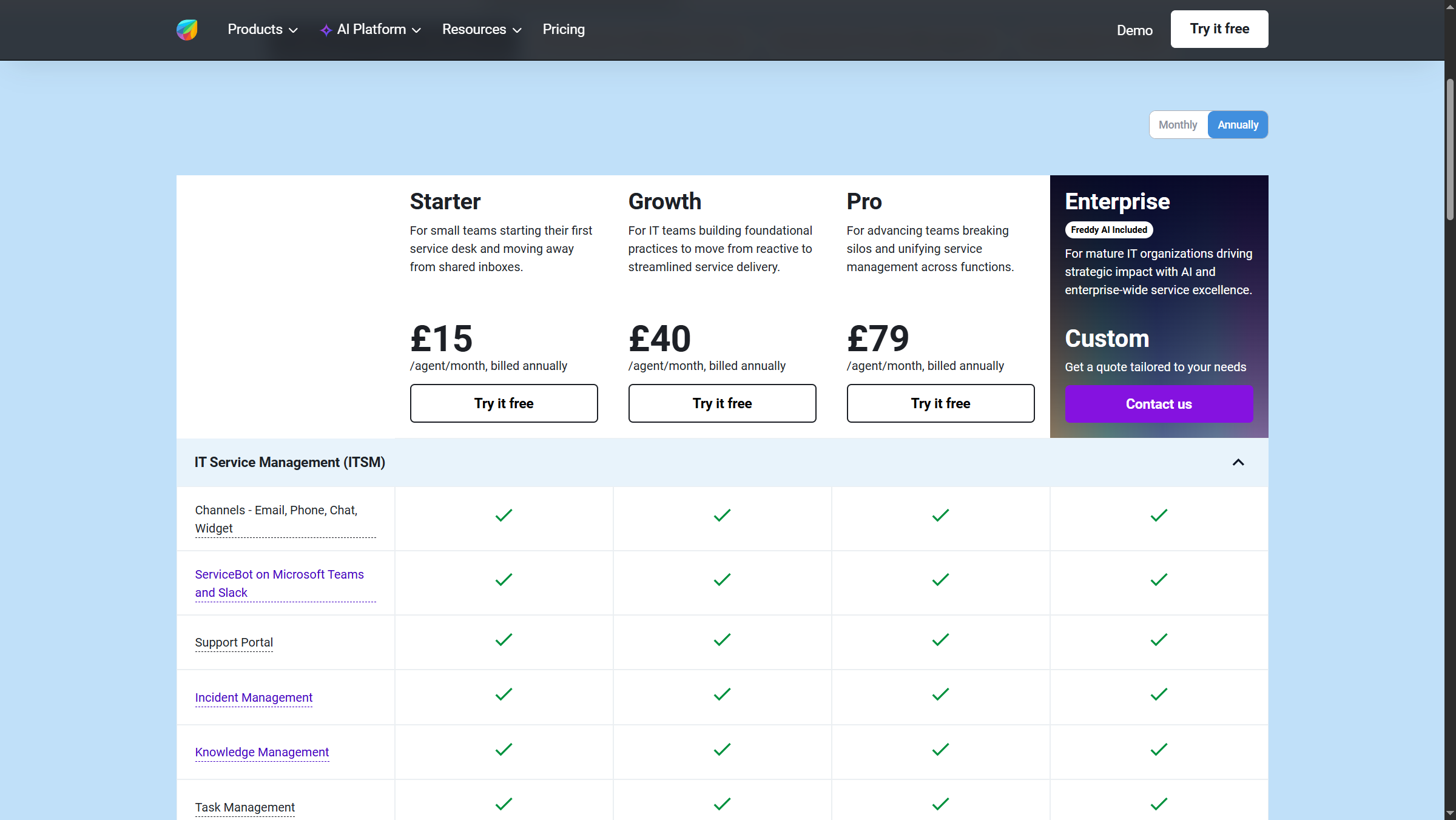
Freshservice pricing tiers:
Pricing verified April 2026 from Freshservice's pricing page:
- Starter: $19/user/mo annual ($29 monthly)
- Incident management
- Knowledge management
- Self-service portal
- Growth: $49/user/mo annual ($59 monthly)
- Everything in Starter
- Task management
- Occasional agents
- Pro: $99/user/mo annual ($119 monthly)
- Everything in Growth
- Problem management
- Change management
- Enterprise: Contact sales
- Everything in Pro
- Freddy AI Agent
- Freddy AI Copilot
Freddy AI Copilot is an additional $29/agent/month on Pro and Enterprise tiers. The fully autonomous Freddy AI Agent is Enterprise-only and session-metered, billed at 1,200 AI sessions per agent license per year before overage charges apply. Lower tiers can purchase Freddy chatbot sessions at $49 per 100 sessions.
ServiceNow pricing (community-reported estimates): ServiceNow does not publish pricing publicly; estimates from Reddit r/servicenow threads and third-party reseller quotes suggest the following ranges for ITSM SKUs in 2026:
| Tier | Estimated Price | Includes |
|---|---|---|
| ITSM Standard | Approximately $100 per user per month | Incident, problem, change, basic CMDB |
| ITSM Professional | Around $125-150/user/month | Performance Analytics, Predictive Intelligence, Virtual Agent |
| ITSM Enterprise | $150-200+/user/month | Process Optimization, Workforce Optimization, AI Search |
| Now Assist add-on | +$50-100/user/month | GenAI features, agent orchestration |
| Implementation | $50K-$450K+ one-time | Certified partner mandatory |
These figures come from community-reported quotes and partner conversations, not from ServiceNow’s price book. Actual quotes vary by procurement size, multi-product bundles, and geography. A typical 500-user organisation reports total cost of ownership in the $500K-$1M+ per year range once implementation amortisation, support, and Now Assist consumption are factored in.
The pricing transparency gap is real. Freshservice buyers get a same-day commercial. ServiceNow buyers typically need three to six weeks of partner discovery before a firm quote lands.
Who Freshservice is not for: organisations needing to amortise cost across 5,000+ light users, or teams wanting consumption-based AI usage priced per seat rather than per session.
Who ServiceNow is not for: any IT shop without procurement muscle to push back on annual list-price increases averaging 9-12% per renewal since 2023.
AI Agents Showdown: Freddy AI vs Now Assist
This is where the two platforms have genuinely diverged in 2026, and where the decision gets harder than the marketing pages suggest.
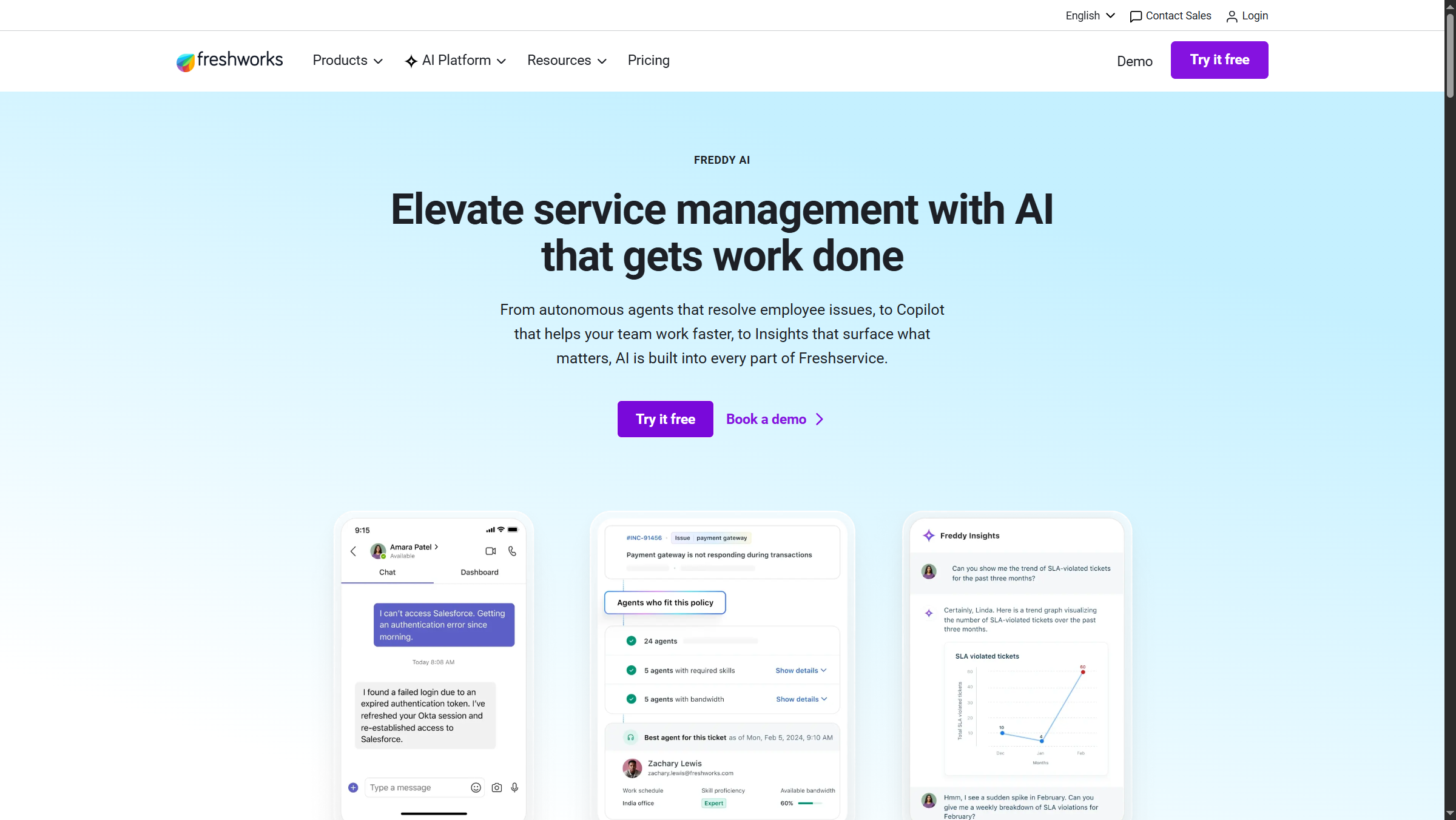
Freshservice Freddy AI. Freshworks published a Freddy AI roadmap update in early 2026 splitting its agentic capability into two tiers. Freddy AI Copilot is an assistive layer - it summarises tickets, drafts replies, performs sentiment analysis, and suggests knowledge articles. It runs at $29/agent/month on Pro and Enterprise. Freddy AI Agent is autonomous resolution - it triages, classifies, requests information, executes runbooks, and closes tickets without handoff. Freshworks claims a 66% deflection rate on enabled categories. Agent capability is Enterprise-only and metered by session.
Freddy ties tightly into the Freshservice service catalogue and CMDB - it does not need a separate orchestration layer to act on tickets.
Where Freddy AI falls short: agent reasoning is constrained to Freshservice-native workflows. Cross-platform multi-agent orchestration (e.g., Freddy handing off to a Salesforce or custom internal agent) is on the roadmap but not generally available as of May 2026.
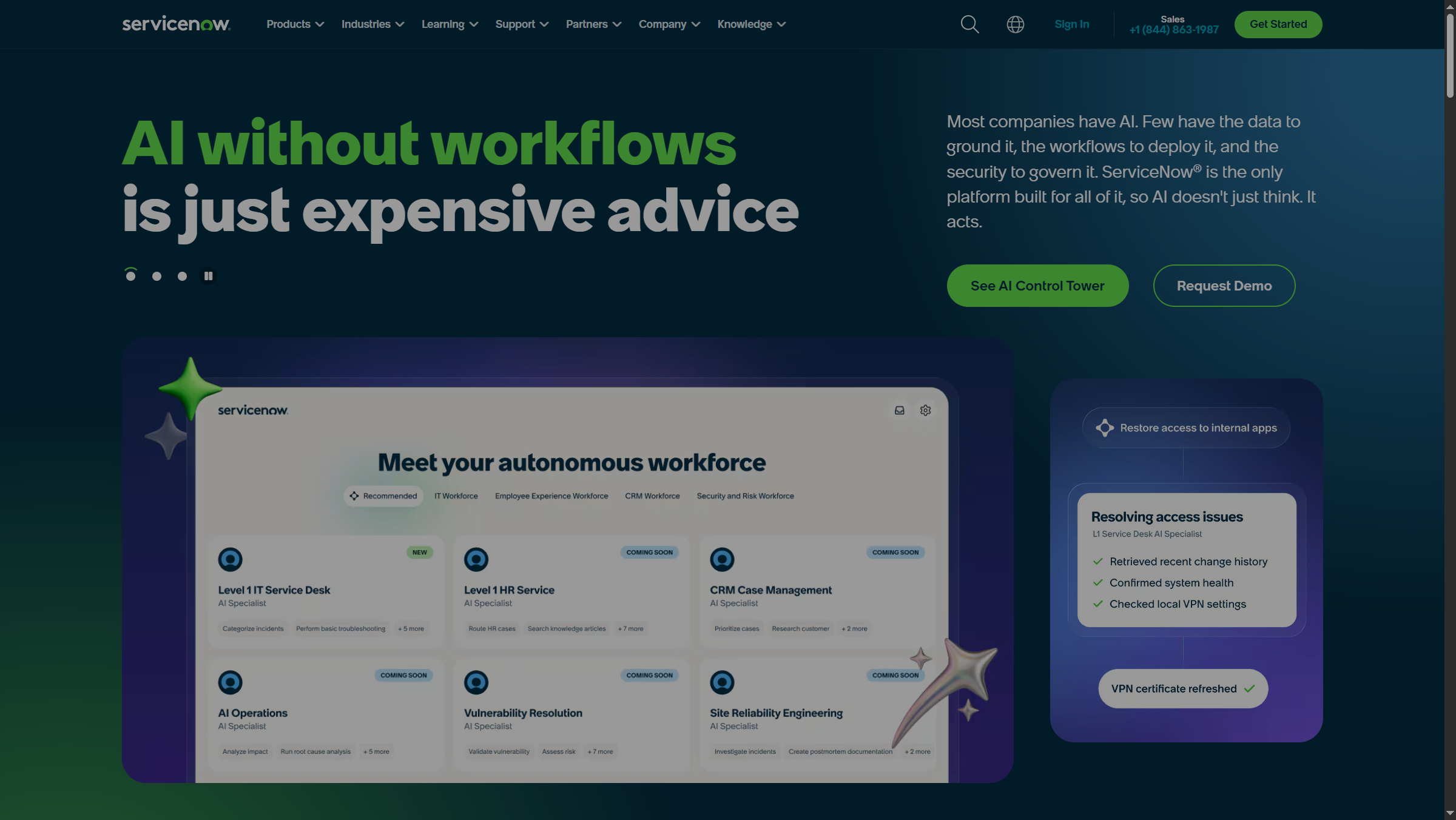
ServiceNow Now Assist and AI Agents. The Yokohama release in Q1 2026 was ServiceNow’s biggest AI-era refresh. It introduced RaptorDB Pro for higher-throughput data ops, unified Workflow Studio across the five Now Platform clouds, and the AI Control Tower - a governance dashboard monitoring every AI agent action across an enterprise tenant for audit, compliance, and risk scoring.
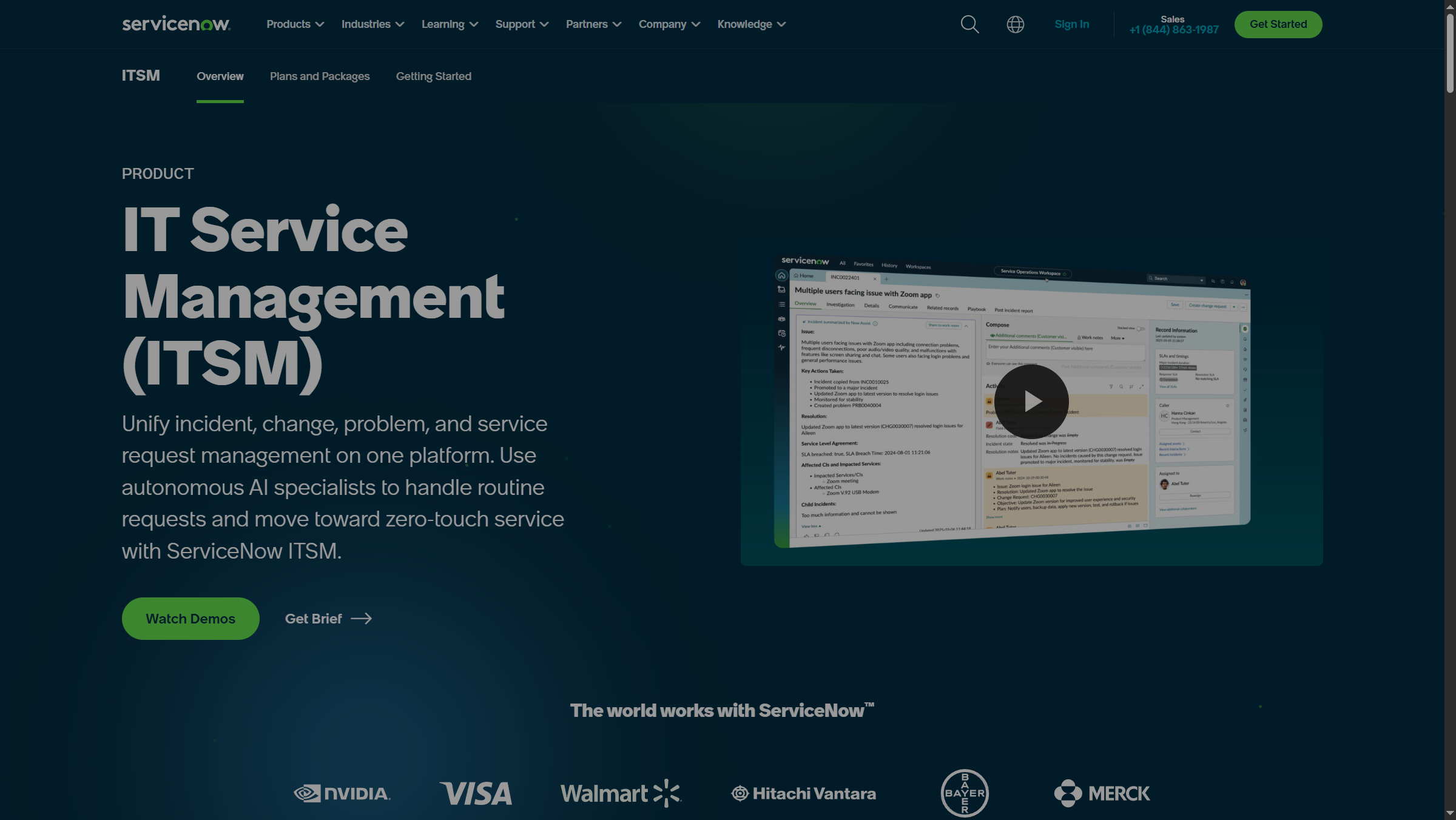
Now Assist is included in Pro Plus and Enterprise Plus SKUs and offers ticket summarisation, change risk scoring, knowledge generation, and code search. AI Agents - the autonomous tier - cover incident resolution, change management, knowledge curation, and multi-agent orchestration. AI Agents are consumption-priced separately from the platform license, the source of most TCO surprise in renewals.
The Zurich release preview at Knowledge 2026 hints at deeper agent-to-agent handoff protocols - if multi-agent workflows are central to the buyer’s three-year roadmap, ServiceNow has the deeper architecture today.
Where Now Assist falls short: consumption pricing is opaque, the AI Control Tower itself is a separate licensable add-on at the Enterprise Plus tier, and meaningful agent deployment typically requires a certified implementation partner billing $200-$400/hour.
AI agent tradeoff: Skip Freddy AI if IT shops need autonomous agents to reach across into Salesforce, HRIS, or custom-built internal systems on day one - Freshservice Freddy is still primarily a self-contained service-desk agent in 2026 and lacks integration with non-Freshworks platforms. Skip Now Assist if budget is tight - consumption-priced AI Agent calls on top of enterprise platform fees and a separately licensed AI Control Tower add-on routinely push first-year AI spend into six-figure territory before measurable deflection lands, a real drawback for mid-market buyers.
ITIL Compliance and Process Coverage
Both platforms are PinkVERIFY-certified, but breadth differs. Freshservice carries certification across nine ITIL 4 processes - Incident, Problem, Change Enablement, Service Request, Service Configuration, Knowledge, Service Level, Service Catalogue, Release. ServiceNow carries fifteen, adding Event Management, IT Asset Management, Project Management, Continual Improvement, Information Security Management, and Supplier Management.
For most mid-market IT shops, the nine Freshservice processes cover everything actively used. For enterprise shops running formal ISO 20000 audits or government compliance regimes (FedRAMP High, IL5), ServiceNow’s broader certification carries weight in procurement scoring matrices.
ITIL coverage tradeoff: Freshservice’s nine processes work for 90% of mid-market shops, but a fast-moving compliance program (HIPAA Audit, SOX, ISO 20000) often needs the extra six processes ServiceNow covers - especially Information Security Management and Supplier Management.
Asset Management & CMDB Depth
Freshservice includes asset management from the Growth tier with a 100-asset cap; Pro removes the cap. Discovery uses an agent or Probe scan. The CMDB schema is opinionated but extensible, and most mid-market shops map their estate inside two weeks.
ServiceNow’s CMDB is the industry reference standard. Combined with Service Mapping (application dependency discovery via traffic analysis), Discovery (agentless network scanning), and Software Asset Management Pro (license reconciliation), it forms a configuration store no competitor matches. All four are separately licensed and the implementation is complex enough that most enterprises run a dedicated CMDB team. If your organisation is preparing for SOX, HIPAA, or PCI audits where dependency mapping evidence is non-negotiable, ServiceNow wins on CMDB depth almost without question.
CMDB tradeoff: Freshservice’s CMDB ships fast and covers typical mid-market estates within two weeks, but lacks ServiceNow’s traffic-based Service Mapping which is the only practical way to discover application dependencies in microservices estates exceeding 500 services.
Customisation & Workflow Automation
Freshservice ships with a no-code Workflow Automator - a visual drag-and-drop canvas for triggers, conditions, and actions. Custom Objects and Custom Apps allow extension without leaving the no-code surface.
ServiceNow’s customisation is a different category - a full development platform. JavaScript business rules, server and client scripts, and the AppEngine Studio low-code surface cover everything from “small workflow tweak” to “build a SaaS product on the Now Platform.” Serious customisation requires Certified System Administrators and often Certified Application Developers billing $130-$220k/year as full-time hires.
For organisations with one or two unusual workflows, Freshservice handles them in days. For dozens of bespoke processes spanning HR, Legal, Facilities, Procurement, and IT - with headcount to develop them - ServiceNow becomes the obvious choice.
Customisation tradeoff: Freshservice’s no-code surface saves headcount but caps complexity - anything requiring stored procedures, async background jobs, or custom integration middleware sits outside the Workflow Automator’s reach.
Integrations & Ecosystem
Freshservice marketplace lists 1,000+ apps as of May 2026, covering monitoring (Datadog, New Relic, PagerDuty), collaboration (Slack, Teams, Zoom), identity (Okta, Azure AD, JumpCloud), and hundreds of SaaS connectors. Freshservice Workspaces lets one tenant host multiple service teams - HR, Facilities, Finance - without separate instances.
ServiceNow’s IntegrationHub lists around 400 certified spokes, but each spoke is typically deeper than the equivalent Freshservice app - bidirectional sync, transform mapping, Flow Designer integration. For SAP, Oracle, and IBM mainframe environments, ServiceNow is materially better connected.
Integration tradeoff: Freshservice’s larger app catalog is broader but shallower; ServiceNow’s 400 spokes are deeper and the only practical path for SAP / Oracle / mainframe ERP estates.
How Long Does Freshservice vs ServiceNow Take to Implement?
Freshservice deployment typically lands in 4-12 weeks for a mid-sized IT team. The path involves agent setup, ticket type and category mapping, SLA configuration, asset import via CSV or discovery agent, and approval workflow design. Most organisations self-implement or use a Freshworks-certified consultancy for asset and CMDB work.
ServiceNow implementation runs 6-18 months in most enterprise scenarios, with 9-12 months typical for a clean ITSM Pro deployment. Data migration from a legacy ITSM (often BMC Remedy, HP Service Manager, or Cherwell) is the bulk of the cost. ServiceNow’s Now Assist can now generate migration playbooks, but a certified partner remains effectively mandatory.
Switching away from ServiceNow once it’s the system of record for change management is genuinely hard. Switching off Freshservice is meaningfully easier - the data model is simpler and exports more cleanly.
Implementation tradeoff: Skip Freshservice if IT teams are migrating from a heavily customised legacy ITSM with hundreds of bespoke workflow rules - Freshservice’s no-code Workflow Automator forces a simplification pass that some shops are not politically ready to take on, a real limitation for migration-heavy estates. Skip ServiceNow if the organisation needs to be live in under six months or lacks budget for a six-figure implementation partner engagement - the platform’s strengths only materialise after the long deployment runway is paid for.
Total Cost of Ownership: 500-User Worked Example
Take a mid-sized IT organisation: 500 employees, 30 IT agents, modest customisation needs, asset management for 800 endpoints.
Freshservice TCO (5-year projection):
- Pro tier: 30 agents × $99/agent/month × 12 = $35,640/year
- Freddy AI Copilot: 30 × $29 × 12 = $10,440/year
- Implementation (one-off): $20,000
- Optional Freshworks Premium Support: $8,000/year
- Year 1 total: approximately $74,000
- 5-year TCO: approximately $292,000 (assuming 7% annual price uplift)
ServiceNow TCO (5-year projection, community-estimated):
- ITSM Pro: 30 named users at around $135 per user per month × 12 = approximately $48,600/year (low estimate)
- Now Assist add-on: 30 users at approximately $75 per month × 12 = $27,000/year
- Implementation (one-off): $180,000
- Annual support and renewal uplift: $15,000/year
- AI Agent consumption (estimated): $20,000/year
- Year 1 total: approximately $290,600
- 5-year TCO: approximately $815,000 (assuming 9% annual list-price uplift)
The servicenow cost premium for this scenario lands at roughly 2.8x Freshservice over five years. The delta widens at smaller user counts and narrows at 5,000+ users where ServiceNow enterprise discounting often hits 30-40% off list. At 500 users, Freshservice is the financially defensible choice unless a specific ServiceNow capability (deep CMDB, FedRAMP High, multi-instance governance) makes the platform mandatory.
What About Atlassian Rovo? The Third Option
The mid-market ITSM conversation in 2026 increasingly includes a third name: Atlassian’s Jira Service Management with Rovo Agents. Rovo is Atlassian’s AI agent layer, bundled at an effective uplift of around $20/agent/month over standard JSM Premium. For organisations already running Jira and Confluence, the lock-in cost of staying on the Atlassian estate is lower than migrating to either Freshservice or ServiceNow. Rovo’s strength is pulling context from connected Jira tickets, Confluence pages, and Bitbucket repos.
It is not a fit if the IT shop has serious ITAM, formal change advisory boards, or compliance auditing as core needs - JSM’s process maturity is still meaningfully behind both Freshservice and ServiceNow.
ITSM cost tradeoff for sub-1000 user shops: the gap between Freshservice and ServiceNow at this scale typically dwarfs any feature gap - 60% of cited ServiceNow displacements occur because the buyer simply could not justify the multi-quarter implementation timeline.
Industry Fit: Who Should Pick What
Freshservice fits mid-market companies (100-5,000 staff), professional services, hospitality and retail chains, education, and growing tech companies - industries where ITIL discipline matters but a six-figure implementation budget is not justifiable.
ServiceNow fits global enterprises (5,000+ staff), regulated industries (banking, insurance, pharmaceutical), public sector (FedRAMP environments), and any organisation already running ServiceNow in HR, CSM, or SecOps where ITSM consolidation makes contractual sense.
Atlassian Rovo is the freshservice alternative most worth serious consideration if Jira already runs the engineering organisation and IT can live with Jira-style ticket semantics rather than ITIL-purist semantics.
Industry fit tradeoff: Skip Freshservice if the organisation is a bank, insurer, pharma, or federal-civilian agency running ISO 20000 or FedRAMP High audits - the nine-process PinkVERIFY footprint and lighter CMDB schema are real drawbacks under heavy auditor scrutiny in those regimes. Skip ServiceNow if the organisation is a retail chain, hospitality group, professional-services firm, or growth-stage tech company under 5,000 staff - the per-named-user TCO and 9-18 month deployment timeline are misaligned with the operational tempo these industries actually run on, a fundamental limitation for fast-moving mid-market shops.
Frequently Asked Questions
Is Freshservice the same as ServiceNow?
No. Freshservice and ServiceNow are different products from different vendors targeting different segments. Freshworks built Freshservice as a cloud-native ITSM platform optimised for mid-market IT with transparent per-agent pricing starting around $19/agent/month annually. ServiceNow built the Now Platform as an enterprise application platform where ITSM is one of many products, priced per named user with quote-only commercials typically starting around $100 per user per month based on community-reported quotes.
Who is the biggest competitor of ServiceNow?
In the enterprise ITSM segment, BMC Helix is ServiceNow’s most direct head-to-head competitor on platform breadth and deal size. In the mid-market, Freshservice and Atlassian Jira Service Management are the most-considered alternatives for buyers downscoping from ServiceNow on cost or timeline grounds. Microsoft is increasingly viewed as a strategic competitor through Power Platform, Dynamics 365 Customer Service, and Copilot Studio agents.
Is Freshworks a competitor to ServiceNow?
Yes, but not at the top of the enterprise pyramid. Freshworks competes with ServiceNow primarily in the mid-market through Freshservice for ITSM and Freshdesk for customer service, positioning as the modern, transparent-pricing alternative for organisations that find ServiceNow’s quote-only sales motion prohibitively expensive. Freshworks reports steady displacement wins in the 500-3,000 user band where ServiceNow’s TCO is hardest to justify.
The Bottom Line
The freshservice vs servicenow choice in 2026 is fundamentally a buyer-segment question. Mid-market IT teams (100-5,000 staff) needing fast deployment, transparent pricing, and a competent AI ticketing assist are almost always best served by Freshservice. Global enterprises (5,000+ staff) needing deep CMDB, multi-process certification, the AI Control Tower governance layer, and the willingness to staff a Now Platform development team are almost always best served by ServiceNow.
The honest disclosure stands: Freshservice is the affiliate-supported option in this comparison; ServiceNow does not run a partner program of equivalent structure. Where ServiceNow genuinely wins - CMDB depth, multi-agent orchestration via the Yokohama-release Control Tower, fifteen-process ITIL certification - this article called those wins out by name. The right tool is the one your organisation can actually run, staff, afford, and grow into.
Related Reading
- Freshservice tool review - our complete platform breakdown
- Best Customer Support Software 2026 - adjacent service-desk category review
- Linear vs Jira - related ticketing platform comparison
- Best Workflow Automation Tools 2026 - broader automation category context
- Enterprise Collaboration Platforms - enterprise SaaS landscape
External Resources
- Freshservice Features - official Freshworks feature catalogue
- ServiceNow ITSM - official Now Platform ITSM product page
- ITIL Framework Overview - background on the IT service management practice both platforms align to