






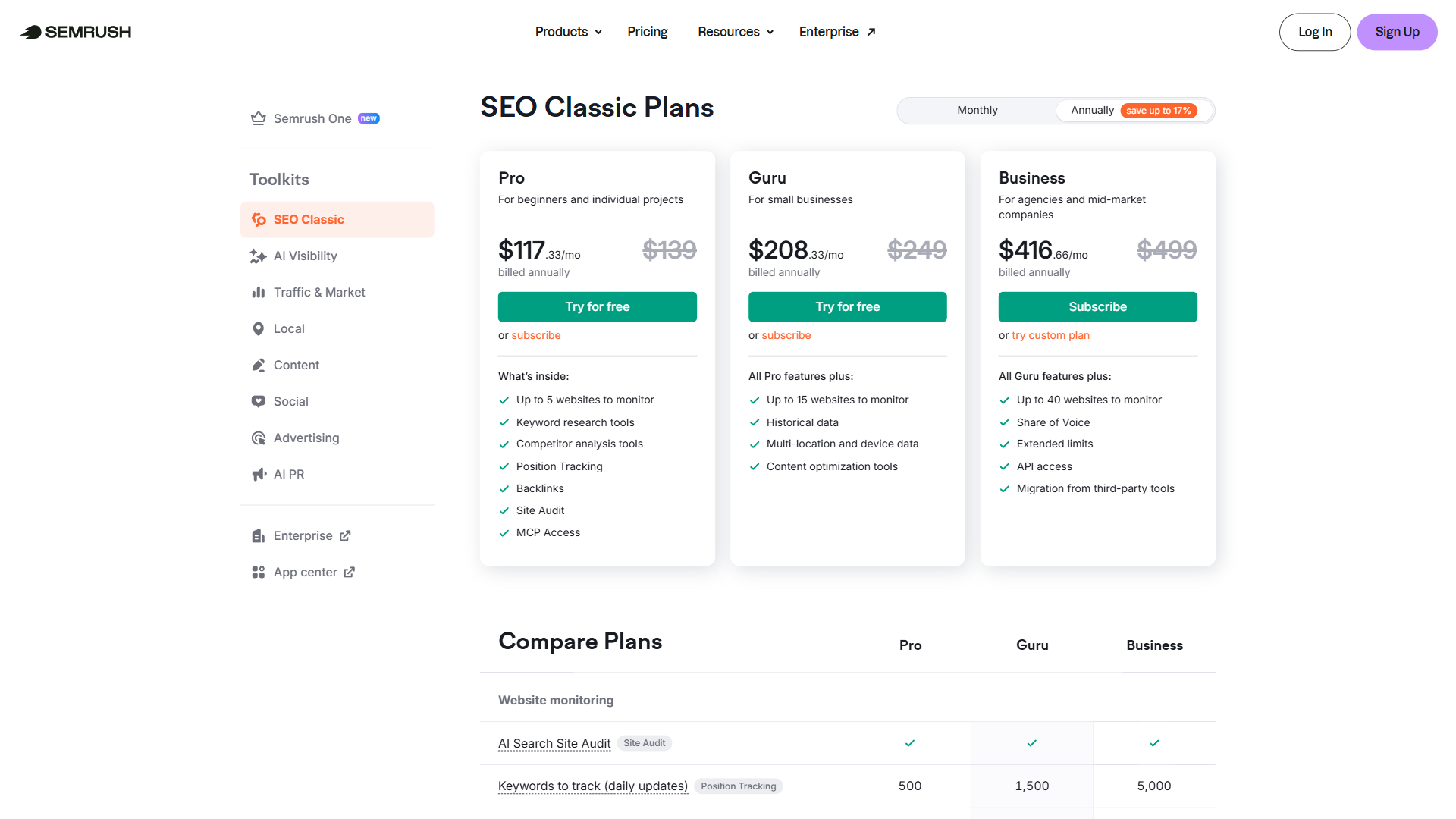
Semrush pricing in 2026 spans five tiers: a limited Free plan, Pro at $139.95/month, Guru at $249.95/month, Business at $499.95/month, and custom Enterprise pricing. For most SEO professionals and small marketing teams, the Pro plan covers core needs - keyword research, site audits, position tracking for 500 keywords, and the free Semrush Copilot AI assistant. But the right plan depends on project volume, team size, and whether content marketing tools are a priority. Teams that lean heavily on AI-assisted writing also pair Semrush with content tools like NeuronWriter for drafting at scale.
The pricing gap between tiers is significant, and several costs hide beneath the surface: additional user seats, the AI Visibility Toolkit add-on, and project limits that force upgrades sooner than expected. This guide breaks down every plan, calculates the real annual costs, compares Semrush to Ahrefs head-to-head, and matches each tier to specific use cases - so the investment goes to the right plan from day one.
Pricing at a Glance: Semrush Plans
Here is every Semrush plan side by side as of March 2026:
| Feature | Free | Pro | Guru | Business | Enterprise |
|---|---|---|---|---|---|
| Monthly Price | $0 | $139.95 | $249.95 | $499.95 | Custom |
| Annual Price (per mo) | $0 | $117.33 | $208.33 | $416.66 | Custom |
| Projects | 1 | 5 | 15 | 40 | Custom |
| Keywords Tracked | 10 | 500 | 1,500 | 5,000 | Custom |
| Results per Report | 10 | 10,000 | 30,000 | 50,000 | Custom |
| Daily Reports | 10 | 3,000 | 5,000 | 10,000 | Custom |
| Historical Data | No | No | Unlimited | Unlimited | Unlimited |
| Content Toolkit | No | No | Yes | Yes | Yes |
| API Access | No | No | No | Yes | Yes |
| Semrush Copilot | No | Yes (free) | Yes (free) | Yes (free) | Yes |
Semrush Free Plan: Testing the Waters
The free tier exists primarily as a trial funnel, not a production tool. With 10 requests per day across both domain and keyword analytics, it provides enough access to evaluate the interface and data quality before committing to a paid plan.
What is included:
- 10 domain analytics requests per day - Enough to check a handful of competitor domains, but not enough for systematic research
- 10 keyword analytics requests per day - Run a few keyword queries to see volume, difficulty, and SERP features
- Basic SEO checker - Scan a URL for fundamental on-page issues
- Limited access to tools - Most features are visible but gated behind usage caps
What is missing:
The free plan lacks position tracking, site audits, backlink analytics at scale, and any AI features. There is no Semrush Copilot, no Content Toolkit, and no historical data access. The 10-query daily limit makes it impractical for anything beyond casual exploration - even basic Core Web Vitals checks recommended by Google Search Central are off the table at this tier.
Who it is for: Anyone evaluating whether Semrush’s data quality and interface justify the investment. For actual SEO work, even at a basic level, the 14-day free trial of Pro is a better starting point.
Limitations and who it’s not for: The free plan’s drawbacks are severe. The 10-query daily cap, no position tracking, no site audits, and no historical data make it useless for any production SEO workflow. Skip the free tier entirely if the goal is real research; start the 14-day Pro trial instead.
Semrush Pro: The Core SEO Toolkit
At $139.95/month (or about $117 per month billed annually), Pro is the entry point for professional SEO work. It covers keyword research, competitor analysis, site auditing, and rank tracking - the four pillars that most SEO workflows depend on daily.
What Pro includes:
- Keyword Magic Tool - Access to Semrush’s database of 20+ billion keywords across 119 countries. Search by seed keyword and get volume, difficulty, intent, CPC, and related variations. The Semrush Keyword Magic Tool guide covers advanced filtering and grouping techniques
- Competitor analysis - Analyze any domain’s organic keywords, paid keywords, backlinks, and traffic estimates. Compare up to 5 domains side by side
- Site Audit (140+ checks) - Crawl up to 100,000 pages per project and identify technical SEO issues including crawlability, performance, structured data, and HTTPS migration problems
- Position Tracking (500 keywords) - Monitor daily ranking changes across 500 keywords per project with SERP feature tracking
- On-Page SEO Checker - Get actionable recommendations for individual pages based on top-ranking competitors
- Semrush Copilot - The free AI assistant that analyzes data from 6 core tools and provides personalized recommendations. Available at no extra cost on all paid plans
- 3,000 daily reports - Domain analytics and backlink analytics queries, resetting every 24 hours
- 5 projects - Each project represents a website or campaign being monitored
The 5-project limit matters more than expected. Each project in Semrush maps to a website with its own site audit, position tracking, and on-page recommendations. Freelancers managing 3-4 client sites plus their own will hit the cap quickly. At that point, the choice is between upgrading to Guru (15 projects) or constantly removing and re-adding projects - which loses historical tracking data. For broader options, see our best AI SEO tools roundup and the dedicated Ahrefs comparison guide covering the closest direct competitor.
What Pro is missing: No historical data access, no Content Toolkit (the AI-powered content creation suite), no branded/white-label reports, and no multi-location tracking. These gaps push content-focused teams and agencies toward Guru.
Who it is for: Solo SEO professionals, freelancers with fewer than 5 client projects, small business owners managing their own SEO, and in-house marketers focused on keyword research and technical audits. If the work is primarily research and monitoring rather than content creation and client reporting, Pro delivers the essential toolkit.
Limitations and who it’s not for: Pro has clear limitations: no historical data, no Content Toolkit, no white-label reports, and a hard 5-project cap that agencies hit fast. Skip Pro if the team publishes content regularly, manages more than five client sites, or needs branded reporting - those gaps push the upgrade to Guru sooner than expected.
Semrush Guru: The Content Marketing Upgrade
Guru costs $249.95/month (about $208 per month annually) and adds the content marketing layer that Pro lacks entirely. The $110 per month jump over Pro buys three things that matter: the Content Toolkit, unlimited historical data, and white-label reporting.
What Guru adds over Pro:
- Content Toolkit (formerly ContentShake AI) - AI-powered article generation, topic research, and a Chrome extension for writing SEO-optimized content directly in Google Docs. This is not just an outline generator - it produces draft articles based on target keywords and competitor analysis
- SEO Writing Assistant with AI Compose - Real-time content scoring as you write, with tone-of-voice settings, readability analysis, and AI-assisted rewriting. Available as a Google Docs add-on, WordPress plugin, and in-browser tool
- Unlimited historical data - Access Semrush’s full historical database for any domain or keyword. Essential for trend analysis, seasonal planning, and understanding how competitors’ strategies have evolved over time
- Multi-location and device tracking - Track keyword rankings by specific city, region, or device type. Critical for businesses with physical locations or those targeting local search results
- White-label and branded reports - Generate professional PDF reports with custom branding for client presentations. Remove all Semrush branding and add your agency’s logo, colors, and domain
- 15 projects - Triple the Pro limit, accommodating growing agencies and multi-brand businesses
- 5,000 daily reports - A 67% increase over Pro’s daily report allowance
The Content Toolkit justifies the upgrade for content teams. A standalone AI writing tool (Jasper, WriteSonic, or similar) costs $49-$99 per month. A separate content optimization tool (Surfer SEO, Clearscope) adds another $89-$170 per month. Guru bundles both capabilities alongside the full SEO suite. For teams that publish regularly and need content to rank, the math favors Guru over Pro plus separate content tools. Compare standalone content optimization options in our best SEO content tools roundup, and review Google’s own helpful content guidance before committing to any AI-assisted workflow.
Historical data is the other major differentiator. Without it, competitive research is limited to current snapshots. With it, you can see how a competitor’s traffic changed after a Google algorithm update, identify seasonal keyword trends across years, and benchmark growth over time. Cross-referencing those trends with the public Google ranking updates history turns raw movements into actionable insight. For strategic SEO work, historical data is not optional - it is foundational, and the Moz Pro alternative is one of the few platforms with a comparable archive depth.
Who it is for: Content marketing teams, growing SEO agencies managing 6-15 client projects, and businesses where content creation is a core part of the SEO strategy. If the team publishes more than 4 blog posts per month and needs data-driven content optimization, Guru is the tier where Semrush transitions from a research tool to a content engine.
Limitations and who it’s not for: Guru’s drawbacks include no API access, no Share of Voice metric, and a 15-project cap that mid-size agencies still outgrow. Additional users are $80 per month each, which adds up fast for teams of 4+. Skip Guru if API integration is required for custom reporting, or if the agency portfolio already exceeds 15 active client projects.
Semrush Business: Agency and Enterprise Scale
The Business plan at $499.95/month (about $417 per month annually) targets agencies and large marketing teams that need API access, extended limits, and advanced competitive intelligence.
What Business adds over Guru:
- API access - Programmatic access to Semrush data for custom dashboards, automated reporting, and integration with internal tools. The Semrush API documentation details available endpoints and rate limits. This is the primary driver for most Business plan subscriptions
- Share of Voice metric - Measure your overall market visibility relative to competitors across an entire keyword universe, not just individual rankings. Useful for executive-level reporting and market share analysis
- 40 projects - More than double Guru’s limit, supporting large agency portfolios
- 50,000 results per report - A significant increase for large-scale competitive research and keyword analysis
- 10,000 daily reports - Double the Guru allowance for high-volume research
- AI-powered traffic predictions - 3-month forecasts for visibility, traffic, and rankings based on current trends and algorithm patterns
- PLA (Product Listing Ad) analytics - Monitor and analyze Google Shopping ads, product placements, and e-commerce competitor strategies
- Free migration from competitors - Semrush provides assisted migration from other SEO tools, transferring projects, tracking data, and settings
- Extended multi-user support - Better accommodates teams with multiple seats accessing the platform simultaneously
The cost calculation for agencies:
| Agency Size | Plan | Monthly Cost | Annual Cost | Cost per Client (10 clients) |
|---|---|---|---|---|
| Small (5 clients) | Pro | $139.95/mo | $1,407.96/yr | $28/mo |
| Medium (15 clients) | Guru | $249.95/mo | $2,499.96/yr | $16.66/mo |
| Large (30+ clients) | Business | $499.95/mo | $4,999.92/yr | $16.66/mo |
For agencies billing clients $500-$2,000 per month for SEO services, even the Business plan represents a fraction of the revenue generated per client. The API access alone enables custom client portals and automated reporting that would cost thousands to build from scratch.
Who it is for: SEO agencies with 15+ active client projects, enterprise marketing teams requiring API integration, e-commerce businesses needing PLA analytics, and organizations where custom reporting and data automation are operational requirements.
Limitations and who it’s not for: Business has tradeoffs to weigh. The AI Visibility Toolkit is not included (still $99 per month extra), the 40-project cap forces enterprise upgrades for the largest portfolios, and per-user costs jump to $100 per month each. Skip Business if AI search visibility tracking is the strategic priority, or if the agency runs 40+ projects - both push toward Enterprise.
Semrush Enterprise: Custom Solutions
Enterprise pricing is not listed publicly - it requires contacting Semrush’s sales team for a custom quote. Based on the feature set, Enterprise targets organizations with needs that exceed the Business plan’s limits.
What Enterprise adds over Business:
- AI Optimization (AIO) beta access - Early access to Semrush’s emerging AI search optimization tools
- AI Visibility Index benchmarking - Track and benchmark brand presence across ChatGPT, Google AI Overviews, Perplexity, and Gemini against competitors
- Custom limits - Tailored project counts, keyword tracking volumes, and API rate limits based on organizational needs
- Dedicated account manager - A named contact at Semrush for strategic support, not just technical troubleshooting
- Custom integrations - Bespoke connections to internal tools, data warehouses, and workflows
- Priority support - Faster response times and escalation paths
Who it is for: Large enterprises with established SEO programs, organizations prioritizing AI search visibility as a strategic initiative, and companies needing dedicated support and custom platform configurations.
Limitations and who it’s not for: Enterprise has predictable downsides: opaque pricing requires sales-cycle negotiation, contracts are typically annual with no monthly flexibility, and the value of bundled AIO/AI Visibility features depends on how much teams actually use AI-search tracking. Skip Enterprise if the team can hit its goals on Business plus the $99 per month AI Visibility Toolkit add-on - the cost gap rarely justifies itself for organizations under 50 active projects.
How Much Do You Save With Annual vs Monthly Billing?
Semrush rewards annual commitment with a consistent 16% discount across all paid tiers. Here is what that looks like in real numbers:
| Plan | Monthly Billing | Annual Billing (per mo) | Annual Savings | Savings % |
|---|---|---|---|---|
| Pro | $139.95/mo ($1,679.40/yr) | $117.33/mo ($1,407.96/yr) | $271.44/yr | 16% |
| Guru | $249.95/mo ($2,999.40/yr) | $208.33/mo ($2,499.96/yr) | $499.44/yr | 17% |
| Business | $499.95/mo ($5,999.40/yr) | $416.66/mo ($4,999.92/yr) | $999.48/yr | 17% |
At the Guru level, annual billing saves nearly $500 per year - enough to cover several months of a complementary tool. At Business, the annual discount saves almost $1,000.
The 14-day free trial strategy: Semrush offers a 14-day free trial with full Pro-level access. The recommended approach is to use the trial intensively for two weeks, evaluate whether the data and features justify the investment, and then commit to annual billing if the answer is yes. Starting with monthly billing “just to test” costs an extra $22.62 in the first month compared to the annual rate - and most users know within two weeks whether Semrush fits their workflow.
Limitations and who it’s not for: Annual billing has tradeoffs. The 16% discount locks the spend for 12 months with no pro-rated refunds if the team downgrades or churns mid-contract. Skip annual commitment if budget is uncertain or if the team is still mid-evaluation - the monthly premium buys flexibility that matters more than the discount when usage is unproven.
Hidden Costs in Semrush Pricing
Semrush pricing is more transparent than many enterprise tools, but several costs sit outside the main plan comparison:
Additional User Seats
Each Semrush plan includes one user seat. Additional users cost extra:
| Plan | Additional User Cost |
|---|---|
| Pro | $45/month per user |
| Guru | $80/month per user |
| Business | $100/month per user |
For a 3-person team on the Guru plan, the real monthly cost is $249.95 + (2 x $80) = $409.95 per month - a 64% increase over the base price. This is the most common hidden cost that catches teams off guard.
AI Visibility Toolkit
The AI Visibility Toolkit - which tracks brand presence across ChatGPT, Google AI Overviews, Perplexity, and Gemini - is available as an add-on at $99 per month. It is included in Enterprise plans but costs extra on Pro, Guru, and Business. For teams prioritizing AI search optimization, this adds meaningful cost on top of the base subscription.
Project Limits Force Upgrades
The 5-project limit on Pro is the most common trigger for upgrading to Guru. Each project encompasses a website’s site audit, position tracking, on-page analysis, and historical data. Agencies managing more than 5 clients have no option but to move to Guru (15 projects) or Business (40 projects), regardless of whether they need the other features those tiers include.
Semrush App Center
Semrush’s App Center includes third-party and first-party add-on tools - some free, some paid separately. Tools like the Local SEO toolkit, the Agency Growth Kit, and traffic analysis add-ons carry their own subscription costs on top of the base plan.
Competitor Analysis Credits
While daily report limits (3,000 for Pro, 5,000 for Guru, 10,000 for Business) cover most workflows, heavy competitive research - analyzing dozens of competitor domains in a single session - can hit these caps. Once the daily limit is reached, queries are blocked until the next day.
Pricing Comparison: Semrush vs Ahrefs
The most common pricing comparison in the SEO tool market is Semrush vs Ahrefs. Here is how the two platforms stack up on cost:
| Feature | Semrush Pro | Ahrefs Lite | Semrush Guru | Ahrefs Standard |
|---|---|---|---|---|
| Monthly Price | $139.95 | $129 | $249.95 | $249 |
| Annual Price (per mo) | $117.33 | $108 | $208.33 | $208 |
| Projects | 5 | 5 | 15 | 20 |
| Keywords Tracked | 500 | 750 | 1,500 | 2,000 |
| Additional Users | $45/mo | $50/mo | $80/mo | $50/mo |
| Content Tools | None (Pro) | None (Lite) | Content Toolkit | None (Standard) |
| Historical Data | No | Yes (limited) | Unlimited | Yes |
| API Access | No | No | No | No |
Key pricing differences:
- Entry-level pricing: Ahrefs Lite ($129 per month) undercuts Semrush Pro ($139.95/month) by roughly $11 per month. However, Ahrefs also offers a Starter plan at $29 per month with 100 credits - a significantly cheaper entry point for very light usage
- Mid-tier value: At the $249 per month level, Semrush Guru and Ahrefs Standard are nearly identical in price. Guru wins on content marketing tools (Content Toolkit, SEO Writing Assistant). Standard wins on project limits (20 vs 15) and keyword tracking (2,000 vs 1,500)
- Additional user costs: Ahrefs charges a flat $50 per month per additional user across all plans. Semrush’s per-user costs scale with the plan tier ($45-$100 per month), making Ahrefs cheaper for multi-user teams on higher plans
- Credit systems: Ahrefs uses a credit-based system for data exports and some features. Semrush uses daily report limits. Neither is strictly better - the impact depends on workflow patterns
The bottom line on Semrush vs Ahrefs pricing: For pure SEO research and backlink analysis, Ahrefs offers slightly better value per dollar. For teams that need content marketing tools, PPC research, and social media features alongside SEO, Semrush’s all-in-one approach eliminates the need for additional subscriptions. For more direct comparison points, see our Semrush competitors guide.
Best Picks by Use Case
Rather than guessing, match the situation to the right tier:
Choose the Free Plan if:
- You need to evaluate Semrush’s data quality before committing
- You have fewer than 10 SEO queries per day
- You are comparing Semrush against other tools and want hands-on experience
Choose Pro ($139.95/month) if:
- You are a solo SEO professional or freelancer managing 1-5 websites
- Your primary needs are keyword research, site audits, and rank tracking
- Content creation happens outside Semrush (in Google Docs, WordPress, or another tool)
- You do not need white-label client reports
- Budget is a constraint and the content marketing tools are not essential
Choose Guru ($249.95/month) if:
- Content marketing is a core part of the SEO strategy, not an afterthought
- You manage 6-15 projects and need room to grow
- Historical data matters for competitive analysis and trend research
- Client-facing reports need professional branding
- The team publishes 4+ pieces of content per month and needs optimization tools
Choose Business ($499.95/month) if:
- API access is required for custom dashboards or automated reporting
- You manage 15+ client projects or large multi-brand portfolios
- E-commerce PPC and Google Shopping analysis are part of the workflow
- Share of Voice reporting is needed for executive presentations
- The team includes multiple users who all need simultaneous access
Choose Enterprise (custom pricing) if:
- AI search visibility tracking is a strategic priority
- Custom integrations with internal tools and data warehouses are required
- The organization needs a dedicated account manager and priority support
- Standard plan limits are insufficient for the scale of operations
The Bottom Line
Semrush pricing in 2026 reflects its position as the most comprehensive digital marketing platform available. The Pro plan at $139.95/month covers the fundamentals for solo practitioners. Guru at $249.95/month is the sweet spot for content-focused teams and growing agencies - bundling content creation tools that would cost $100-$200 per month separately. Business at $499.95/month serves agencies at scale with API access and extended limits.
The most common pricing mistake is starting on Pro and immediately needing Guru. If content marketing is part of the plan - and for most SEO strategies it should be - the Content Toolkit, historical data, and white-label reports in Guru justify the $110 per month premium from day one. Conversely, solo practitioners who primarily need keyword research and site audits will find Pro delivers 90% of the value at 56% of Guru’s cost.
Start with the 14-day free trial to test Pro-level features, then commit to annual billing on the tier that matches your project count and content needs. The 16% annual discount makes a meaningful difference - especially at the Guru and Business tiers where it saves $500-$1,000 per year.
FAQ
Q: How much does a Semrush subscription cost?
A Semrush subscription costs $139.95/month for Pro, $249.95/month for Guru, and $499.95/month for Business. Annual billing reduces each by roughly 16% - bringing Pro to about $117 per month, Guru to about $208 per month, and Business to about $417 per month. Enterprise pricing requires a custom quote from the sales team.
Q: Is Semrush free or paid?
Semrush offers a limited free plan with 10 domain and 10 keyword analytics requests per day, but it lacks position tracking, site audits, and all AI features. Professional SEO work requires a paid plan starting at $139.95/month for Pro. A 14-day free trial of Pro-level features is available without a credit card.
Q: What hidden costs should you watch for with Semrush pricing?
The most common hidden cost is additional user seats: Pro charges $45 per month per extra user, Guru $80 per month, and Business $100 per month. A 3-person Guru team pays $409.95 per month - 64% above the base price. The AI Visibility Toolkit adds $99 per month, and the 5-project limit on Pro frequently forces earlier-than-expected upgrades to Guru.
Related Reading
- Semrush Review: Full Tool Overview - In-depth look at Semrush’s features, ratings, and use cases beyond pricing
- Semrush vs Ahrefs: Which SEO Tool Is Worth Your Money in 2026? - Detailed head-to-head comparison of features, data quality, and value
- Best Semrush Alternatives in 2026 - Explore what other SEO platforms offer if Semrush does not fit your budget
- Semrush Competitors 2026: Who Actually Beats Semrush (and Where) - Competitive landscape analysis across SEO tool categories
- Best AI SEO Tools for Content Optimization - How Semrush’s AI features compare to dedicated AI SEO tools
- Ahrefs Tool Overview - Features, pricing, and ratings for the closest Semrush competitor
- Surfer SEO Tool Overview - Standalone content optimization platform for SERP-driven writing
- Moz Pro Tool Overview - Long-running SEO suite with deep historical metrics
- ChatGPT - AI assistant useful for keyword brainstorming and content drafting alongside Semrush
External Resources
- Semrush Official Pricing Page - Current plan details, feature comparison, and free trial signup
- Semrush Academy - Free certification courses to maximize your plan’s value