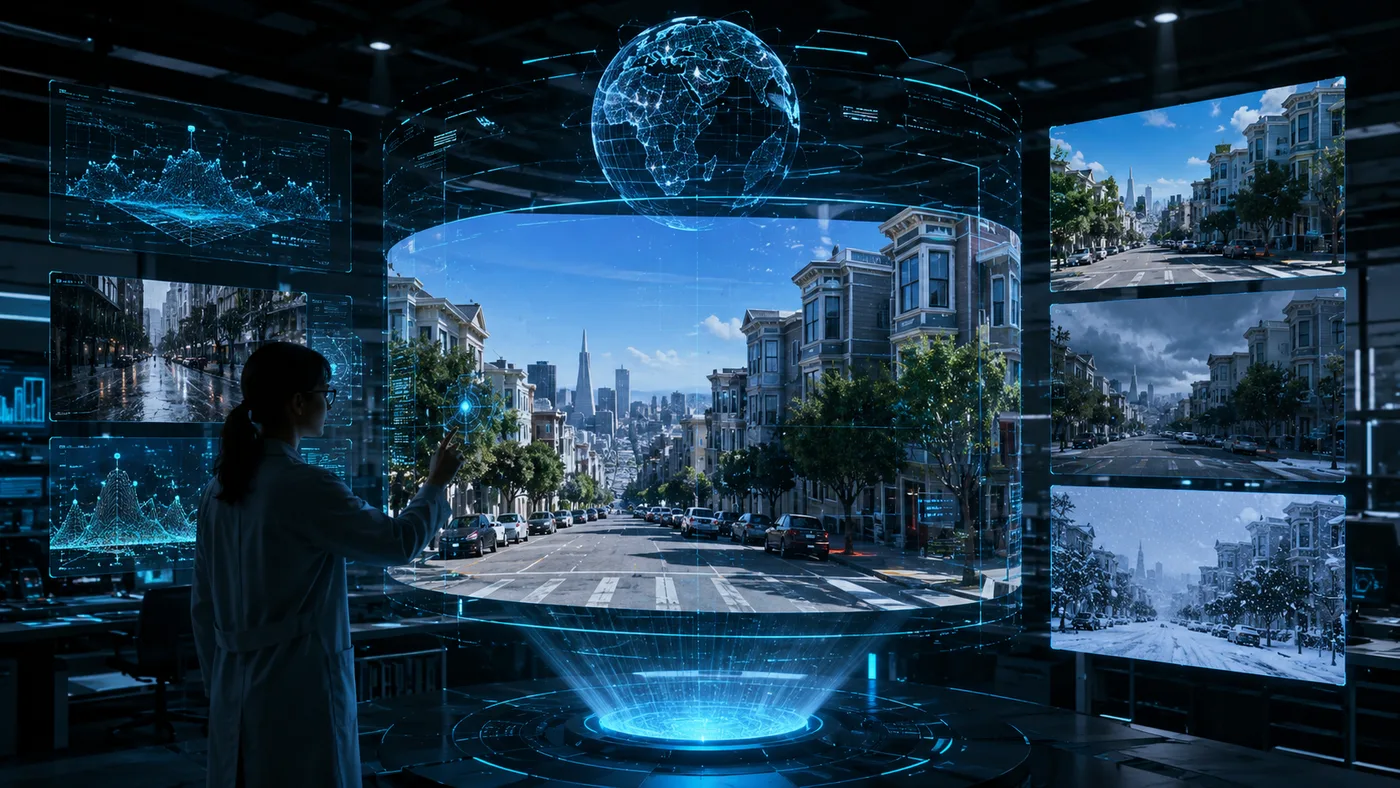
Last year, Genie could build fictional game worlds from a text prompt. Now it can simulate a specific street in London - in a snowstorm or under a July sun - using real imagery from Street View.
Google DeepMind announced the integration at Google I/O on May 19, 2026, connecting Genie 3 to Street View's archive of 280 billion images collected across 110 countries over 20 years. Genie is what researchers call a "world model" - an AI that generates interactive virtual environments you can navigate and manipulate, not just watch like a video. The Street View connection anchors those environments to real locations, with controllable weather, lighting, and conditions.
Genie 3 launched in research preview in August 2025, opened to Google AI Ultra subscribers in the U.S. in January 2026, and the Street View integration is rolling out to the same group starting today, with global expansion over the following weeks.
Waymo's Tornado Problem
The most concrete use case isn't tourism or gaming - it's autonomous vehicles. Waymo uses Genie to simulate rare events its cars have never encountered in real-world driving. The company specifically cited tornadoes as a scenario that needs to exist in training data but can't be captured reliably on real roads.
The same logic applies to robotics more broadly. A robot trained in San Francisco needs to handle London drizzle, high-altitude dust, and heavy snow. Collecting that real-world data takes years. Generating varied scenarios in a world model is much faster. Jack Parker-Holder, a research scientist on DeepMind's open-endedness team, described it as "really powerful for both the agent and robotics use case and for humans to play with."
The Current Ceiling
The honest limitation is that Genie's output is described as "video game quality rather than photorealistic." The model also isn't fully physics-aware yet - it can generate a rainstorm visually but doesn't consistently model how wet pavement affects traction or how wind interacts with objects in the scene. DeepMind puts it at "maybe six to 12 months behind video" in accuracy.
That gap matters a lot for AV safety systems, which need precise physical modeling to be useful. It matters less for robotics navigation training, where volume and variety of scenarios counts more than pixel-perfect realism. A robot learning to walk through a parking lot in rain needs thousands of varied examples, not cinematic accuracy.
For travel previews or game world construction, video game quality is already commercially useful. Real estate platforms, tourism companies, and studios have shipped products with lower visual fidelity than what Genie produces.
The Street View integration is the first version of Genie that feels grounded in something practitioners can point to - a specific location, a specific scenario, a specific training gap they need filled. Whether the physics modeling gets there in the six-to-twelve month window DeepMind projects is the question that will determine how seriously autonomous vehicle and robotics teams can rely on it.