


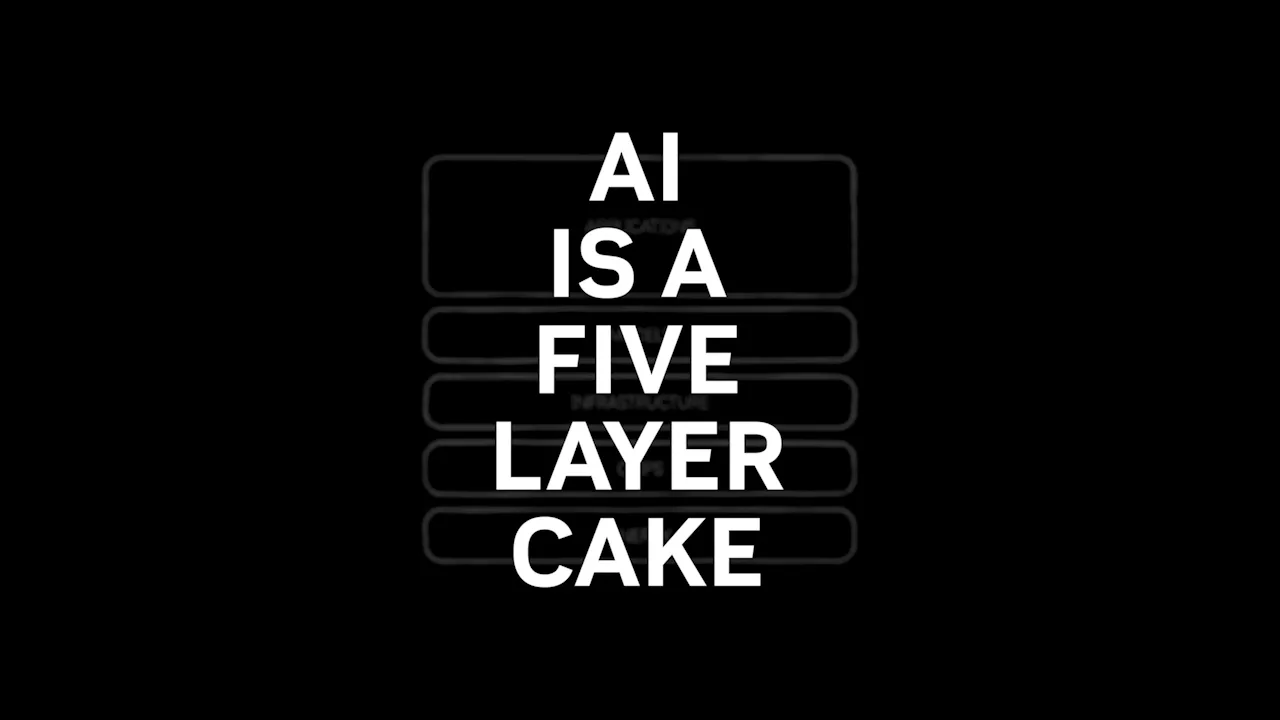
Trillions of dollars. That's how much Jensen Huang says is still needed to build out AI infrastructure - on top of the "few hundred billion" already spent. In a blog post expanding on a framework he first presented at CES 2026, NVIDIA's CEO describes AI not as a single technology but as a vertical stack with five distinct layers, each dependent on everything below it.
The framing is useful because it cuts through the noise about which part of AI "matters most." Huang's answer: all of it, simultaneously.
The Five Layers
Huang's stack runs from the physical to the digital:
Energy - The literal foundation. Every AI-generated token traces back to electrons moving and heat being managed. Real-time intelligence requires real-time power generation. No electricity, no AI.
Chips - Processors built for massive parallelism (running thousands of calculations simultaneously), high-bandwidth memory, and fast interconnects between components. How quickly chips improve determines how fast AI gets cheaper and smarter.
Infrastructure - The data centers, cooling systems, networking, and power delivery that connect tens of thousands of processors into what Huang calls "AI factories." These aren't traditional data centers designed to store information. They're purpose-built to manufacture intelligence.
Models - The actual AI systems. Huang makes a point that language models like ChatGPT and Claude are just one category. Models also work on biology, chemistry, physics, finance, medicine, and physical simulation.
Applications - Where the economic value shows up: drug discovery, industrial robotics, legal copilots, self-driving cars, humanoid robots. Every successful application pulls on every layer beneath it, "all the way down to the power plant."
What Huang Gets Right
The framework is genuinely clarifying for anyone trying to understand where the money is going. When DeepSeek-R1 launched as a free open-source model, some analysts argued it proved you didn't need massive infrastructure spending. Huang uses it as a counterexample: DeepSeek-R1 actually increased demand across the entire stack because cheaper, better models mean more people building more applications, which requires more chips, more data centers, and more power.
This is the same dynamic that played out with cloud computing. AWS didn't reduce total infrastructure spending - it massively increased it by making compute accessible to millions of developers who previously couldn't afford servers.
Huang also makes a sharp observation about AI and jobs using radiology as an example. AI can help read scans, but demand for radiologists keeps growing because the actual job involves judgment and patient care beyond image analysis. The tool makes the professional more productive rather than redundant.
What He Leaves Out
This is, of course, a framework from the CEO of the company selling the picks and shovels. NVIDIA sits squarely at layers two and three - chips and infrastructure - which happen to be the layers requiring the most capital investment. "The largest infrastructure buildout in human history" is a bullish message for a company whose revenue depends on that buildout continuing.
Huang doesn't spend much time on the possibility that efficiency improvements could slow spending. If models keep getting smaller and faster (as the trend with distillation and quantization suggests), the "trillions still needed" figure could shrink. He also glosses over the concentration problem: most of that infrastructure spending flows to a handful of companies, with NVIDIA capturing a dominant share of the chip layer.
Still, as a mental model for understanding how AI actually works from power grid to product, the five-layer cake is one of the cleaner explanations a non-technical audience is going to find. Just remember who's selling the cake pans.