



Every week, someone shares an AI-generated image as if it's real. OpenAI is trying to address that problem with its latest moves on content provenance - the technical term for tracking where a piece of media came from and how it was made.
In a blog post published May 19, OpenAI announced it's expanding support for Content Credentials and SynthID watermarking, and releasing a new verification tool that lets anyone check whether a piece of media is AI-generated.
How the Labels Work
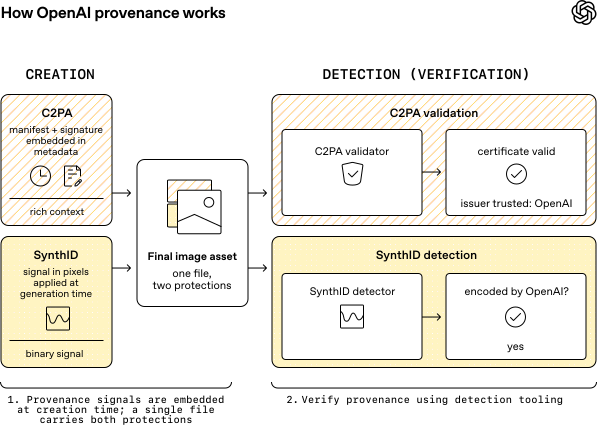
Content Credentials are a standard developed by the Coalition for Content Provenance and Authenticity (C2PA), a group that includes Adobe, Microsoft, and the BBC. The standard embeds metadata directly into image and video files at the moment of creation - recording the tool used, the date, and whether AI was involved. This data travels with the file and can be read by compatible platforms. Think of it as a nutrition label built into the file itself rather than printed on the packaging. Adobe already uses this in Photoshop and Firefly.
SynthID, developed by Google DeepMind, takes a different approach. Instead of metadata that anyone can strip out by editing a file, SynthID embeds an invisible watermark directly into the pixels or audio waveform of AI-generated content. The pattern survives most editing and file compression, and can be detected by software even when it's invisible to the human eye. OpenAI is now backing both standards as part of this initiative, alongside its own verification tool that surfaces provenance data when it's present in a file.
Where This Falls Short
None of this solves the hard case. Content Credentials and SynthID only work when the generating platform embeds them. Anyone running an open-source image model has no obligation to tag anything, and the most harmful deepfakes will almost certainly never carry these markers.
The realistic goal is more modest: making verified content easier to trust, not making unverified content impossible to create. As these labels become standard on legitimate AI outputs, their absence starts to signal something. A marketing image or news photo without provenance data becomes a yellow flag rather than a normal state.
The bigger near-term shift may happen at the platform level. If social networks and media sites start building in C2PA checks - displaying "AI-generated" badges on content that carries the credential, or flagging content that lacks any marker - the incentive structure changes. Tool vendors would face pressure to adopt the standard rather than let their outputs look suspicious by default.
Regulatory pressure is also building. The EU AI Act includes requirements around disclosing AI-generated content, and several US states have passed laws targeting deepfake media. Industry-led voluntary standards are partly a way to establish something functional before governments mandate something more rigid.
For content creators and marketers using ChatGPT image generation, Adobe Firefly, Canva, or D-ID for AI video, your content will increasingly carry verifiable proof of its origin. As clients, publishers, and regulators start asking for that proof, having it in place stops being optional.