

ActiveCampaign delivers enterprise-grade automation at a fraction of HubSpot’s price, making it the better value for most small and mid-sized teams, while HubSpot wins as a true all-in-one platform when marketing, sales, and service must share one CRM. This comparison weighs pricing, automation, email deliverability, CRM depth, AI, and reporting so you can match the right platform to your team.
ActiveCampaign vs HubSpot at a Glance (2026)
ActiveCampaign and HubSpot are two leading marketing platforms that solve the same problem from opposite ends. ActiveCampaign wins on automation-per-dollar, email, and deliverability, giving small teams enterprise-grade workflows on entry plans. HubSpot wins as an all-in-one CRM platform when aligned sales, marketing, and service teams need one shared system of record.
For most marketers and small businesses, ActiveCampaign delivers the better value: full automation, top-ranked deliverability, and a price a fraction of HubSpot’s automation tier. The main limitation is scope - ActiveCampaign is an email-first platform, not a company-wide operating system, so very large sales-and-service organizations may prefer HubSpot’s breadth.
The two platforms also attract different buyers. ActiveCampaign tends to win marketers who think in terms of customer journeys and automated sequences, while HubSpot tends to win operations leaders who want every team logging into one tool. Both are mature, well-funded products with large user bases, so this is not a question of one being legitimate and the other not - it is a question of fit, budget, and which job you are hiring the software to do.
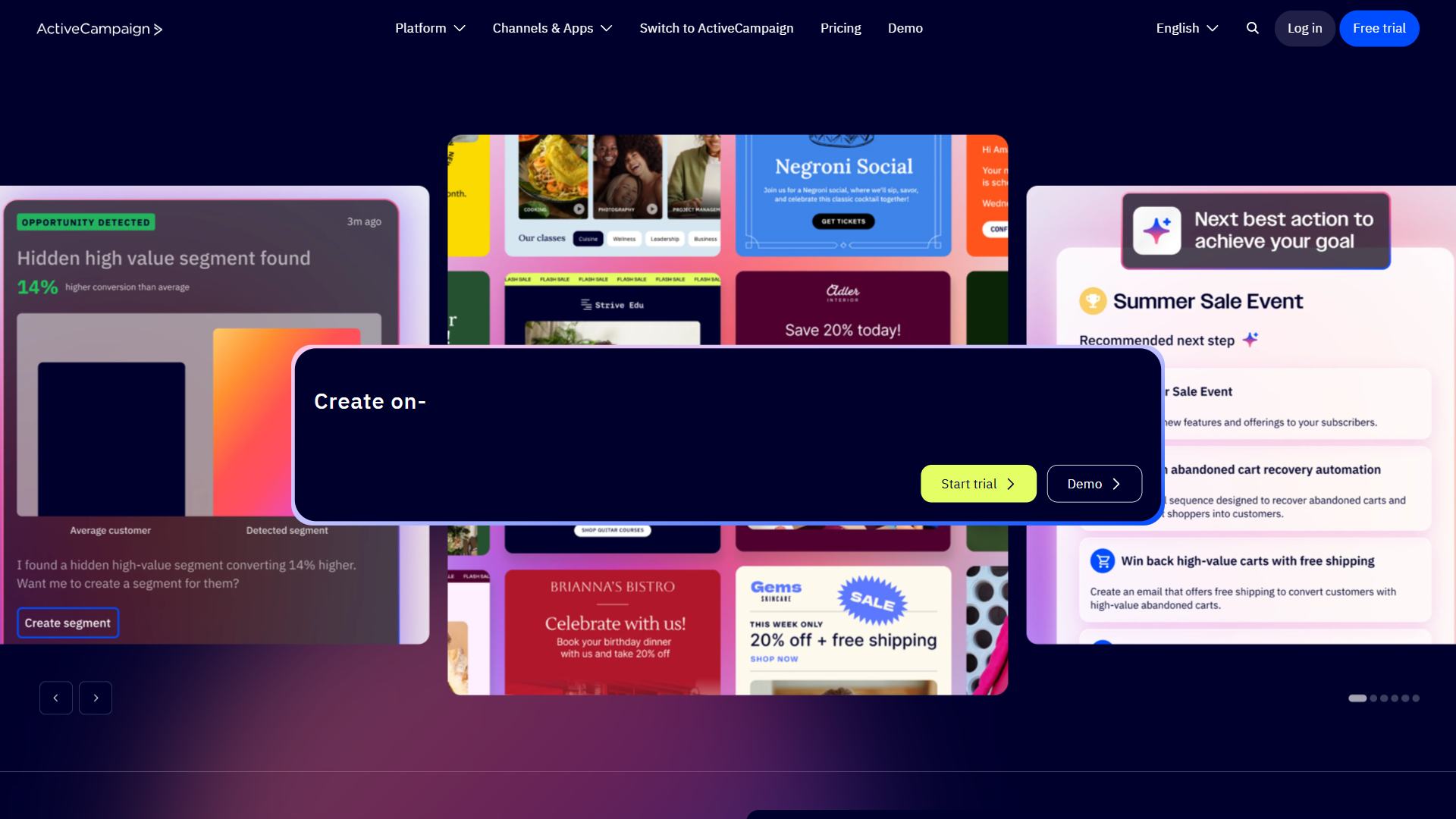
| Factor | ActiveCampaign | HubSpot |
|---|---|---|
| Starting price | $19/month | $20/month |
| Free tier | None (14-day trial) | Free Tools available |
| Automation on entry plan | Full automation on every paid plan | None on Starter; needs Professional |
| Deliverability | Ranked #1 in independent testing (around 94%) | Strong, but behind ActiveCampaign |
| CRM scope | Lighter sales CRM bolted onto email | Full multi-hub customer platform |
| AI | Active Intelligence | Breeze AI |
| Aggregate rating | ||
| Best for | Email-first marketers and SMBs | Aligned sales, marketing, and service teams |
The honest tradeoff: ActiveCampaign’s biggest drawback here is the lack of a free tier - you commit to a 14-day trial, whereas HubSpot lets you start at no cost. The rest of this ActiveCampaign vs HubSpot comparison digs into where each platform earns or loses its place.
Quick Verdict: Choose ActiveCampaign If… / Choose HubSpot If…
ActiveCampaign is the better fit for email-first marketers on a budget, while HubSpot is the better fit for aligned teams that need one shared platform. Use the checklists below to match your situation to the right tool.
Choose ActiveCampaign if:
- You are an email-first marketer, agency, or small business that wants powerful automation without an enterprise budget.
- You need full marketing automation on the cheapest paid plan, not locked behind a premium tier.
- Inbox placement matters - you want the deliverability leader.
- You want a fast learning-to-launch path for campaigns and want to compare options in our best marketing automation tools 2026 roundup.
Choose HubSpot if:
- You run aligned sales, marketing, and service teams that need one shared platform and reporting layer.
- You want a generous free tier to start and can grow into paid hubs later.
- You need deep native CRM, pipelines, ticketing, and a large app marketplace in one place.
- Budget is less of a constraint than consolidation - see HubSpot vs Salesforce if you are weighing the big platforms.
Pricing in 2026: What You’ll Actually Pay
Pricing is where this comparison usually gets decided. Here is current activecampaign pricing for 1,000 contacts:
Pricing verified June 2026 from ActiveCampaign's pricing page:
- Starter: $15/user/mo annual ($19 monthly) (1,000 contacts, 1 user)
- Email marketing
- Marketing automation (up to 5 actions per automation)
- Inline & pop-up forms
- Plus: $49/user/mo annual ($59 monthly) (1,000 contacts, 1 user)
- Everything in Starter
- Active Intelligence AI (usage limits apply)
- Unlimited automation actions
- Pro: $79/user/mo annual ($99 monthly) (1,000 contacts, 3 users)
- Everything in Plus
- Advanced segmentation
- Predictive sending (AI)
- Enterprise: $145/user/mo annual ($179 monthly) (1,000 contacts, 5+ users)
- Everything in Pro
- Premium segmentation
- Dedicated account team
And here is hubspot pricing across the four marketing-relevant tiers:
Pricing verified June 2026 from HubSpot's pricing page:
- Free Tools: $0/mo
- Free CRM for up to 2 users
- 5x Free Core Seat limit with unlimited view-only seats
- Sales, marketing, service, content, and operations tools
- Starter Customer Platform: $15/user/mo annual ($20 monthly)
- Access to all five hubs (Marketing, Sales, Service, CMS, Operations)
- 1,000 marketing contacts included
- Marketing automation basics
- Professional (Marketing Hub): $801/user/mo annual ($890 monthly)
- 2,000 marketing contacts included
- 3 core seats included
- Omnichannel marketing automation
- Enterprise (Marketing Hub): $3240/user/mo annual ($3600 monthly)
- 10,000 marketing contacts included
- 5 core seats included
- Unlimited automated emails
The headline number is the hubspot cost once you need real automation. HubSpot’s Free Tools and low Starter price look approachable, but meaningful workflow automation lives in Marketing Hub Professional. On list prices, a year on HubSpot Marketing Hub Professional (around $890/month plus a one-time $3,000 onboarding fee) runs well over $13,000 in year one, versus roughly $3,200 for ActiveCampaign Pro at $99/month. HubSpot’s Enterprise tier adds a $7,000 onboarding fee on top of its monthly cost.
It is worth being precise about what that year-one gap represents. Treat these as illustrative list prices rather than a negotiated quote - HubSpot frequently discounts, and your actual contact volume changes the math on both sides. But the structural point holds: ActiveCampaign sells you automation at the entry level, while HubSpot sells you a platform and charges platform prices once the useful features switch on. For a business measuring return per dollar of marketing spend, that difference is the whole story.
Where HubSpot falls short: the major drawback is cost escalation. Mandatory onboarding fees, marketing-contact pricing that climbs as your list grows, and automation gated behind the Professional plan mean the affordable entry price is misleading for any team that actually needs workflows. If you only need email and automation, that is a real limitation. ActiveCampaign’s Pro plan delivers comparable automation for a fraction of the spend, and even budget-focused teams eyeing MailerLite as a cheaper alternative should weigh what they give up in workflow depth - MailerLite is cheaper still, but its automation is far simpler than either platform here.
Marketing Automation: Included vs Locked Behind Pro
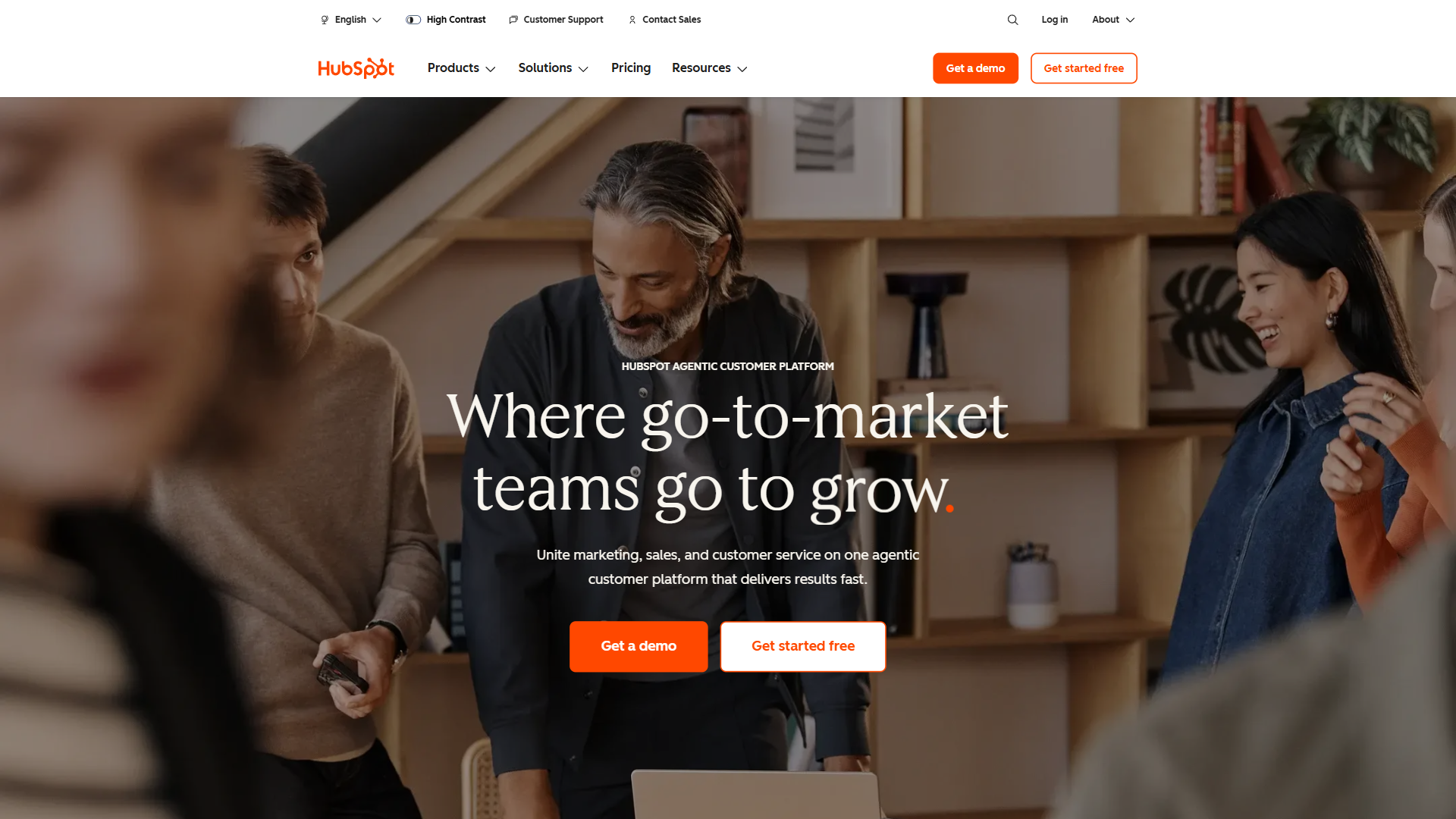
ActiveCampaign was built around automation first, and it shows. Every paid plan - starting at the Starter tier - includes the full visual automation builder, conditional logic, branching, and event triggers. There is no premium gate on the core capability.
HubSpot takes the opposite approach. Its Starter plan has no real workflow automation; you need HubSpot’s Professional plan for comparable automation. The Starter tier offers simple email follow-ups and basic task creation, but the visual workflow engine - the part that actually rivals ActiveCampaign - is reserved for Professional. That is the single biggest functional gap in this matchup, and it is why the sticker price comparison is misleading until you account for the tier you actually need.
ActiveCampaign also reports roughly 3x faster campaign creation, which compounds for teams shipping many sequences a month. Practically, that means you can build a welcome series, an abandoned-cart flow, and a re-engagement campaign on the Starter tier without an upgrade. Our automation builder guide walks through the workflow editor step by step.
ActiveCampaign limitation: the depth is a double-edged sword. The automation builder has a steeper learning curve than HubSpot’s guided setup, and first-time users can feel overwhelmed by the conditional logic. That is a genuine drawback for non-technical teams who want simple drip sequences and nothing more.
Email Marketing and Deliverability
Deliverability is the unglamorous metric that decides whether your campaigns earn revenue. In independent inbox-placement testing by EmailTooltester, ActiveCampaign ranks #1 (around 94%), well ahead of HubSpot. For email-first businesses, that placement gap compounds across every send.
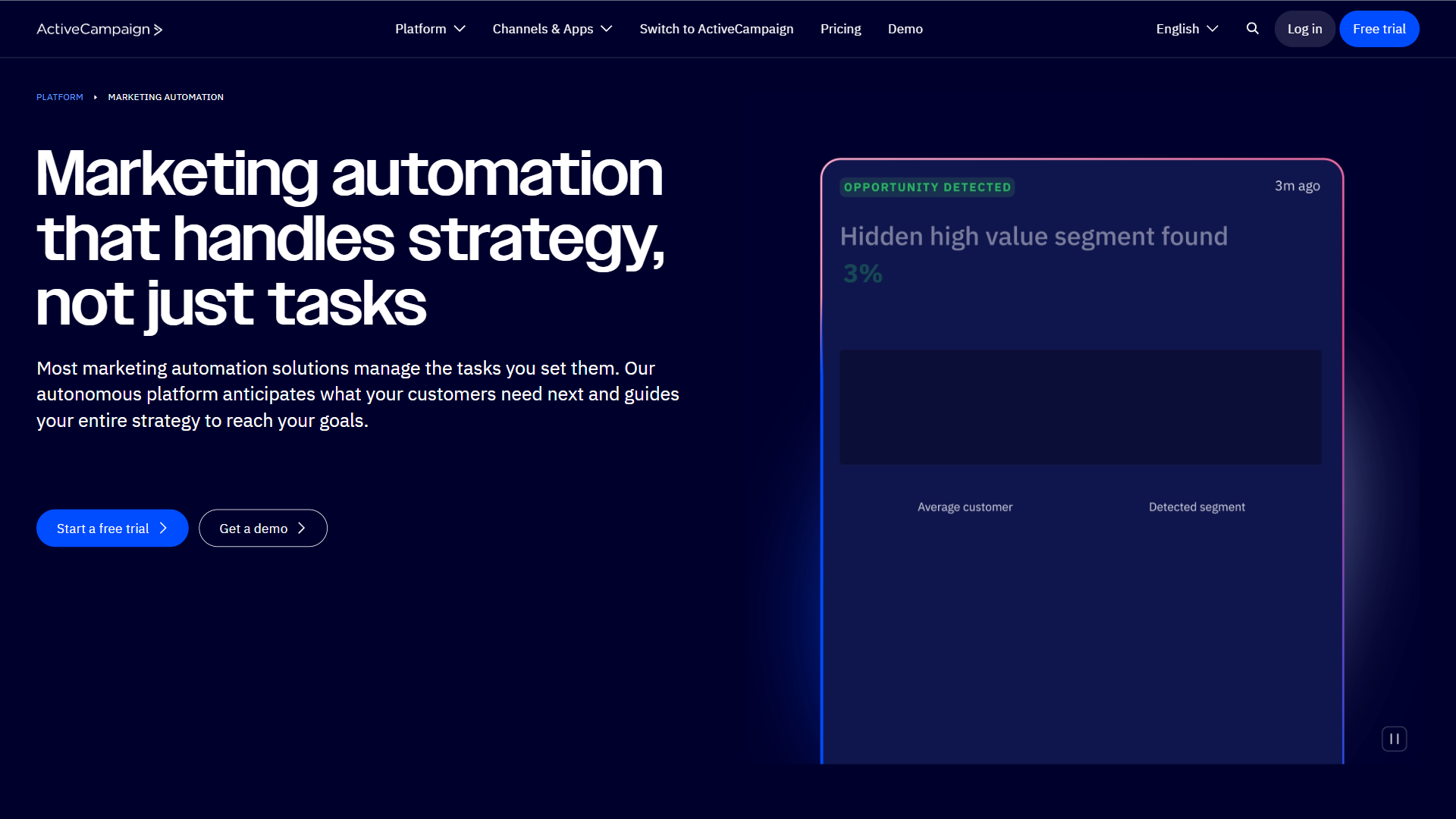
ActiveCampaign pairs that deliverability with a mature email engine built on the same automation core: segmentation, dynamic content, split testing, and predictive sending. The predictive-sending feature times each message for when a contact is most likely to open, and conditional content swaps blocks based on tags or behavior - the kind of personalization that lifts engagement without manual list-splitting. HubSpot’s email tools are solid and tightly integrated with its CRM, but deliverability is one area where the data favors ActiveCampaign rather than the bigger brand.
ActiveCampaign limitation: the email builder, while powerful, is less polished than HubSpot’s drag-and-drop editor, and template variety is narrower out of the box. Teams that prize design speed over raw deliverability may find that a minor drawback. For a closely related head-to-head, see ActiveCampaign vs Mailchimp.
CRM and Sales: Where HubSpot Pushes Back
HubSpot has the stronger CRM and sales suite, and this is where it pushes back hardest. HubSpot’s CRM is the core of a genuine multi-hub platform - deals, pipelines, ticketing, quotes, and a vast app marketplace all share one record. It is a system the entire company can run on.
ActiveCampaign’s CRM is lighter. It is an email and automation platform with a sales CRM bolted on, and that is its most significant drawback in this comparison. It handles contacts, deals, pipelines, and lead scoring competently, and it connects those records straight into automations, so a closed deal can trigger an onboarding sequence automatically. What it lacks is the surrounding apparatus - native ticketing, quotes, knowledge bases, and the deep customization HubSpot offers across hubs. If you need deep pipeline management, native ticketing, and company-wide reporting in a single tool, ActiveCampaign’s CRM will feel thin next to HubSpot’s. Our ActiveCampaign CRM setup guide shows how to make the most of what is there - lead scoring, pipelines, and task automation - but it is not a full replacement for a dedicated platform CRM.
The practical read: if marketing automation is the center of gravity, ActiveCampaign’s CRM is more than enough. If sales-and-service operations are the center of gravity, HubSpot earns the nod, and our best CRM software 2026 roundup compares it against the wider field. If you are still narrowing the field, our best marketing automation tools 2026 comparison maps where each platform fits.
AI Features: Active Intelligence vs Breeze
ActiveCampaign and HubSpot both offer mature AI features, but each scopes its assistant differently. ActiveCampaign’s Active Intelligence layers predictive sending, content generation, and automation suggestions directly into the workflow builder, so the AI serves the automation you already run.
HubSpot’s Breeze AI spans its hubs with a content assistant, prospecting agents, and AI-assisted reporting. The breadth is impressive and matches HubSpot’s all-in-one ambition - if your sales and service teams live in HubSpot, Breeze can draft outreach, summarize tickets, and surface insights across the same data your reps already use. ActiveCampaign keeps its AI closer to the marketer’s core loop instead of spreading it across departments.
ActiveCampaign drawback: Active Intelligence is narrower in scope - it is focused on email and automation rather than a company-wide AI copilot, so sales and service use cases are thinner.
HubSpot drawback: the most capable Breeze features are concentrated in higher tiers, so the AI you can actually use is a limitation of your plan and budget rather than a flat capability. As with automation, the value depends on how much you are willing to pay. If AI-assisted marketing is a priority, weigh both against the field in our best marketing automation tools 2026 guide.
Reporting and the All-in-One Question
HubSpot offers the stronger reporting and all-in-one analytics, a real advantage that deserves a fair concession. HubSpot ships more out-of-the-box reporting dashboards, cross-hub attribution, and a unified analytics layer that connects marketing, sales, and service in one view. For leadership teams that want a single source of truth, that is genuinely valuable. A revenue leader can open one dashboard and trace a lead from first touch through closed deal to support ticket without stitching tools together - that end-to-end visibility is exactly what an all-in-one platform is meant to deliver, and HubSpot does it well.
ActiveCampaign limitation: reporting is its weaker side. It offers fewer prebuilt dashboards than HubSpot and leans on automation and campaign reporting rather than company-wide analytics. Teams that need rich, cross-department reporting out of the box will find this a notable drawback - it is the clearest example of HubSpot being a full platform while ActiveCampaign stays focused on marketing.
Real Results: Switching Between the Two
Migration stories cut through the spec sheets. According to ActiveCampaign, the art-platform Artivive “grew from 100 to 100,000 users after the switch” from HubSpot - a proof point the vendor highlights for automation-led growth. Many teams move from a basic email tool to ActiveCampaign specifically to unlock automation without the enterprise price tag.
That said, switching is not friction-free, and ActiveCampaign falls short in places. Support reviews are mixed - some users praise responsiveness while others report slow resolution on complex issues, a recurring drawback in third-party feedback. The learning curve is also a real limitation during onboarding, since the automation depth that makes ActiveCampaign powerful takes time to master. Budget a week or two to map your existing flows, set up tags and lists deliberately, and lean on templates before building from scratch. Our ActiveCampaign getting started guide is designed to shorten that ramp.
If you are coming from HubSpot, expect to rebuild workflows rather than lift-and-shift them, since the automation models differ. HubSpot organizes logic around its CRM objects, while ActiveCampaign organizes it around contact tags and events, so the mental model shifts even when the end result is the same. Plan the migration in stages - move your highest-value automations first, verify deliverability with a small send, then port the rest.
The Bottom Line
ActiveCampaign is the better pick for most marketers and small businesses in this ActiveCampaign vs HubSpot matchup. It includes full automation on every paid plan, ranks first for deliverability, and costs a fraction of HubSpot’s automation tier - the value gap is decisive when marketing automation is your priority. Ready to try it? You can start an ActiveCampaign trial and test the automation builder against your own use case.
Choose HubSpot if you genuinely need an all-in-one platform - aligned sales, marketing, and service teams running on one shared CRM with deep reporting, and a budget that absorbs Professional-tier pricing plus onboarding fees. For that buyer, HubSpot’s breadth justifies the cost, and ActiveCampaign’s lighter CRM would be a real limitation. For everyone focused on email and automation, ActiveCampaign delivers more capability per dollar - and that is most marketers and small businesses, which is why it earns our recommendation here. Run the 14-day trial against your own list and workflows before committing either way; the platform that fits your actual process, not the one with the biggest brand, is the right call.
Frequently Asked Questions
Is HubSpot better than ActiveCampaign?
HubSpot is better for companies that need one all-in-one platform uniting marketing, sales, and service with deep CRM and reporting. ActiveCampaign is better for email-first marketers who want full automation and top deliverability at a much lower price. The right answer depends on whether you prioritize platform breadth or automation value.
Who is HubSpot’s biggest competitor?
HubSpot’s biggest competitor is Salesforce among enterprise CRM platforms, while ActiveCampaign, Mailchimp, and Klaviyo compete with it in marketing automation and email. For small and midsize teams choosing a marketing-led platform, the HubSpot vs ActiveCampaign decision is the most common one, because ActiveCampaign offers comparable automation at a fraction of the cost.
Is ActiveCampaign a good CRM?
ActiveCampaign is a good CRM for marketing-led teams, offering lead scoring, pipelines, and task automation tightly linked to its email engine. However, it is lighter than a full platform like HubSpot, so its main limitation is depth for large sales-and-service operations. For automation-centric businesses, its CRM is more than sufficient.
Is ActiveCampaign cheaper than HubSpot?
Yes, ActiveCampaign is significantly cheaper than HubSpot once automation is required. HubSpot gates real workflow automation behind its Professional plan, while ActiveCampaign includes full automation on every paid plan. On list prices, a year of ActiveCampaign Pro costs roughly a quarter of comparable HubSpot Marketing Hub Professional with onboarding fees.
Related Reading
- ActiveCampaign review and pricing
- HubSpot review and pricing
- ActiveCampaign vs Mailchimp
- Best CRM software 2026
- HubSpot vs Salesforce
External Resources
- EmailTooltester deliverability test - independent inbox-placement testing
- ActiveCampaign vs HubSpot official comparison
- HubSpot Marketing Hub pricing