

ActiveCampaign is the stronger email marketing platform for growing businesses that need deep automation and a built-in CRM, while Mailchimp is the better pick for beginners, tiny lists, and the lowest budgets. This comparison breaks down pricing, ease of use, automation, deliverability, CRM, multichannel, and AI so you can choose with confidence.
ActiveCampaign vs Mailchimp at a Glance (2026)
ActiveCampaign and Mailchimp are the two email marketing platforms most growing businesses compare in 2026. ActiveCampaign wins on automation depth, a real built-in CRM, and inbox deliverability, making it the stronger choice for businesses that want to scale. Mailchimp wins on its free tier, beginner-friendly editor, and lower entry price, making it ideal for newcomers and simple newsletters. Each comes with real tradeoffs: ActiveCampaign’s power adds a learning curve and a higher price, while Mailchimp’s simplicity means shallower automation and a thinner CRM.
The short version: if email is a serious revenue channel, ActiveCampaign gives you more horsepower. If you are sending your first newsletter on a tight budget, Mailchimp gets you live faster. The ActiveCampaign vs Mailchimp decision usually comes down to how much automation and CRM depth you need versus how fast and cheaply you want to start. If you are still shortlisting tools, our roundup of the best email marketing platforms 2026 puts both in wider context. The table below summarizes how the two platforms stack up across the factors that matter most.
| Factor | ActiveCampaign | Mailchimp |
|---|---|---|
| Starting price | $19/month (Starter, 1,000 contacts) | $13/month (Essentials, 500 contacts) |
| Free tier | No (14-day trial) | Yes (up to 250 contacts) |
| Automation | 900+ recipes, 75+ triggers | ~100 templates, fewer triggers |
| Deliverability | Ranked #1 in independent testing | Strong, but below AC |
| CRM | Full sales CRM and pipelines | Basic contact management |
| SMS/WhatsApp | Native SMS and WhatsApp | Limited SMS add-on |
| AI | Active Intelligence suite | Lighter AI assistant |
| Best for | Growing businesses, automation | Beginners, simple newsletters |
Quick Verdict: Choose ActiveCampaign If… / Choose Mailchimp If…
ActiveCampaign is the right call for teams that need automation depth, a sales CRM, and top deliverability, while Mailchimp is the better fit for beginners who want a free plan and the simplest possible start. The two checklists below make the decision concrete, and our ActiveCampaign review covers the platform in more depth.
Choose ActiveCampaign if you:
- Want deep, multi-step automation with conditional logic and 75+ triggers
- Need a built-in CRM with lead scoring and sales pipelines
- Treat deliverability and inbox placement as a priority
- Plan to add SMS or WhatsApp to your campaigns
- Are migrating off a basic tool and expect to scale
Choose Mailchimp if you:
- Are brand new to email marketing and want the gentlest learning curve
- Have a very small list and want a genuine free plan
- Mostly send simple newsletters or occasional broadcasts
- Value an enormous template library and a familiar, trusted brand
- Need an all-in-one starter feel without configuring much
Pricing in 2026: What You’ll Actually Pay
Pricing is where most people start, so let’s get specific. Both platforms charge by contact count, but they count contacts very differently - and that difference can flip the “Mailchimp is cheaper” assumption on its head.
Here is ActiveCampaign’s current pricing pulled from verified data:
Pricing verified June 2026 from ActiveCampaign's pricing page:
- Starter: $15/user/mo annual ($19 monthly) (1,000 contacts, 1 user)
- Email marketing
- Marketing automation (up to 5 actions per automation)
- Inline & pop-up forms
- Plus: $49/user/mo annual ($59 monthly) (1,000 contacts, 1 user)
- Everything in Starter
- Active Intelligence AI (usage limits apply)
- Unlimited automation actions
- Pro: $79/user/mo annual ($99 monthly) (1,000 contacts, 3 users)
- Everything in Plus
- Advanced segmentation
- Predictive sending (AI)
- Enterprise: $145/user/mo annual ($179 monthly) (1,000 contacts, 5+ users)
- Everything in Pro
- Premium segmentation
- Dedicated account team
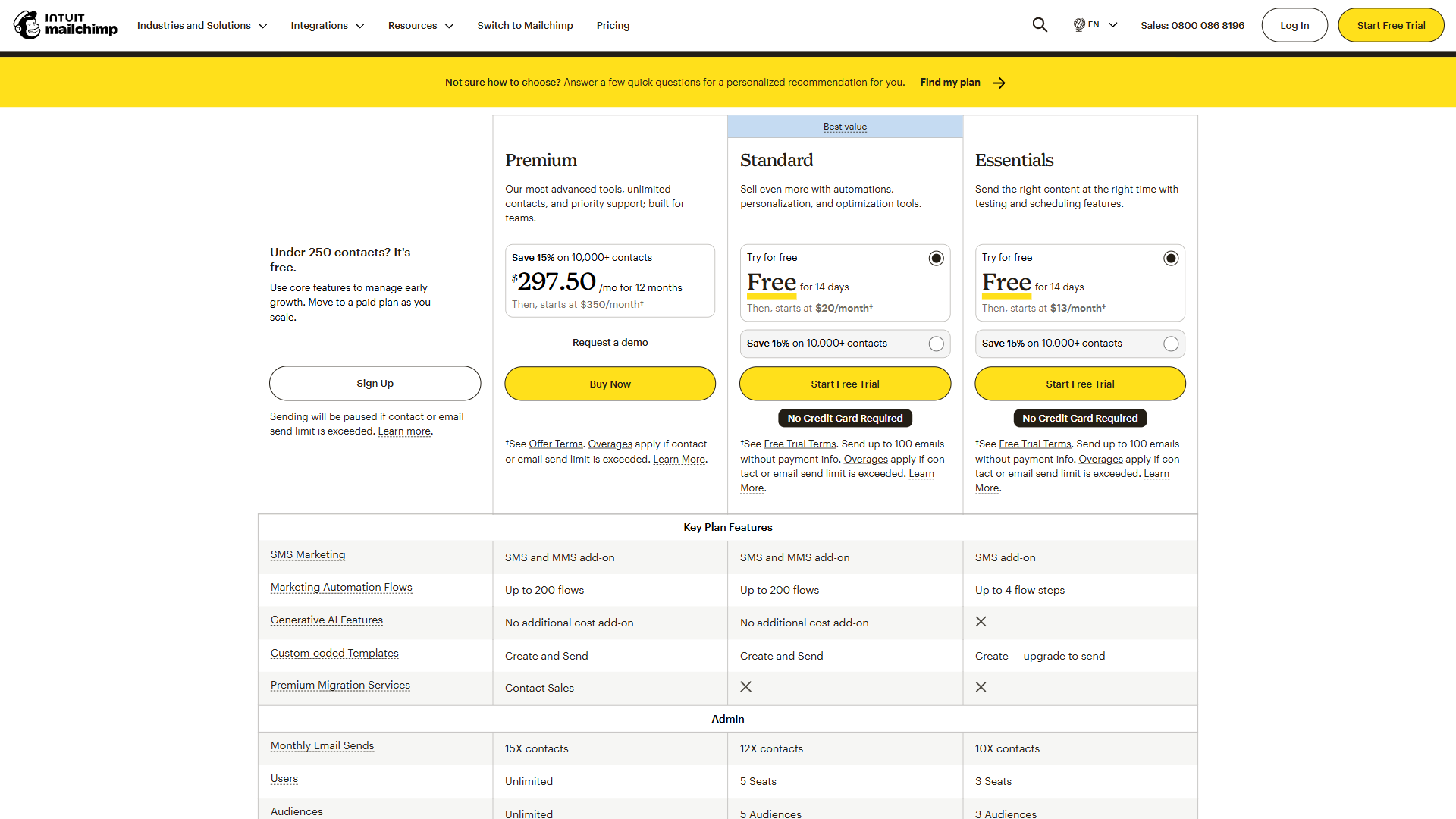
And here is Mailchimp’s pricing for the same comparison:
Pricing verified April 2026 from Mailchimp's pricing page:
- Free: $0/mo (Up to 250 contacts, 1,000 monthly sends (500 daily))
- Basic marketing CRM
- Website builder
- Forms & landing pages
- Essentials: $13/user/mo (Up to 50,000 contacts, 10x contact limit sends)
- Pre-built email templates
- Marketing automation flows (Customer Journey Builder)
- A/B testing
- Standard: $20/user/mo (Up to 100,000 contacts, 12x contact limit sends)
- Intuit Assist (Write with AI, Creative Assistant, Content Optimizer)
- AI-generated automation flows
- Send time & send day optimization
- Premium: $350/user/mo (10,000-250,000 contacts, 15x contact limit sends)
- All Standard features (full Intuit Assist access)
- Advanced segmentation
- Multivariate testing
On paper, Mailchimp looks cheaper. Its Essentials plan starts at $13/month and it offers a free plan for up to 250 contacts, while ActiveCampaign’s Starter plan starts at $19/month for 1,000 contacts with no free tier (just a 14-day trial). For a first-time sender, that gap is real, and it is the main reason beginners pick Mailchimp.
But the headline hides a billing detail that matters. Mailchimp can count the same contact more than once. If a single subscriber sits in two or more audiences, Mailchimp may bill you for each instance of that person, inflating the contact count you pay for. ActiveCampaign bills on unique contacts - one person is one contact, no matter how many lists, tags, or segments they belong to. As your data grows and contacts naturally land in multiple groups, your effective mailchimp cost can climb faster than the sticker price suggests, which narrows or even erases the apparent savings.
So the honest read on activecampaign pricing vs mailchimp pricing is this: Mailchimp is cheaper at the entry point and unbeatable at zero contacts on the free plan, but ActiveCampaign’s unique-contact model can be more economical at scale. If you want to dig deeper, ActiveCampaign’s pricing page breaks down each tier. Budget-focused readers comparing Mailchimp vs Klaviyo and other rivals should also know that MailerLite is a popular lower-cost alternative worth a quick look before committing.
Where ActiveCampaign falls short (the main drawbacks): the entry price is higher than Mailchimp’s, and there is no free tier at all - only a 14-day trial - so there is no permanently free way to test it on a live list. Costs also climb as your contact count grows, and crossing tier thresholds can produce a noticeable jump in your bill, so it pays to forecast your list growth before committing. If you do switch, our ActiveCampaign getting started guide walks through the initial account setup.
Ease of Use and Onboarding
Mailchimp is the easier platform to learn, and it would be dishonest to pretend otherwise. Mailchimp was built for people who have never sent a marketing email, and it shows. Based on user reviews, most beginners can sign up, build a template, and send their first campaign in roughly 30 minutes. The drag-and-drop editor is forgiving, the onboarding wizard holds your hand, and the defaults are sensible.
ActiveCampaign is more powerful, and that power comes with a steeper initial climb. There are more settings, more automation options, and more decisions to make on day one. Analysis shows the learning curve is the most common complaint from new ActiveCampaign users - not that features are missing, but that there are so many of them.
The tradeoff is straightforward. Mailchimp optimizes for time-to-first-send; ActiveCampaign optimizes for what you can do once you are up and running. If you value a frictionless first hour above all else, Mailchimp is the better onboarding experience. If you are willing to invest a weekend to unlock far more capability, ActiveCampaign rewards that effort.
Marketing Automation: 900+ Recipes vs Basic Workflows
Automation is the single biggest reason businesses move from Mailchimp to ActiveCampaign. The difference is not subtle.
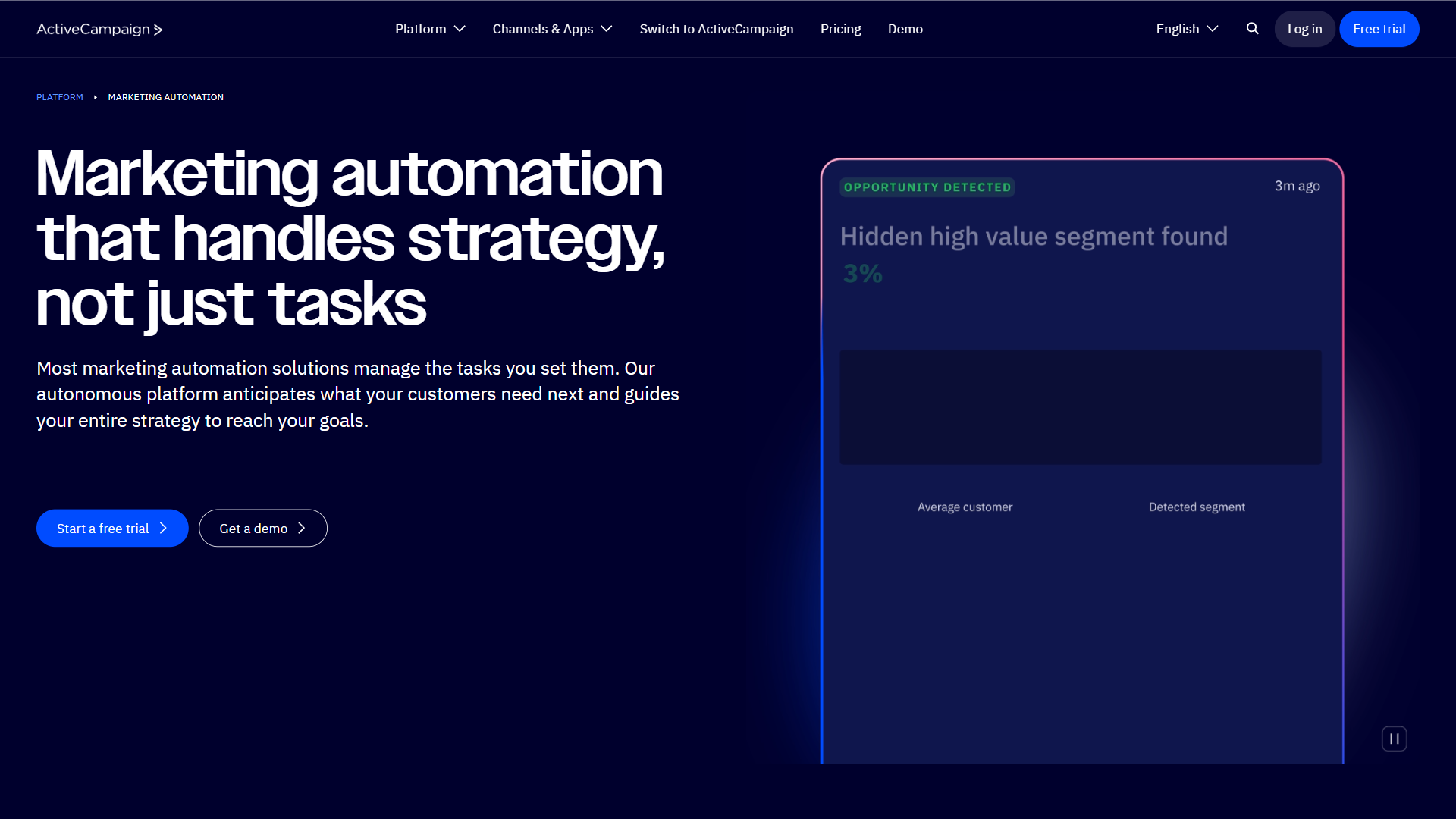
ActiveCampaign provides far deeper automation: 900+ pre-built automation recipes and 75+ triggers that you can chain into multi-step, branching workflows. Its automation builder uses a visual canvas where you can add conditional splits, wait steps, goal tracking, and CRM actions all in one flow. You can, for example, watch a contact’s behavior on your site, score them, wait for a trigger, branch based on whether they opened an email, and hand them to a salesperson - without leaving the builder.
Mailchimp offers automation too, but it is lighter: roughly 100 pre-built journey templates and fewer than 35 triggers, versus ActiveCampaign’s 75+ triggers. It handles the essentials - welcome series, abandoned cart, basic date-based sends - well enough for simple needs. Where it struggles is complex, conditional logic that adapts to each contact’s behavior across channels.
Where Mailchimp falls short: its automation depth is shallow - you get basic if/else branching rather than the deep, multi-condition logic ActiveCampaign offers - and you need to be on the Standard tier before real automation unlocks at all, so the cheapest paid plan will not get you there. If your marketing is mostly broadcasts and a welcome email, Mailchimp’s automation is fine. If you want lifecycle marketing that reacts to real behavior, the gap is decisive. Our ActiveCampaign automation builder guide walks through building your first advanced workflow step by step, and the predictive sending guide shows how AI picks the optimal send time per contact.
Email Deliverability: The Independent Test Data
ActiveCampaign delivers stronger inbox placement than Mailchimp, reaching about 94% versus roughly 89% in independent testing. Deliverability is the quiet factor that separates platforms, and it is hard to measure yourself - which is why third-party data matters more than any vendor claim.
In independent inbox-placement testing by EmailTooltester, ActiveCampaign ranks #1 (around 94% inbox placement), ahead of Mailchimp at roughly 89% - a gap of about 5% in the same test. That advantage is not a marketing slogan; it comes from a third party that repeatedly sends seed campaigns across major inbox providers and records where messages land.
What does a deliverability edge actually buy you? If you send to 10,000 contacts, even a few percentage points more in the inbox means hundreds of additional people who actually see your message. Over a year of campaigns, that compounds into real revenue. Mailchimp’s deliverability is still respectable and good enough for most casual senders, but the data gives ActiveCampaign the edge for businesses where every open counts. The honest limitation here is that strong deliverability still depends on your own list hygiene - neither platform can rescue a neglected list with bad addresses and low engagement. ActiveCampaign documents its approach on its email deliverability page, and our deliverability guide covers the authentication and list-hygiene steps that protect your sender reputation.
CRM, Lead Scoring, and Sales Pipeline
ActiveCampaign provides a full sales CRM, while Mailchimp offers only basic contact management - the two platforms are not really playing the same sport here.
ActiveCampaign includes a full sales CRM. You get visual deal pipelines, lead and contact scoring, task management, and the ability to trigger automations from sales activity. Marketing and sales share one contact record, so a lead’s email behavior, site visits, and deal stage all live in the same place. For a small or mid-sized business that wants marketing automation and a lightweight sales CRM without buying two products, that integration is a genuine advantage.
Mailchimp’s CRM is basic by comparison. It offers contact management, tags, and audience insights, but it is not a sales pipeline tool. There is no native deal-stage tracking or lead scoring of the depth ActiveCampaign provides. For a pure newsletter sender, that is no loss. For a business trying to turn subscribers into closed deals, it means bolting on a separate CRM. The drawback of ActiveCampaign’s all-in-one model is the reverse: its CRM, while genuinely useful, is lighter than a dedicated sales platform, so sales-led teams with very complex pipelines may find it limited.
If your email list is also your sales pipeline, ActiveCampaign’s combined approach removes a whole category of integration headaches.
Multichannel: Native WhatsApp and SMS
Email is no longer the only channel that matters, and this is a clear ActiveCampaign differentiator.
ActiveCampaign offers native SMS and WhatsApp, so you can add a text message or WhatsApp message as a step inside the same automation that sends your emails. A contact who ignores an email can get a follow-up SMS; a cart-abandoner can get a WhatsApp nudge - all orchestrated from one workflow (our ActiveCampaign SMS marketing guide shows how to set this up). ActiveCampaign also connects to 900+ integrations, so it slots into most existing stacks without custom development.
Mailchimp’s multichannel story is thinner. It has historically focused on email, with SMS available in a more limited capacity and no comparable native WhatsApp automation. For brands that want true cross-channel journeys rather than email-only campaigns, ActiveCampaign is built for it out of the box. Mailchimp’s limitation here is its email-first focus; if SMS or WhatsApp are core to your strategy, it is not ideal for that use case.
AI Features Compared (2026)
ActiveCampaign offers deeper AI than Mailchimp, though both platforms have leaned into it at different depths.
ActiveCampaign’s Active Intelligence suite is the more ambitious offering. It includes an AI campaign and automation builder that can scaffold a full workflow from a prompt, plus predictive sending that uses each contact’s engagement history to pick the optimal send time per person. The aim is to remove the guesswork from both what you build and when you send it.
Mailchimp also offers AI, but it is lighter - geared mainly toward content assistance such as subject-line suggestions and copy generation, as outlined on its features page, rather than the deeper automation-building and per-contact predictive timing that ActiveCampaign emphasizes. For most users, the practical difference is that ActiveCampaign’s AI helps you build and optimize campaigns, while Mailchimp’s AI mostly helps you write them. Our ActiveCampaign AI features guide covers how to put Active Intelligence to work. The drawback of ActiveCampaign’s richer AI is that some Active Intelligence capabilities carry usage limits and are reserved for higher tiers, so the cheapest plan does not unlock everything.
Real Results: Switching From Mailchimp to ActiveCampaign
Migrations from Mailchimp are common enough that it is worth looking at what businesses report after switching - while being clear these are ActiveCampaign’s own figures, not independent measurements.
According to ActiveCampaign, businesses that switched from Mailchimp such as UN|HUSHED saw a 238% increase in open rates. ActiveCampaign reports it handles 600+ migrations from Mailchimp every month, which it attributes to customers outgrowing Mailchimp’s automation ceiling and wanting deeper segmentation, CRM, and deliverability.
Take vendor case-study numbers with appropriate caution - they reflect successful customers, not a controlled trial. Still, the volume of migrations and the consistent themes (automation depth, deliverability, unique-contact billing) line up with the structural differences this comparison has already covered. If you are weighing a move, our Mailchimp to ActiveCampaign migration guide explains how to bring your lists, tags, and automations across without losing data.
The ActiveCampaign vs Mailchimp switch is not friction-free, though. Where ActiveCampaign falls short here (a real drawback): support quality gets mixed reviews, with some users reporting slow responses on lower tiers, so the steeper learning curve is not always offset by fast help when you get stuck. Budget for some self-directed setup time rather than assuming hand-holding.
For reference, here is how each platform rates across aggregated review sources:
ActiveCampaign:
Mailchimp:
The Bottom Line
ActiveCampaign is the better email marketing platform in 2026 for most growing businesses. It offers far deeper automation, a real built-in CRM with lead scoring, native SMS and WhatsApp, top-ranked deliverability in independent testing, and a more capable AI suite. The unique-contact billing model also means its pricing can compare more favorably than the headline numbers suggest once your contacts spread across multiple segments. If email is a real revenue channel for you, the extra capability pays for itself.
The cleanest path is to test it on your own list. You can start your ActiveCampaign trial or switch from Mailchimp and run a few real campaigns before deciding.
That said, be honest with yourself about where you are. Stick with Mailchimp if you are a true beginner who values the gentlest possible onboarding, if you have a very small list and need a free plan today, or if your needs genuinely begin and end with simple newsletters. Mailchimp’s free tier, ease of use, brand familiarity, and template library are real strengths, and for the right user they are exactly enough. As your automation, CRM, and deliverability needs grow, that is the moment ActiveCampaign starts to pull clearly ahead. Ultimately, the ActiveCampaign vs Mailchimp choice is less about which tool is “better” in the abstract and more about which stage your email program is in right now.
Frequently Asked Questions
Is ActiveCampaign better than Mailchimp?
For growing businesses, ActiveCampaign is generally better thanks to deeper automation, a built-in CRM, native SMS and WhatsApp, and top-ranked deliverability in independent EmailTooltester testing. Mailchimp is better for beginners, very small lists, and simple newsletters because of its free tier and easier onboarding. The right choice depends on your needs and budget.
Who is Mailchimp’s biggest competitor?
ActiveCampaign is widely regarded as Mailchimp’s biggest competitor in the marketing automation space, offering far deeper workflows, a real sales CRM, and stronger deliverability. Other notable competitors include MailerLite for budget-conscious users and several all-in-one platforms. ActiveCampaign reports it handles 600+ migrations from Mailchimp every month, underlining the rivalry.
What is the weakness of Mailchimp?
Mailchimp’s main weaknesses are shallow automation compared with ActiveCampaign, a basic CRM without true sales pipelines or deep lead scoring, and a billing model that can count the same contact multiple times across audiences. Its deliverability is solid but ranks below ActiveCampaign in independent testing. For complex, behavior-driven campaigns, these limits become significant.
Does Mailchimp charge for the same contact twice?
Yes, Mailchimp can charge for the same contact more than once. If one subscriber sits in multiple audiences, Mailchimp may count each instance separately, inflating the contact total you pay for. ActiveCampaign bills on unique contacts, so one person counts once regardless of how many lists, tags, or segments they belong to.
Related Reading
- ActiveCampaign review and pricing
- Mailchimp review and pricing
- Mailchimp alternatives in 2026
- Mailchimp vs Klaviyo: which email platform wins
- Best email marketing platforms 2026
External Resources
- EmailTooltester email deliverability test - independent inbox-placement testing
- ActiveCampaign vs Mailchimp official comparison
- Mailchimp Help Center