



TL;DR: Which Should You Choose?
Perplexity vs Claude is one of the most common comparisons in this category, alongside the wider debate against ChatGPT and the broader 2026 AI-assistant landscape. Perplexity and Claude take different approaches to solving similar problems, and the right choice depends on your workflow, budget, and team size. This guide compares both tools across the features that actually matter for daily work.
The perplexity vs claude research debate comes down to a simple split. Use Perplexity when you need real-time information with verifiable sources. Use Claude when you need deep analysis, complex reasoning, or working with large documents.
Most serious researchers end up using both.
| Feature | Perplexity | Claude |
|---|---|---|
| Real-time web search | Built-in with citations | Pro/Max only, no inline citations |
| Context window | Conversation-based | 200K tokens (1M beta) |
| Best for | Fact-finding, current events | Deep analysis, document review |
| Citation quality | Inline with clickable sources | Research mode available |
| Pricing | $20/mo Pro, $200/mo Max | $20/mo Pro, $100/mo Max |
| Rating |
Perplexity vs Claude: Head-to-Head Feature Comparison
Both tools have evolved dramatically in 2026, and this perplexity vs claude research comparison reveals how each has carved out distinct territory in the AI landscape - territory readers also weigh against Gemini and Grok when shortlisting. Understanding their core differences helps you choose the right tool for each research task.
The Fundamental Difference
Perplexity is a search engine that thinks. Every response comes with numbered citations you can click to verify. It searches the live web, academic papers, Reddit discussions, SEC filings, and more, synthesizing information from dozens of sources into coherent answers - the architecture behind this approach is documented in the Perplexity getting-started guide, which explains how its retrieval-augmented generation pipeline differs from a traditional LLM.
Claude is a reasoning engine that researches. Built on Constitutional AI principles, Claude excels at analyzing information you provide, drawing insights from massive documents, and maintaining complex chains of logic across extended conversations. The full feature set is laid out in the Anthropic documentation, including guidance on long-context prompts and tool use.
Think of it this way: Perplexity finds information; Claude understands it.
Tradeoffs at a glance: Perplexity’s drawbacks include shallower reasoning, no persistent project memory, and pricier Max tier ($200 per month). Claude’s drawbacks include weaker live web citations, no source-type focus modes, and stricter rate limits at the $20 Pro tier. Skip Perplexity if your work is dialogue-heavy synthesis; skip Claude if every claim must link to a verifiable URL.
Research Capabilities Deep Dive
Information Retrieval
Perplexity shines when you need current, verifiable information:
- Real-time web access: Searches the live internet, not a training cutoff
- Inline citations: Every claim links to its source [1], [2], [3]
- Focus modes: Filter by academic papers, Reddit, YouTube, news, or SEC filings
- Pro Search: Synthesizes 20+ sources into comprehensive answers
- Deep Research: Creates multi-page reports with 50+ citations
Claude takes a different approach:
- Research mode (Pro/Max): Can search the web but without Perplexity’s citation granularity
- Document analysis: Upload PDFs, entire codebases, or research papers
- 200K context window: Analyze 150,000+ words in a single conversation - the context window documentation explains how Claude prioritizes information across long inputs
- Cross-reference capability: Connect insights across multiple uploaded documents
Reasoning Quality
This is where Claude pulls ahead. Constitutional AI training produces more nuanced, thoughtful analysis:
- Complex logical chains: Claude maintains coherent arguments across extended exchanges
- Reduced hallucinations: More likely to acknowledge uncertainty than fabricate
- Nuanced interpretation: Better at understanding context, subtext, and implications
- Code analysis: Opus 4.5 scores 80%+ on SWE-bench for technical documentation review
Perplexity’s reasoning is competent but more surface-level. It excels at gathering and summarizing, not at deep interpretive analysis.
Limitations on both sides: Perplexity’s biggest drawback is shallow synthesis - it stitches sources together but rarely produces a true thesis. Claude’s biggest drawback is web-search granularity - the citations it does provide are less consistent than Perplexity’s inline numbered links, and it cannot filter by source type (academic, Reddit, SEC). Skip whichever tool’s weakness blocks your specific research workflow.
Perplexity Strengths: When Citations Matter
The Citation Advantage
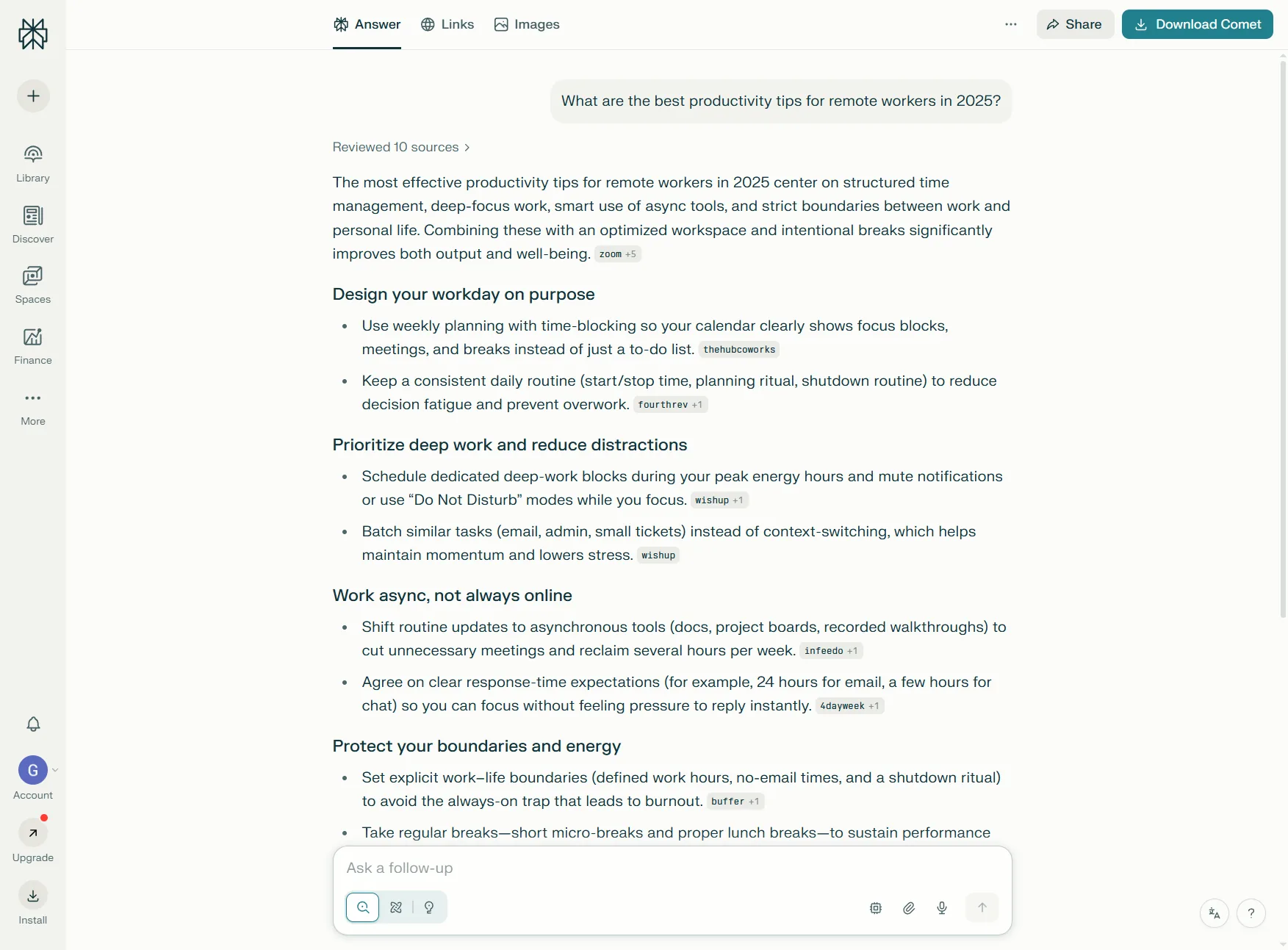
Perplexity’s killer feature is transparency. Every answer includes clickable citations that link directly to source material. This transforms AI from a black box into a verifiable research assistant.
Why this matters for researchers:
- Audit trail: Know exactly where information came from
- Fact-checking: Verify claims in seconds, not minutes
- Academic credibility: Citations you can actually include in papers
- Source quality assessment: See whether you’re getting peer-reviewed journals or SEO content farms
Focus Modes for Specialized Research
Perplexity lets you filter searches by source type:
- Academic: Only peer-reviewed papers and scholarly sources
- Reddit: Community discussions and firsthand experiences
- YouTube: Video content and transcripts
- News: Recent articles from verified news outlets
- SEC filings: Company financial reports and regulatory documents
This filtering alone saves hours of manual source curation.
Multi-Model Flexibility
Pro subscribers can switch between AI models mid-conversation:
- GPT-5 for general queries
- Claude 4 for nuanced writing tasks
- Gemini 2.5 for multimodal analysis
- o3-pro and Claude Opus 4.5 on the Max tier for frontier reasoning
This flexibility means you’re never locked into one model’s limitations.
Limitations and who it’s not for: Perplexity is not a deep reasoning engine. Skip Perplexity if you need long-form analysis, multi-document synthesis, or persistent project memory across sessions - it loses context aggressively and treats each thread as a separate fact-finding mission. The drawbacks include occasional citation hallucinations (links exist but do not say what Perplexity claims), a Max tier ($200 per month) that is hard to justify against Claude Max ($100), and limited code-analysis depth compared to Claude Opus on technical reviews.
Claude Strengths: When Depth Matters
The Context Window Advantage
Claude’s 200K token context window (1M in beta for Sonnet 4.5) is a research superpower. You can:
- Analyze entire research papers without chunking
- Review complete codebases for technical documentation
- Compare multiple documents in a single conversation
- Maintain context across complex, multi-session research projects
For literature reviews or technical deep-dives, this capability has no equivalent in Perplexity.
Projects: Persistent Research Memory
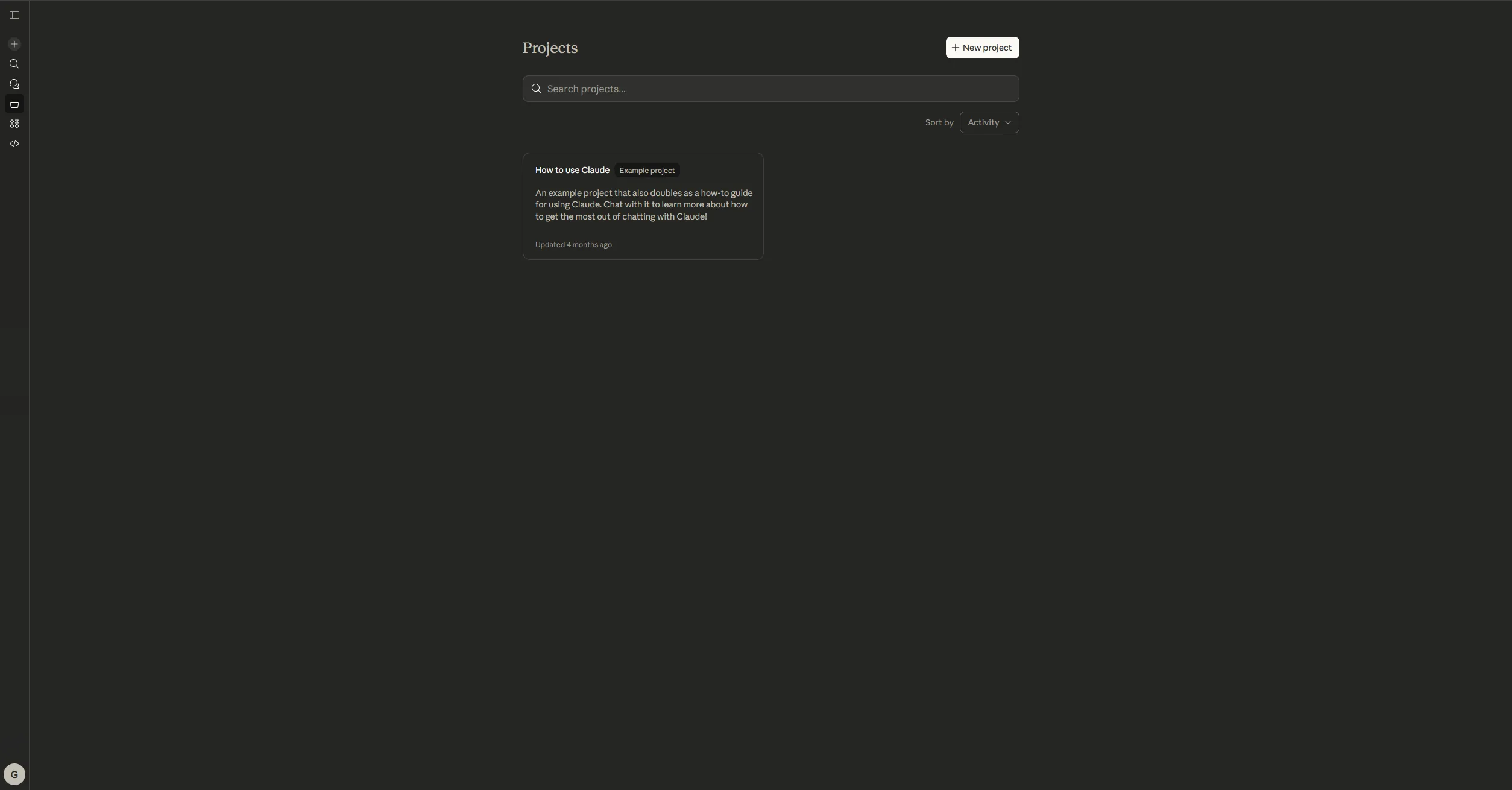
Claude’s Projects feature creates dedicated workspaces with:
- 200K token persistent context: Your research notes survive across sessions
- Role-based permissions: Share projects with collaborators (view/edit access)
- Document uploads: Build a knowledge base Claude remembers
- Team collaboration: Multiple researchers working from shared context
This is fundamentally different from Perplexity’s conversation-by-conversation approach.
Superior Reasoning for Complex Analysis
Claude’s Constitutional AI training produces demonstrably better outputs for:
- Synthesizing contradictory sources: Weighing evidence, not just summarizing
- Identifying gaps in research: Noting what’s missing, not just what’s present
- Theoretical frameworks: Applying concepts across domains
- Critical analysis: Questioning assumptions and methodology
When you need to understand information, not just find it, Claude excels.
Privacy-First Architecture
For sensitive research, Claude offers stronger guarantees:
- Data not used for training: Your conversations stay yours
- Enterprise compliance: SOC 2, audit logs, custom retention
- Project-level permissions: Control who sees what
Perplexity’s privacy practices are reasonable, but Claude’s architecture is built for enterprise-grade data protection.
Limitations and who it’s not for: Claude is not a substitute for a real-time research engine. Skip Claude if your work depends on minute-by-minute current events, SEC filings on the day they drop, or source-type-filtered search - Perplexity beats it cleanly on all three. The drawbacks also include strict rate limits on the $20 Pro tier (heavy users hit them in long Opus sessions), no built-in source-type focus modes, and a “Research” mode that produces fewer inline citations than Perplexity Pro Search.
Interface Comparison
Perplexity’s Interface Philosophy
- Search-first design: Query box front and center
- Citation prominence: Numbered sources visible in every response
- Focus mode selector: Easy filtering by source type
- Model switcher: Change AI models without starting new conversations
- Thread organization: Conversations grouped by topic
Claude’s Interface Philosophy
- Conversation-first design: Extended dialogue without interruption
- Artifacts panel: Code, documents, and visualizations appear alongside chat
- Projects sidebar: Quick access to persistent research contexts
- Clean, minimal UI: Focus on the exchange, not the interface
- MCP integrations: Connect to external tools and data sources via the Model Context Protocol
The interfaces reflect their purposes: Perplexity is built for discovery; Claude is built for dialogue.
Interface tradeoffs: Perplexity’s drawbacks include a search-box-first UI that discourages long-form dialogue and a Threads model that can be hard to navigate after dozens of conversations. Claude’s drawbacks include the lack of a built-in source filter, no inline citation panel, and a Projects sidebar that scales poorly past 50 active projects. Skip whichever interface gets in the way of how you actually work.
Pricing Comparison
Both tools offer competitive pricing, but the value proposition differs:
Perplexity Pricing (February 2026)
| Tier | Monthly | Annual | Key Features |
|---|---|---|---|
| Free | $0 | $0 | 5 Pro searches/day, unlimited basic |
| Pro | $20 | $200 | Unlimited Pro, multi-model, file uploads |
| Max | $200 | $2,000 | Frontier models, Comet browser, priority |
| Enterprise | Custom | Custom | Team management, SSO, internal KB |
Claude Pricing (February 2026)
| Tier | Monthly | Annual | Key Features |
|---|---|---|---|
| Free | $0 | $0 | ~20 queries/day, Sonnet access |
| Pro | $20 | $204 | 5x usage, limited Opus, Projects, web search |
| Max | $100 | $1,200 | Generous Opus, Claude Code, browser automation |
| Team | Custom | Custom | Collaborative Projects, premium seats available |
| Enterprise | Custom | Custom | SSO, audit logs, compliance |
Value Analysis
For budget-conscious researchers: Claude’s free tier offers more daily queries, but Perplexity’s 5 Pro searches with citations may be more valuable for fact-checking work.
At $20 per month: Both Pro tiers deliver excellent value. Perplexity wins for citation-heavy research; Claude wins for document analysis and reasoning tasks.
At premium tiers: Claude Max at $100 per month is half the price of Perplexity Max at $200 per month, making it the better value unless you specifically need Perplexity’s frontier model research capabilities or Comet browser.
Use Case Recommendations
Use Perplexity When:
- Fact-checking claims: You need verifiable sources, not AI assertions
- Current events research: Information from today, not the training cutoff
- Academic literature reviews: Academic Focus mode filters to peer-reviewed sources
- Competitive intelligence: SEC filings, news, and company research
- Quick answers with attribution: When “trust me” isn’t acceptable
- Multi-source synthesis: Combining information from 20+ sources
Best for: Journalists, researchers, analysts, students writing papers, anyone who needs to cite their sources.
Use Claude When:
- Document analysis: Reviewing contracts, papers, or codebases
- Complex reasoning tasks: Multi-step analysis requiring logical chains
- Long-form writing: Reports, documentation, extended analysis
- Sensitive research: Projects requiring data privacy guarantees
- Team research projects: Shared context across collaborators
- Code review and technical docs: Using that 80% SWE-bench performance
Best for: Developers, writers, legal professionals, teams needing collaborative research, anyone working with large documents.
Use Both When:
Many power users subscribe to both tools for different parts of their workflow:
- Start with Perplexity: Gather initial sources, verify facts, get current data
- Continue with Claude: Deep analysis, synthesis, writing the final output
- Return to Perplexity: Fact-check Claude’s conclusions, find supporting evidence
This combined approach captures the best of both tools.
Use case limitations: Neither tool fits every research need. Skip Perplexity if your work involves analyzing uploaded documents larger than its file-attach limits or maintaining context across weeks of work - Claude Projects handle that better. Skip Claude if your research is breaking-news driven, requires source-type filters, or needs verifiable inline citations for academic submission. Both have real drawbacks at their respective edges.
Final Verdict
In the perplexity vs claude research matchup, there is no single winner. The two tools excel at fundamentally different aspects of research.
Choose Perplexity if:
- Citation transparency is non-negotiable
- You research current events or need real-time data
- Source verification matters more than depth of analysis
- You want multi-model flexibility in a single interface
Choose Claude if:
- You work with large documents (contracts, papers, codebases)
- Complex reasoning and analysis are your primary needs
- Data privacy is a concern
- You need persistent project context across sessions
- Writing quality matters as much as research quality
The Power User Approach
Subscribe to both. Our perplexity vs claude research testing shows the best approach is using Perplexity Pro ($20 per month) for discovery and verification alongside Claude Pro ($20 per month) for analysis and synthesis. At $40 per month combined, you have the most powerful research stack available in 2026.
For most professionals, this $40 per month investment pays for itself in the first few hours of saved research time.
Frequently Asked Questions
Can Perplexity replace Claude for research?
Not entirely. Perplexity excels at finding information with verifiable sources, but Claude’s reasoning capabilities and massive context window make it superior for deep analysis and document review. They serve different parts of the research workflow.
Can Claude replace Perplexity for research?
Only partially. Claude’s Research mode provides web search, but without Perplexity’s inline citation system or focus modes. If you need verifiable sources you can cite, Perplexity is essential.
Which is more accurate?
Perplexity’s accuracy is more verifiable because you can check citations instantly. Claude’s accuracy depends more on the quality of information you provide. For claims requiring verification, Perplexity’s transparency gives you an audit trail.
Which has better privacy?
Claude. Anthropic explicitly does not use your data for training, with Enterprise-grade compliance certifications. Perplexity’s practices are reasonable but less explicitly privacy-focused.
Which is better for academic research?
Perplexity for literature discovery (Academic Focus mode), Claude for analyzing and synthesizing what you find. Most academic researchers benefit from using both.
Is the Max tier worth it for either tool?
Claude Max ($100 per month) is worth it if you need generous Opus 4.5 access or heavy Claude Code usage. Perplexity Max ($200 per month) is harder to justify unless you specifically need frontier models like o3-pro or GPT-5 Thinking for complex research tasks.
Other Research Tools Worth Considering
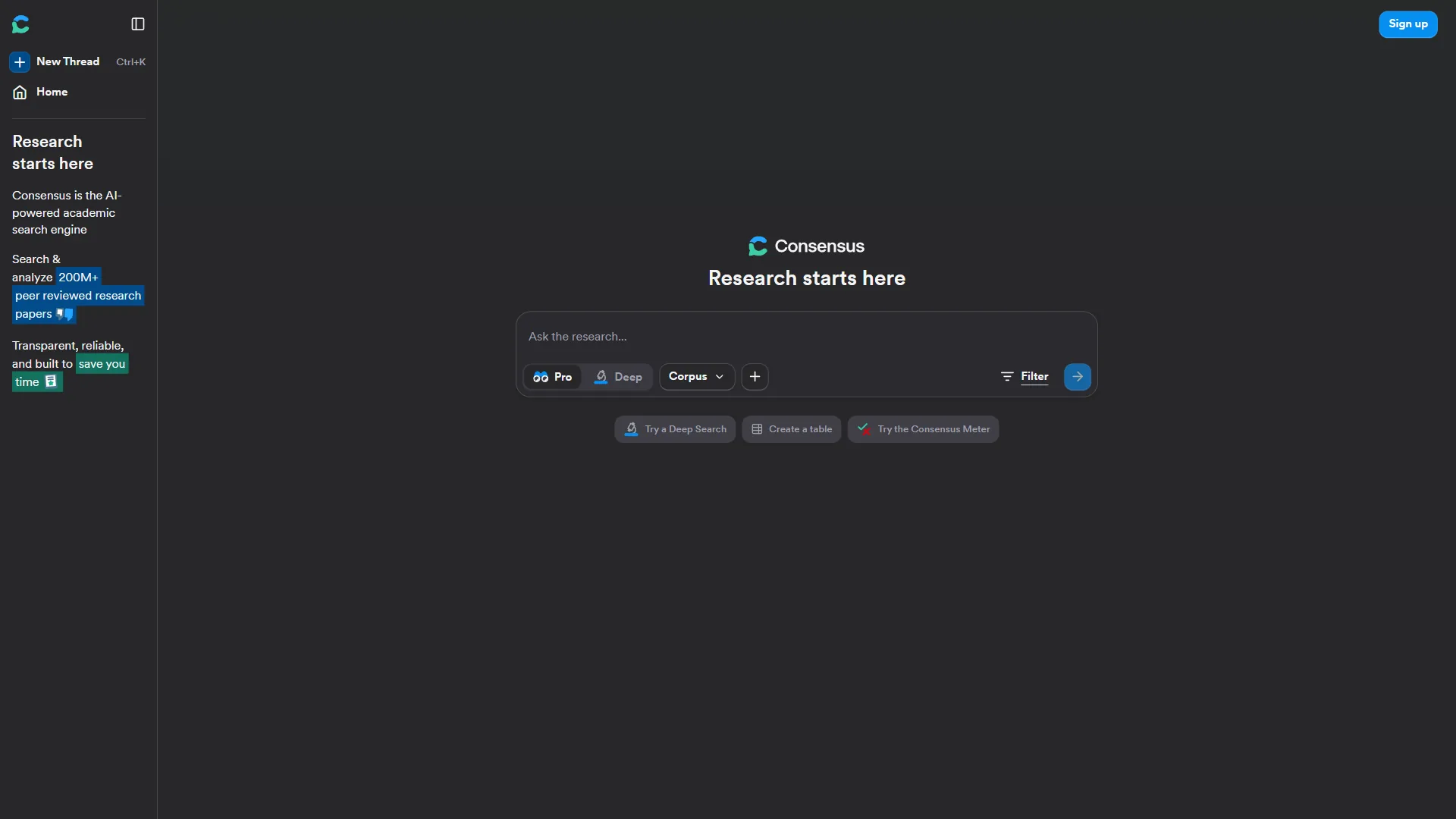
If neither Perplexity nor Claude fully covers your research needs, Consensus specializes in evidence-based answers from scientific literature, while Elicit automates systematic literature reviews with high-accuracy data extraction. Paperguide is another solid pick for managing references and AI-assisted reading of academic PDFs. For broader workflow context, the best AI research tools roundup compares all four side by side, and the AI tools for data analysts guide covers complementary analytical workflows.
Limitations to weigh: Consensus is narrowly scoped - skip it if you need anything beyond peer-reviewed scientific abstracts. Elicit’s drawbacks include a steep learning curve and pricing that climbs quickly past free-tier limits. Neither tool replaces a generalist like Perplexity or Claude; they complement rather than substitute.
Related Reads
Tradeoffs: these companion guides explore the limitations and best-fit scenarios for each tool across research workflows.
- Perplexity - Full tool review with pricing details
- Claude - Full tool review with feature breakdown
- Best AI Research Tools 2026 - Comprehensive guide including Consensus, Elicit, and more
- ChatGPT Tips and Tricks - If you’re comparing multiple AI assistants
- ChatGPT vs Claude - Another head-to-head comparison of leading AI assistants
- Best AI Assistants for Productivity in 2026 - Broader guide to AI productivity tools
External Resources
- Perplexity Hub - Official guides and feature documentation
- Anthropic Documentation - Claude API and feature guides