


An enterprise CDP guide is a practical evaluation framework for marketing operations leaders, data architects, and directors managing six-figure platform decisions. Unlike vendor brochures, it covers how a customer data platform unifies known and anonymous interactions into persistent profiles - feeding email, advertising, analytics, and personalization systems at a scale mid-market solutions cannot match.
Choosing a customer data platform at the enterprise level is a decision that affects every downstream marketing, analytics, and personalization effort your organization runs. Yet most buying guides read like vendor brochures rather than practical evaluation frameworks. This enterprise CDP guide is built for the people who actually have to evaluate, implement, and live with the platform - marketing operations leaders, data architects, and the directors who sign off on six-figure contracts.
The stakes are high. According to mParticle, poor data quality costs companies up to 31% of revenue through misallocated spend, missed personalization opportunities, and duplicated customer records. A well-chosen CDP eliminates those losses. A poorly chosen one becomes an expensive data silo that your team quietly routes around.
Here is what you need to know before you start talking to vendors in 2026.
What Is an Enterprise CDP?
Enterprise CDP Guide walks through the complete process from initial configuration to advanced usage. Whether you are starting fresh or optimizing an existing setup, this walkthrough covers every decision point, common pitfall, and the settings that make the biggest difference.
A customer data platform ingests customer data from every source your organization touches - website behavior, purchase history, email engagement, mobile app events, CRM records, support tickets - and unifies it into persistent, individual customer profiles. Those profiles then feed every downstream system: your email platform, ad networks, analytics tools, and personalization engines.
The distinction from related technologies matters when scoping your requirements:
-
CRM vs. CDP - A CRM stores known contacts and manages sales relationships. A CDP captures both known and anonymous interactions, stitching them into unified profiles automatically. Your CRM tells you who bought last quarter. Your CDP tells you the behavioral journey that led to the purchase.
-
DMP vs. CDP - Data management platforms work with anonymous, cookie-based audience segments for advertising. CDPs build persistent first-party profiles using deterministic identifiers. With third-party cookies disappearing, the DMP use case is collapsing into CDPs.
-
Data warehouse vs. CDP - Your Snowflake or BigQuery warehouse stores raw data for analysts. A CDP makes that data actionable for marketers without SQL queries, offering pre-built segmentation, audience activation, and real-time event processing.
Enterprise CDPs handle the scale and complexity that mid-market solutions cannot: billions of events per month, sub-second identity resolution across dozens of data sources, governance controls for global privacy regulations, and integration architectures that connect to 100+ downstream tools.
Must-Have Capabilities
Not every feature a CDP vendor promotes is equally important. These five capabilities separate enterprise-grade platforms from overhyped middleware.
Data Unification and Ingestion
The foundation of any CDP is its ability to ingest data from every source without losing fidelity. Look for native connectors to your existing stack - not just marketing tools, but ERP systems, data warehouses, mobile SDKs, and IoT platforms. The platform should handle batch imports and real-time event streams equally well. Ask about schema flexibility: can it adapt when your data model changes, or does every update require professional services?
Identity Resolution
This is where enterprise CDPs earn their price tag. Identity resolution stitches together anonymous browsing sessions, email addresses, phone numbers, loyalty IDs, and device fingerprints into a single customer profile. The quality of this stitching directly determines every personalization and analytics use case downstream. Evaluate whether the platform uses deterministic matching (exact matches like email-to-email) or probabilistic matching (behavioral signals to connect likely matches). Most enterprises need both, with configurable confidence thresholds.
Real-Time Segmentation and Activation
Building a segment and waiting 24 hours for it to sync is not acceptable for enterprise use cases. Your CDP should support real-time segment evaluation - when a customer triggers an event, they should enter or exit relevant segments within seconds, not minutes. Activation speed matters equally: how quickly can a newly qualified segment member receive a personalized experience on your website, see a targeted ad, or trigger an email workflow?
AI and Machine Learning
Predictive capabilities have moved from nice-to-have to table stakes. Look for native models that calculate purchase propensity, churn risk, customer lifetime value, and optimal send times. The key question is whether these models train on your data or use generic benchmarks. Enterprise platforms should offer both out-of-the-box models and the ability to bring your own models for specialized use cases.
Privacy and Compliance
With GDPR, CCPA, and expanding global privacy regulations, your CDP must be a compliance asset rather than a liability. Evaluate consent management integration, data residency options (especially for multi-region deployments), automated data deletion workflows, and audit logging. Ask whether the platform enforces consent preferences across all downstream activations - not just within the CDP itself.
Types of CDPs
The CDP market has fragmented into three distinct architectural approaches. Understanding which type fits your needs is critical before evaluating specific vendors. This enterprise CDP guide categorizes them as follows.
Campaign CDPs
Campaign CDPs combine data unification with built-in campaign execution. Platforms like Insider and Bloomreach fall into this category. The advantage is a single platform for both data management and activation - your marketers build segments and launch campaigns in the same interface. The trade-off is that you are committing your execution layer to the same vendor as your data layer, which creates deeper lock-in.
Best for: Organizations that want a unified marketing platform and are comfortable with a single-vendor approach for data and activation.
Analytics CDPs
Analytics CDPs focus on data collection, unification, and making clean data available to other tools. Segment (now part of Twilio) is the canonical example. These platforms excel at being the single source of truth for customer data, feeding clean profiles and events to whatever downstream tools you choose. They typically do not include campaign execution, which means more flexibility but also more integration work.
Best for: Organizations with a mature marketing stack that want a dedicated data layer without replacing existing execution tools.
Composable CDPs
The newest entrant, composable CDPs like Hightouch and Census sit on top of your existing data warehouse rather than replicating data into a separate platform. They use reverse ETL to activate warehouse data directly, avoiding duplication and reusing existing infrastructure investments. The promise is compelling - use the warehouse you already pay for - but the approach requires a mature data engineering team.
Best for: Data-forward organizations with strong engineering teams and significant existing warehouse investments.
Leading Platforms
No enterprise CDP guide would be complete without evaluating the major players. Rather than covering every vendor in the market, here are the platforms that represent each architectural approach and consistently appear on enterprise shortlists.
Insider
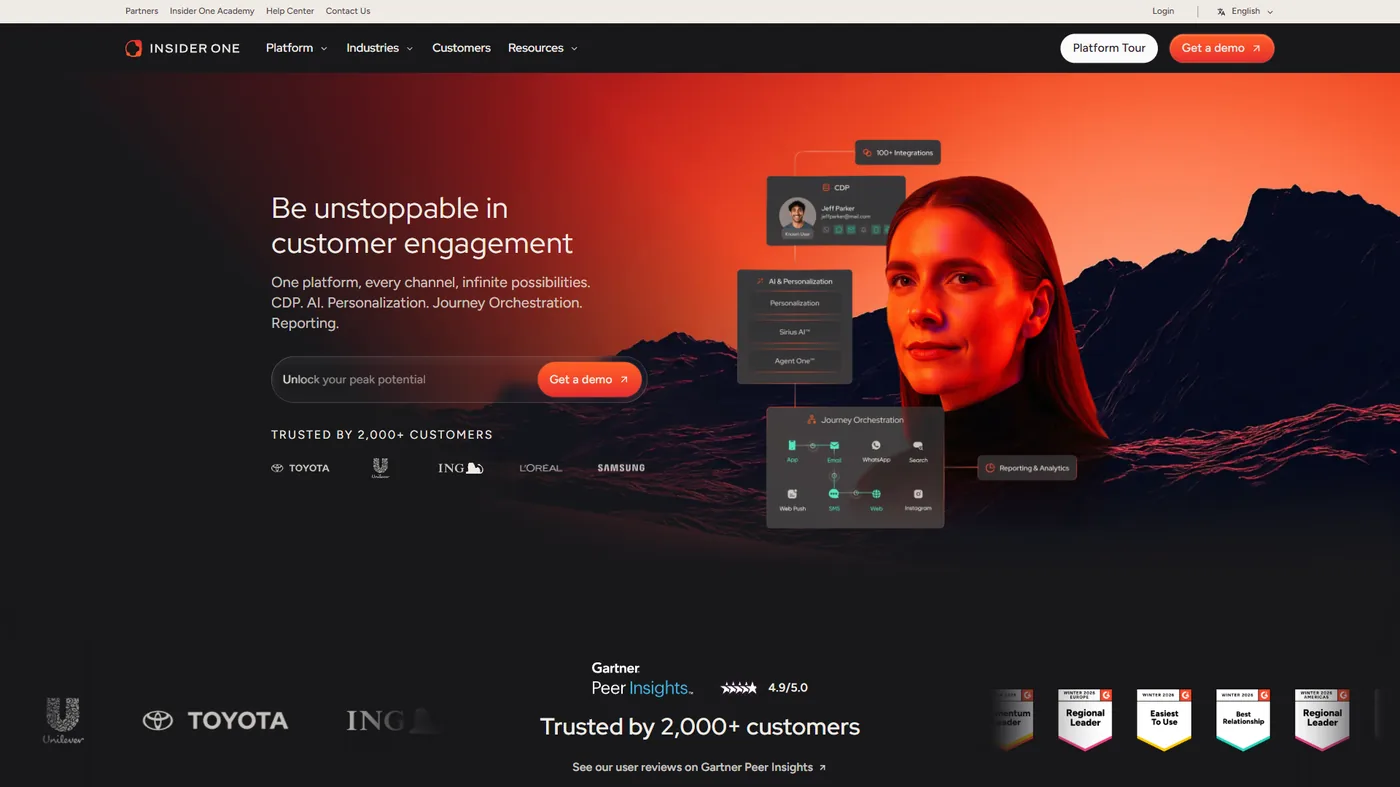
Insider is an AI-native platform that combines CDP capabilities with cross-channel campaign execution across 12+ channels. Backed by $771M in funding and holding unicorn status, Insider serves over 1,200 brands globally including Samsung, IKEA, and Estee Lauder. The platform is consistently ranked #1 across multiple enterprise software categories for personalization and customer data platforms.
What sets Insider apart is the depth of its AI layer. Predictive segmentation identifies customers likely to purchase, churn, or respond to specific offers. The journey orchestration engine selects the optimal channel for each customer based on engagement history - someone who opens push notifications but ignores email will receive a push-heavy sequence without manual rule configuration.
Strengths: True omnichannel execution (email, SMS, WhatsApp, push, web, app), unified CDP with real-time identity resolution, AI-driven personalization that improves autonomously, strong track record with enterprise brands.
Limitations: Enterprise pricing excludes smaller organizations, implementation requires dedicated technical resources, the full feature set has a steep learning curve.
Segment (Twilio)
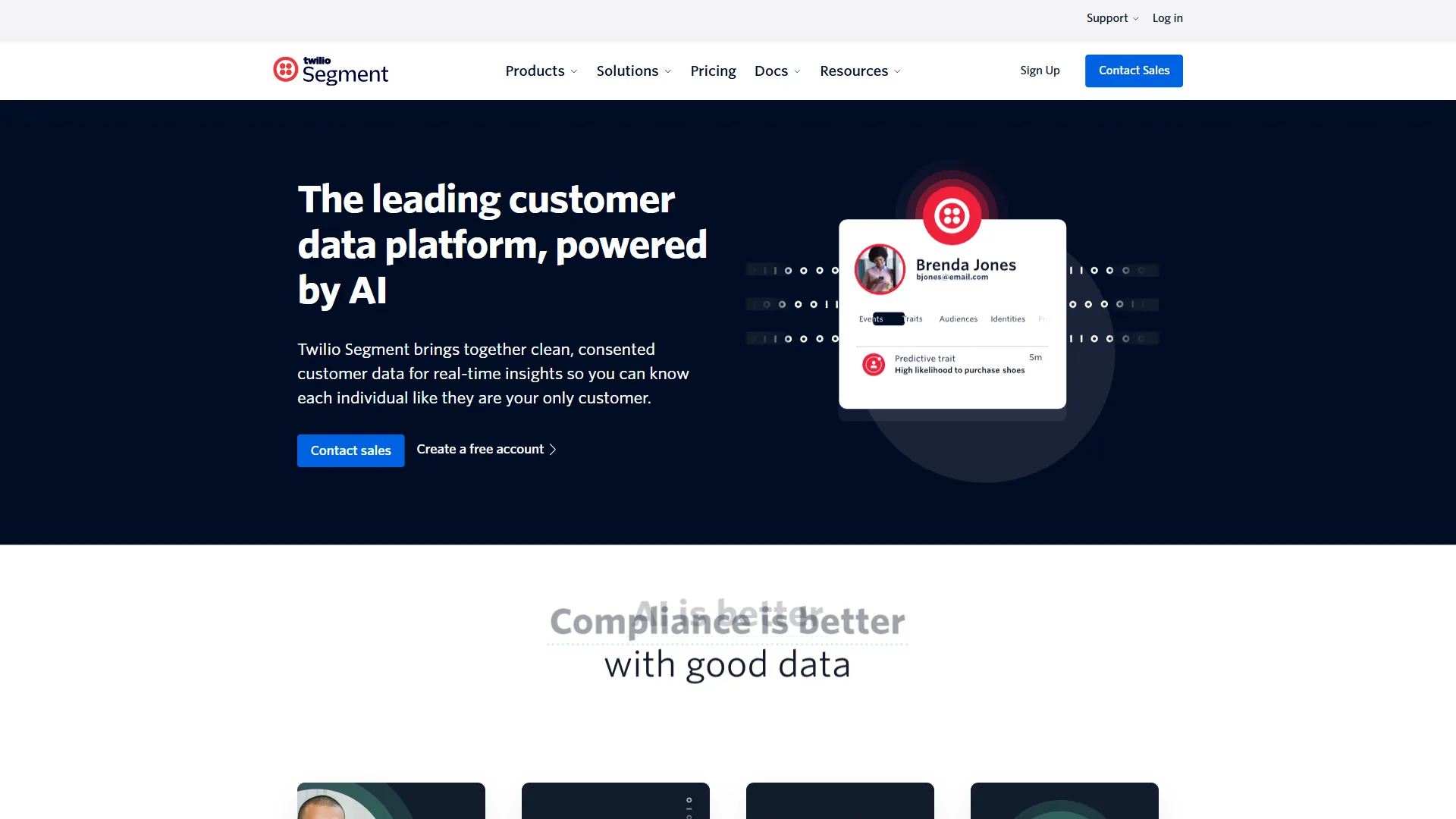
Segment takes a fundamentally different approach. Rather than trying to be your campaign execution platform, it focuses on being the best data collection and routing layer in your stack. It ingests events from websites, mobile apps, servers, and cloud tools, then routes unified data to over 400 downstream destinations.
The Twilio acquisition added communication capabilities, but Segment’s core value remains its role as the neutral data layer. For organizations that have invested in best-of-breed marketing tools and want a single platform to manage data quality across all of them, Segment delivers. The Protocols feature enforces data schemas at ingestion, catching tracking errors before they pollute downstream systems.
Strengths: Best-in-class data routing with 400+ integrations, strong data governance through Protocols, developer-friendly SDKs, vendor-neutral architecture that avoids lock-in.
Limitations: No campaign execution - you still need separate tools for email, push, and ads. Pricing scales with tracked users and can become expensive at enterprise volumes. Less accessible for non-technical marketers.
Other Platforms Worth Evaluating
-
Tealium - Strong in tag management and real-time data orchestration. A good fit for organizations that already use Tealium iQ for tag management and want a unified data layer from the same vendor.
-
mParticle - Specializes in mobile and app-centric data collection. Particularly strong for organizations where mobile apps are the primary customer touchpoint.
-
Bloomreach - Combines CDP capabilities with commerce-specific search and merchandising. Best suited for ecommerce brands that want product discovery and personalization in one platform.
How to Evaluate CDP Vendors
Vendor demos are designed to impress, not inform. Structure your evaluation around these practical criteria to cut through the marketing.
Key Questions for Every Vendor
- How does your identity resolution handle conflicting data (e.g., two profiles with the same email but different phone numbers)?
- What is the average time from event ingestion to segment qualification in production - not in a demo environment?
- How many customers at our scale are live in production, and can we speak with them?
- What happens to our data if we cancel? What is the export process and timeline?
- How do you handle consent revocation across all downstream activations?
POC Criteria
Run a proof of concept with at least two finalists. Define success criteria before starting - not after. Focus on three areas: data ingestion accuracy (are all events captured without loss?), identity resolution quality (how many duplicate profiles remain?), and activation speed (how quickly do segment changes propagate to downstream tools?).
Set a fixed 30 to 45 day timeline. Vendors will ask for more time - resist this. If the platform cannot demonstrate value in 45 days, the full implementation will likely exceed timeline estimates as well.
Vendor Scorecard Approach
Build a weighted scorecard across five dimensions: data capabilities (30%), integration ecosystem (20%), ease of use (20%), total cost of ownership (20%), and vendor stability (10%). Have both technical evaluators and business users score independently, then reconcile. The gap between scores often reveals where training investments will be needed.
Implementation Timeline
Most CDP vendors quote 4 to 8 weeks for implementation. In practice, enterprise deployments consistently take 3 to 6 months to reach production readiness. Here is a realistic breakdown.
Month 1: Foundation - Data source inventory, schema design, initial SDK integration for primary data sources (website, mobile app). This phase requires heavy involvement from data engineering.
Month 2: Identity and Integration - Identity resolution configuration, testing merge rules against actual data, connecting primary activation destinations (email platform, ad networks). Expect to discover data quality issues that need upstream fixes.
Month 3-4: Segmentation and Activation - Building audience segments, configuring activation workflows, testing end-to-end data flow from ingestion through activation. Marketing operations takes the lead.
Month 5-6: Optimization and Training - Refining identity resolution rules based on production data, training the marketing team on self-service capabilities, building dashboards, and documenting governance processes.
Common Pitfalls
Underestimating data cleanup - Most organizations discover that their source data is messier than expected. Budget 20-30% more time for data quality work than your initial estimate.
Skipping governance planning - Defining who can create segments, who approves audience activation, and how data access is controlled is boring work that prevents expensive mistakelaterer.
Trying to migrate everything at once - Start with 3-5 critical data sources and 2-3 key activation use cases. Expand only after those are stable in production.
Cost Considerations
CDP pricing is notoriously opaque, which makes budgeting difficult. This enterprise CDP guide breaks down the total cost of ownership factors that vendors often understate.
Pricing Models
Most enterprise CDPs use one or more of these pricing dimensions:
- Event volume - Charged per million events ingested per month. High-traffic websites and mobile apps can generate billions of events monthly, making this the largest variable cost.
- Profile count - Charged per unified customer profile stored in the platform. This rewards good identity resolution (fewer duplicates = fewer profiles = lower cost).
- Activation volume - Charged per audience sync or API call to downstream destinations. Frequent segment updates to multiple destinations compound this cost.
- Module-based - Campaign CDPs often charge separately for each channel (email, SMS, push) or capability (AI predictions, advanced analytics).
Total Cost of Ownership
The license fee is typically 40-60% of your first-year TCO. Factor in these additional costs:
- Implementation services - Professional services from the vendor or a systems integrator. Budget $50K-$200K depending on complexity.
- Internal engineering time - Your data engineering team will spend significant hours on integration, testing, and maintenance. Estimate 2-3 full-time engineers for the first 3 months.
- Training - Both initial onboarding and ongoing training as team members change. Budget for this separately from the license.
- Incremental tooling - Analytics CDPs require separate campaign execution tools. Factor in the cost of tools the CDP does not replace.
ROI Metrics
Justify the investment by tracking these outcomes: reduction in duplicate profiles (directly reduces wasted ad spend), improvement in campaign conversion rates from better personalization, time saved by marketing operations through self-service segmentation, and reduction in data-related support tickets. Organizations that track these metrics report positive ROI within 6-12 months of production deployment.
The Bottom Line: Enterprise CDP Guide Takeaways
The CDP market is maturing, and the choice is no longer whether you need one but which architectural approach fits your organization. Campaign CDPs like Insider deliver the fastest path to omnichannel personalization for teams that want a unified platform. Analytics CDPs like Segment give you flexibility and data control at the cost of more integration work. Composable CDPs offer a compelling alternative for data-engineering-heavy organizations.
Start by honestly assessing your team’s technical maturity, your existing stack’s strengths, and the use cases that will drive ROI in the first year. Then use this enterprise CDP guide’s evaluation framework to score vendors against criteria that matter for your business - not the criteria vendors want you to use.
The worst outcome is buying a platform your team cannot fully implement. Budget for the CDP you can actually deploy, not the one with the longest feature list.
Frequently Asked Questions
What is an enterprise CDP?
An enterprise CDP ingests customer data from every source an organization touches - website behavior, purchase history, email engagement, mobile app events, CRM records, and support tickets - and unifies it into persistent individual profiles. These profiles feed downstream systems like email platforms, ad networks, and personalization engines. Enterprise-grade platforms handle billions of events monthly, sub-second identity resolution, global privacy governance, and 100+ integrations.
Is a CDP worth it?
A CDP can be worth it when tracked properly. Organizations that measure outcomes - reduced duplicate profiles, improved campaign conversion rates, marketing operations time savings, and fewer data-related support tickets - report positive ROI within 6 to 12 months of production deployment. Poor data quality can cost companies up to 31% of revenue, making a well-chosen CDP a meaningful investment.
How long does enterprise CDP implementation take?
Most vendors quote 4 to 8 weeks, but enterprise deployments consistently take 3 to 6 months to reach production. Plan for a Foundation phase (data source inventory, schema design), an Identity and Integration phase (resolving merge rules and connecting destinations), and an Optimization phase (refining rules and training the marketing team).
What is the difference between a CDP and a CRM?
A CRM stores known contacts and manages sales relationships. A CDP captures both known and anonymous interactions and stitches them into unified profiles automatically. The CRM tells you who bought last quarter; the CDP tells you the behavioral journey that led to the purchase.
What are the three types of enterprise CDPs?
The CDP market breaks into three architectural approaches. Campaign CDPs like Insider combine data unification with built-in campaign execution. Analytics CDPs like Segment focus on clean data collection and routing to other tools without campaign execution. Composable CDPs like Hightouch and Census sit on top of your existing data warehouse, using reverse ETL to activate data directly - but they require a mature data engineering team.
Want to learn more about Insider?
Related Guides
- AI Product Discovery: How It Boosts Ecommerce Revenue - How AI-powered product discovery drives conversions for online stores
- Enterprise Data Governance Implementation Guide - Sibling framework for governing the data feeding your CDP
- Ecommerce Conversion Optimization Guide - Tactics that pair well with CDP-driven personalization
Related Reading
- Insider - Full review of the AI-native CDP and omnichannel marketing platform
- Best Omnichannel Marketing Platforms - How Insider, Klaviyo, HubSpot, and others compare for cross-channel campaigns
- Insider vs Bloomreach: Which Personalization Platform Wins? - Head-to-head comparison of two leading personalization platforms
External Resources
- CDP Institute - Industry body with vendor-neutral research, RFP templates, and CDP certification programs
- The Good Data Guide by Segment - Practical resource on data quality and governance for customer data platforms
Related Guides
- 15 Calendly Tips and Tricks to Save 4+ Hours Weekly
- ActiveCampaign AI Features: Active Intelligence Guide
- ActiveCampaign CRM Setup: How to Set Up ActiveCampaign CRM
- ActiveCampaign Email Automation: 10 Workflows That Work
- ActiveCampaign Lead Scoring: Complete Setup Guide (2026)
- AI Avatar Video Marketing: 2026 Walkthrough for Teams
- AI Chatbots Customer Service Setup: Complete 2026 Guide
- AI Product Discovery Ecommerce: Lift Revenue in 2026
- Apollo Sales Prospecting: Build a Predictable System
- Apollo Sequences Automated Outreach: Complete 2026 Guide