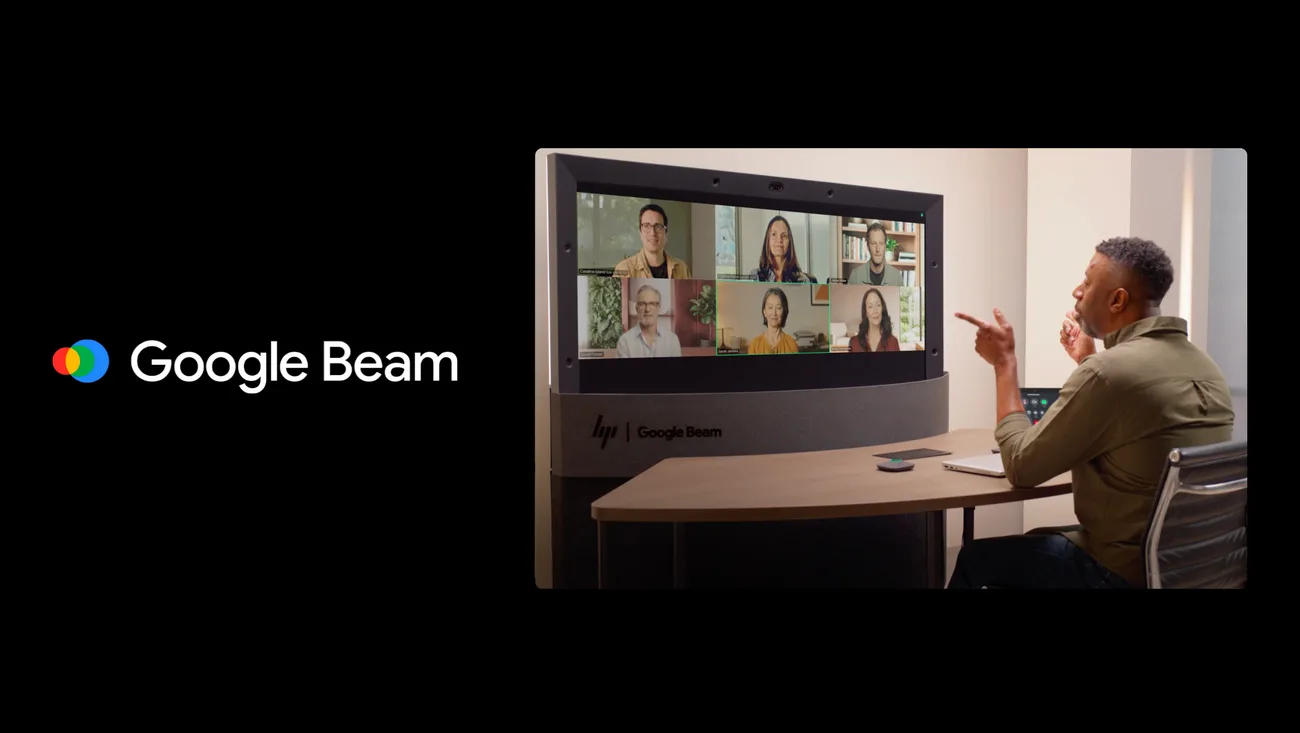
50% stronger social connection and a 21% increase in participants' ability to contribute to conversations. Those are the numbers Google is reporting from its new group meeting experiment on Google Beam, the company's high-end 3D video calling platform.
The experiment expands Beam beyond its existing one-on-one setup. Using HP Dimension's immersive display hardware, remote participants are now rendered at true-to-life size and positioned on screen as if seated around a shared physical table. Spatial audio ties each voice to a specific on-screen location, so when someone talks, the sound comes from where they appear - not from a speaker bar in the corner of the room. The system automatically adjusts for both home and office environments, and works with Google Workspace and Zoom.
The core problem Google is trying to solve is a real one. In a typical hybrid meeting, the people physically in the room have a massive social advantage - eye contact, body language, presence. The people on a laptop screen are, in practice, second-class participants. Beam's approach is to make remote attendees feel spatially present by rendering them at accurate scale rather than as thumbnails in a grid. The research results suggest that at least in controlled conditions, this approach works. A 21% lift in perceived ability to contribute is not a small number for a product update.
The catch is the hardware requirement. Google Beam runs on HP Dimension displays, which are enterprise-grade devices - not something a freelancer is buying for home office use. This technology is squarely aimed at companies that already invest in high-end conference room infrastructure. The research was conducted by Mohamed Abdelgany's group product team at Google Beam, published May 20, 2026.
For most workers, the daily meeting experience lives inside Zoom or Google Meet on a standard monitor. But Google Beam represents a real bet that the videoconferencing ceiling is much higher than where the industry has settled - and the group meeting update is a meaningful step toward making that case with actual data.