

What Happened
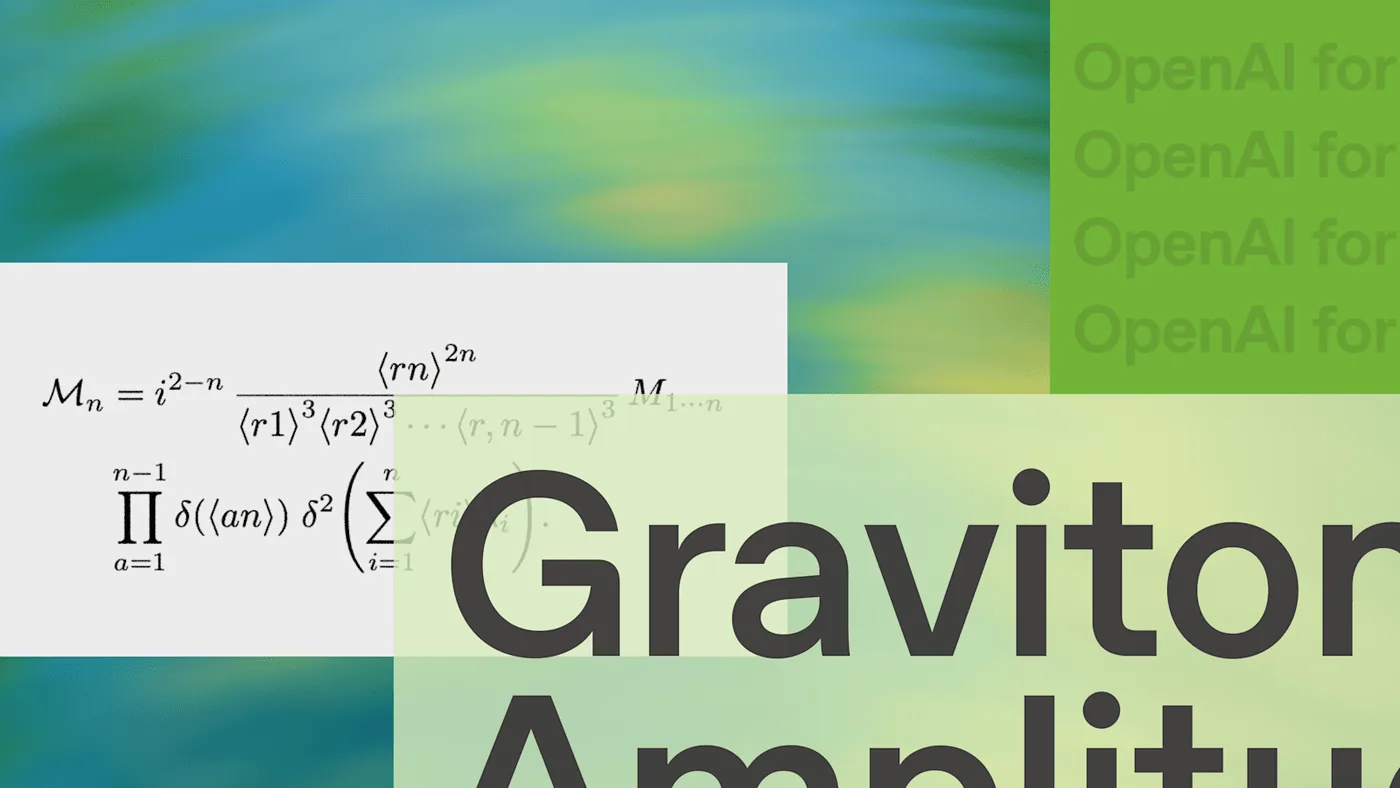
OpenAI published a new preprint on March 4, 2026, extending earlier work on single-minus gluon amplitudes to gravitons - the hypothetical particles that would carry gravitational force in a quantum theory of gravity.
This builds on the February 2026 paper "Single-minus gluon tree amplitudes are nonzero," authored by Alfredo Guevara (Institute for Advanced Study), Alex Lupsasca (Vanderbilt University and OpenAI), David Skinner (University of Cambridge), Andrew Strominger (Harvard University), and Kevin Weil on behalf of OpenAI. That original paper used GPT-5.2 Pro to identify nonzero tree amplitudes in gluon scattering that physicists had dismissed as zero for roughly 40 years.
The new graviton extension was also AI-assisted. GPT-5.2 Pro helped derive and verify that the same class of nonzero amplitudes exists for gravitons, generalizing the result from the strong nuclear force (gluons) to gravity. The team has also noted that supersymmetric extensions are possible.
The preprint is available on arXiv and is being submitted for peer-reviewed journal publication.
Why It Matters
This is one of the clearest examples of an AI model contributing to genuinely novel scientific results rather than just summarizing or retrieving existing knowledge.
The original gluon finding was already notable: GPT-5.2 Pro spotted a pattern in particle physics that human physicists had overlooked for decades, and the result was confirmed mathematically. Extending it to gravitons pushes the work into quantum gravity territory, one of the hardest open problems in theoretical physics.
For AI tool users, the practical takeaway is about the ceiling of what reasoning models can do. GPT-5.2 Pro wasn't just checking math or formatting LaTeX. It was exploring a hypothesis space and identifying results that trained physicists at Harvard, Cambridge, and the Institute for Advanced Study found publishable.
Lupsasca has publicly stated he wants to use this approach to find a mathematically well-behaved version of quantum gravity "by the end of the year." That's ambitious, but the track record so far backs up the ambition.
Our Take
We've been skeptical of AI-does-science claims before, because most of them amount to "we used GPT to write a literature review." This is different. The gluon result passed peer scrutiny from serious physicists, and the graviton extension suggests the approach generalizes rather than being a one-off lucky hit.
What's most interesting from a tools perspective: this was done with GPT-5.2 Pro's reasoning capabilities, not a specialized scientific model. That means the same model people use for coding and analysis can also operate at research-grade levels in theoretical physics when paired with the right human expertise.
The researchers aren't claiming AI replaced them. They're claiming AI found something they missed, and then they verified it. That collaborative pattern - AI explores, human validates - is probably the highest-value use case for frontier models right now. If you're in any research-adjacent field, this is worth paying attention to as a template for how to work with these tools.