

What Happened
OpenAI announced the Learning Outcomes Measurement Suite (LOMS) on March 4, 2026, a framework designed to measure whether AI tools actually improve student learning or just make schoolwork faster to complete.
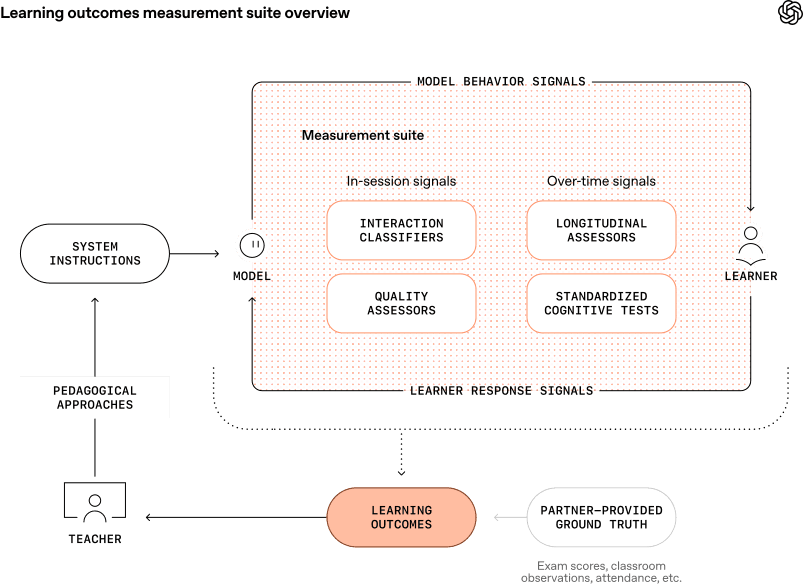
LOMS tracks three specific cognitive outcomes: learning retention, student motivation, and creative problem-solving skills. The system monitors both the AI model's behavior and how students interact with it, then analyzes which outcomes change over time. The stated goal is answering whether "the benefits gained and the productive behavioral changes associated with them endure over time."
OpenAI plans to validate the framework through large-scale studies before broad deployment. One such study is already underway: a partnership with the University of Tartu and Stanford tracking 20,000 students longitudinally. After validation, OpenAI says it will release LOMS as an open resource for schools and universities.
This arrives alongside OpenAI's broader education push, including the "Education for Countries" program launched with Estonia, Greece, Italy, Jordan, Kazakhstan, Slovakia, Trinidad and Tobago, and the UAE, which gives participating institutions access to ChatGPT Edu, GPT-5.2, study mode, and canvas tools.
Why It Matters
Schools have gone from banning ChatGPT to integrating it in about two years. What's been missing is any rigorous measurement of whether that integration is helping students learn or just helping them produce assignments faster.
That distinction matters enormously. If students use ChatGPT to skip the struggle of working through a problem, they might get better grades while learning less. If they use it as an interactive tutor that adapts to their understanding, they might learn more deeply. LOMS is designed to tell the difference.
The 20,000-student longitudinal study with Stanford and University of Tartu is the right scale for this kind of research. Small-scale studies in education are notoriously noisy, and short-term measurements miss the most important question: does the learning stick?
For anyone using AI in training, education, or knowledge work, this framework could eventually provide the evidence base for deciding how and when to deploy AI tools for learning.
Our Take
This is overdue and welcome. The education sector has been flying blind on AI adoption, with individual teachers making their own rules based on gut feeling. Having a standardized measurement framework - especially one that tracks retention over time rather than just test scores - would be genuinely useful.
The commitment to making LOMS an open resource is the right call. If only OpenAI can measure learning outcomes, the results will always carry an asterisk. Open tools let independent researchers validate or challenge the findings.
The skeptic's read: OpenAI has a clear financial interest in showing that ChatGPT helps students learn, since that drives institutional adoption. But the Stanford partnership and the plan for public release suggest they're at least structuring this to be credible rather than purely promotional.
If you're in education or L&D, watch the validation studies. The question isn't whether students like using AI - they do. The question is whether they remember what they learned three months later. That's what LOMS is designed to answer, and it's the right question to ask.