






NeuronWriter SEO optimization is an NLP-driven approach to content improvement that analyzes what top-ranking pages cover at a semantic level rather than focusing on keyword density. Built around semantic analysis from the ground up, it identifies where content falls short and supports both Google rankings and AI search visibility across platforms like Google AI Overviews and Perplexity.
If you are still optimizing content by manually checking keyword density and hoping for the best, 2026 is going to be a rough year. Google’s ranking algorithm has moved far beyond keyword matching, and the rise of AI search engines like Google AI Overviews, Perplexity, and ChatGPT Search means your content now needs to satisfy two fundamentally different discovery systems at once.
NeuronWriter approaches this problem with NLP-driven semantic analysis rather than traditional keyword tools. Instead of telling you to mention “best SEO tool” twelve times, it analyzes what top-ranking pages actually cover at a semantic level and shows you exactly where your content falls short. This NeuronWriter SEO optimization tutorial covers everything from initial project setup through advanced GEO (Generative Engine Optimization) strategies, and if you are weighing NeuronWriter vs Surfer SEO, the workflow here shows where its semantic approach pulls ahead so your content works for both Google and AI search engines.
NeuronWriter currently holds across review platforms, with particularly strong marks for its content optimization engine and pricing accessibility.
Why Traditional SEO Is No Longer Enough
The SEO landscape in 2026 looks nothing like it did even two years ago. Three shifts have fundamentally changed how content gets discovered:
Google’s NLP evolution. Google’s ranking systems now use advanced natural language processing to understand topic coverage, entity relationships, and semantic completeness. A page that covers a topic thoroughly with the right semantic signals outranks a page that simply repeats target keywords. Tools that still focus primarily on keyword density are fighting the last war.
AI search engines are eating clicks. AI Overviews and conversational search now answer many queries directly, pulling information from pages that demonstrate topical authority. If your content is not structured in a way that AI systems can parse and cite, you lose visibility in this growing channel.
User intent matching matters more than ever. Google’s systems increasingly evaluate whether content genuinely satisfies search intent rather than just containing the right words. NLP analysis tools like NeuronWriter help you understand what searchers actually want to know, not just what keywords they type.
This is where NeuronWriter fits in. It bridges the gap between traditional SEO and the new AI search landscape by giving you NLP-powered recommendations that improve both Google rankings and AI search visibility. For context on where NeuronWriter sits among its peers, see our best AI SEO tools 2026 roundup.
What NeuronWriter Does Differently
Most content optimization tools started as keyword research platforms and bolted on content scoring later. The neuronwriter seo optimization approach was built from the ground up around NLP semantic analysis. The difference shows in how it generates recommendations.
NLP-first approach. When you enter a target keyword, NeuronWriter does not just count how often competitors use that phrase the way most content optimization tools free of semantic analysis still do. It runs the top-ranking pages through Google’s NLP API to extract entities, sentiment patterns, and topic coverage signals. Your recommendations come from what search engines actually understand about the content, not surface-level keyword counting.
Competitor SERP deconstruction. The tool breaks down what top-ranking pages are doing structurally - heading patterns, content depth, NLP term coverage, and semantic gaps. You see exactly what the ranking pages cover that yours does not.
Integrated content workflow. Unlike tools that only analyze, NeuronWriter combines research, writing, optimization, and scoring in one interface. You can go from SERP analysis to finished content without switching between five different tabs.
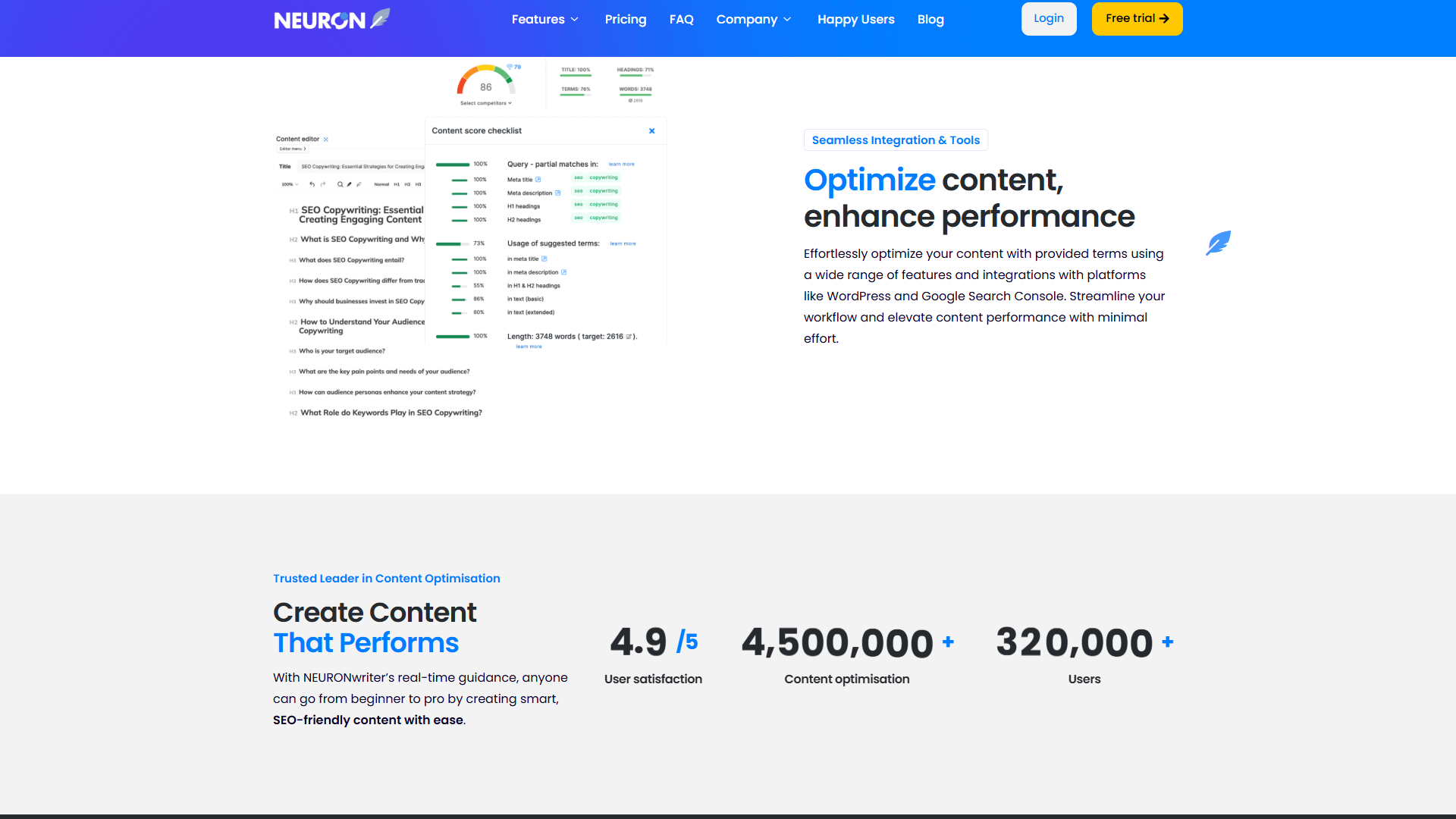
Content scoring with semantic targets. As you write, NeuronWriter scores your content in real-time against NLP benchmarks from competitor analysis. The score is not arbitrary - it reflects how well your semantic coverage matches what Google’s systems expect to see for that topic.
Setting Up Your First Content Project
Getting started with NeuronWriter takes about five minutes, but the setup decisions you make here affect the quality of every recommendation you receive.
Creating a Project
NeuronWriter organizes work into projects, which function like folders for related content. If you are working on a single blog, one project is enough. Agencies managing multiple clients will want separate projects for each.
Step-by-step setup:
- Create a new project - Name it after your website or client. This keeps analyses organized as you build a content library.
- Set your target country and language - NeuronWriter pulls SERP data specific to your geo-target. Selecting the wrong country means your competitor analysis reflects the wrong search results.
- Add your target keyword - Enter the primary keyword you want to rank for. NeuronWriter will analyze the top-ranking pages for this term.
- Run the content analysis - This triggers the SERP pull, NLP analysis, and competitor breakdown. It uses one of your monthly content writer analyses, so choose keywords strategically.
Understanding the Analysis Dashboard
Once your analysis runs, NeuronWriter presents several views that can be overwhelming at first. Focus on these three sections:
- NLP Terms - The semantic terms that top-ranking pages cover. These are not keywords to stuff - they are topics and entities your content should naturally address.
- Competition Tab - A breakdown of each ranking page’s structure, word count, and NLP coverage. Use this to understand the content depth your page needs.
- Content Score - Your real-time optimization score as you write, showing how well you match the NLP profile of ranking content.
What Can You Learn from NeuronWriter’s SERP Analysis and Competitor Research?
The SERP analysis feature is where NeuronWriter delivers the most actionable intelligence. Rather than guessing what Google wants to see, you get data on what is already working.
What the SERP Analysis Reveals
For each top-ranking page, NeuronWriter shows:
- Word count and content depth - How long competing content is and how thoroughly it covers the topic
- Heading structure - The H2s and H3s competitors use, revealing the subtopics Google associates with your keyword
- NLP entity coverage - Which entities (people, products, concepts) appear in ranking content
- Content gaps - Topics that some competitors cover and others miss, representing opportunities for your content to be more comprehensive
Using Competitor Data Strategically
The goal is not to copy what competitors do. It is to understand the minimum topical coverage Google expects and then exceed it. Here is how to approach the competitor data:
- Identify consensus topics - If 8 out of 10 ranking pages cover a subtopic, your content needs to address it. These are table stakes.
- Find coverage gaps - Topics that only 2-3 competitors cover are opportunities to add depth that most ranking content lacks.
- Analyze heading patterns - The H2 structure of ranking pages reveals how Google expects the topic to be organized. Use this as a structural starting point, not a template.
- Check content length benchmarks - If the top 5 pages average 2,500 words, a 500-word article is unlikely to compete. Match or exceed the depth, but only with substance.
How Does the NeuronWriter Content Optimization Workflow Work?
This is where the neuronwriter seo optimization workflow delivers its core value: a real-time optimization loop that guides you toward content Google’s algorithms will favor.
How Does the NeuronWriter Content Score Work?
NeuronWriter’s content score reflects three factors:
- NLP term coverage - How many of the recommended semantic terms your content includes naturally. This is not keyword stuffing - it is topical completeness.
- Content structure - Whether your heading hierarchy and content organization match patterns that perform well in search.
- Content depth - Word count and paragraph coverage relative to competitor benchmarks.
Target score ranges:
- Below 50 - Significant gaps in topic coverage. Your content likely misses key subtopics.
- 50-70 - Decent coverage but missing some NLP terms that competitors include. Good starting point for a draft.
- 70-85 - Strong optimization. Most ranking content falls in this range. This is your target for competitive keywords.
- 85+ - Exceptional coverage. Only aim this high for very competitive keywords where marginal gains matter.
Optimization Best Practices
Here is the workflow that produces the best results:
- Write your draft naturally first. Do not optimize as you write the first draft. Get your ideas down, then optimize.
- Check your score and identify gaps. Look at which NLP terms you are missing and which ones appear most frequently in competitor content.
- Add missing topics organically. Do not force NLP terms into random sentences. Find natural places where the topic fits or add new sections to cover missing subtopics.
- Review heading structure. Make sure your H2s and H3s align with the topic organization Google expects based on competitor analysis.
- Re-check and iterate. After edits, verify your score improved and no new gaps appeared.
Critical rule: never sacrifice readability for score. A well-written article scoring 72 will outperform a keyword-stuffed article scoring 90 every time. Google’s systems detect unnatural writing patterns, and readers will bounce immediately.
AI Writing Assistant for Content Generation
NeuronWriter includes a built-in AI writing assistant that integrates directly with the optimization workflow. This is not a standalone AI writer like Jasper or ChatGPT - it is specifically designed to generate content that aligns with your NLP recommendations.
How the AI Writer Works
The AI writer uses your NLP analysis as context, generating paragraphs and sections that naturally incorporate recommended semantic terms. This saves the step of writing a draft, analyzing it, and then rewriting to include missing terms.
Best uses for the AI writer:
- Section drafts - Generate a first draft for specific H2 sections, then edit for voice and accuracy
- Introduction and conclusion - Let the AI handle structural sections while you focus on original insights
- Filler paragraphs - When you need transitional content between major sections, the AI produces serviceable text that hits NLP targets
Where the AI writer falls short:
- Original insights - The AI cannot add expert opinions, personal experience, or unique data. These need to come from you.
- Brand voice - Generated content reads generically. Budget time to edit for your publication’s tone and style.
- Accuracy - Always fact-check AI-generated claims, especially statistics and feature descriptions.
AI credits are tiered by plan - the Free tier includes 20,000 credits per month, scaling up to 75,000 on the Diamond plan. For most individual users, the Bronze plan’s 15,000 credits are sufficient for supplementing (not replacing) your writing.
GEO Optimization: Preparing Content for AI Search Engines
GEO - Generative Engine Optimization - is the emerging discipline of optimizing content so AI search engines cite it in their responses. This is separate from traditional SEO, though the two share significant overlap.
Why GEO Matters in 2026
AI search engines like Google AI Overviews, Perplexity, and ChatGPT Search work differently from traditional search. Instead of showing ten blue links, they synthesize answers from multiple sources and cite the pages they pull from. Getting cited means your content needs to be:
- Clearly structured - AI systems parse well-organized content more reliably. Clear headings, logical flow, and explicit topic sentences help AI understand what each section covers.
- Factually authoritative - AI systems prefer citing content that demonstrates expertise through specific data, original research, and detailed explanations.
- Comprehensive but scannable - AI systems extract specific answers from larger pieces. Content that clearly addresses specific questions in dedicated sections gets cited more often.
How NeuronWriter Supports GEO
NeuronWriter’s NLP analysis naturally supports GEO optimization because the same semantic signals that help Google rank content also help AI systems select sources for citations. Specifically:
Entity coverage. NeuronWriter’s NLP analysis identifies the entities (people, products, concepts, places) that top-ranking content covers. AI search engines use entity relationships to evaluate source authority. Content that covers relevant entities comprehensively is more likely to be cited.
Semantic completeness. The content scoring system pushes you toward thorough topic coverage. AI search engines favor sources that provide complete answers rather than partial information. A high NeuronWriter score correlates with the kind of comprehensive coverage AI systems prefer.
Structured content patterns. By following the heading structure and topic organization that NeuronWriter recommends based on competitor analysis, you create content that AI parsing systems can navigate efficiently.
Practical GEO Strategies Using NeuronWriter
Here is how to use NeuronWriter specifically for GEO optimization:
- Target question-based keywords. AI search queries are often conversational. Use NeuronWriter to analyze keywords phrased as questions - “how does X work” rather than just “X.”
- Optimize individual sections as standalone answers. Each H2 section should fully answer a specific aspect of the topic. AI systems cite sections, not entire articles.
- Include specific data points. When NeuronWriter’s NLP analysis shows that competitors include statistics, case studies, or specific numbers, make sure your content does too. AI systems gravitate toward citable facts.
- Use NLP terms as topic completeness signals. The NLP terms NeuronWriter recommends are the same semantic signals AI systems use to evaluate whether a source is comprehensive enough to cite.
If you are interested in broader SEO strategies that complement this approach, the best-for SEO specialists page covers tools across the full optimization stack, and our Writesonic GEO AI search visibility guide walks through the citation-friendly structure AI search engines reward.
Internal Linking Suggestions
NeuronWriter includes internal linking recommendations that analyze your existing content to suggest connections between pages. While not as sophisticated as dedicated internal linking tools, this feature helps you build topical clusters that strengthen both SEO and GEO signals.
The tool identifies pages on your site that share semantic relevance with the content you are optimizing, suggesting anchor text and linking opportunities you might miss manually. For sites with 50+ pages of content, this saves significant time compared to manually reviewing your content library for linking opportunities. The Google guidance on crawlable links is worth bookmarking before you bulk-implement any internal link suggestions.
Tips for using internal linking suggestions effectively:
- Review suggestions for relevance before implementing - not every suggestion makes contextual sense
- Prioritize links to cornerstone content and pages you want to rank for competitive keywords
- Use varied anchor text rather than exact-match keyword anchors, which can trigger over-optimization signals
How Much Does NeuronWriter Cost for Different User Types?
NeuronWriter’s pricing is its strongest competitive advantage. Here is how the plans break down by user type.
| Plan | Monthly Price | Analyses/Month | AI Credits | Best For |
|---|---|---|---|---|
| Free | $0 | 3 | 20,000 | Testing the platform |
| Bronze | $23 | 25 | 15,000 | Solo bloggers and freelancers |
| Silver | $45 | 50 | 30,000 | Growing content creators |
| Gold | $69 | 75 | 45,000 | Professional teams + WordPress integration |
| Platinum | $93 | 100 | 60,000 | Multi-client agencies |
| Diamond | $117 | 150 | 75,000 | Large-scale content operations |
Annual billing saves 20% - dropping the Bronze plan to $23/month (annual) and Gold to $69/month (annual). NeuronWriter also offers a 7-day free trial and 30-day money-back guarantee, which effectively eliminates purchase risk.
Recommendation by user type:
- Freelancers and solo bloggers - Start with Bronze ($23/month). The 25 analyses per month cover 5-6 articles with research iterations. The value compared to Surfer SEO (premium pricing) is significant.
- Small content teams - Silver or Gold depending on WordPress integration needs. The Gold tier adds direct WordPress publishing and Google Docs integration.
- Agencies - Platinum or Diamond for the project limits and analysis volume. At $93-117/month, still far cheaper than enterprise alternatives like Clearscope ($170+/month).
NeuronWriter vs Alternatives
NeuronWriter operates in a competitive space. Here is how it compares at a high level:
-
vs Surfer SEO - Surfer offers a more polished UI, broader feature set (including the Sites Dashboard and Topical Map), and stronger AI content generation. But it costs significantly more per month versus NeuronWriter’s Bronze plan at $23/month. For core NLP optimization, NeuronWriter delivers 80-90% of Surfer’s value at roughly a quarter of the price.
-
vs Clearscope - Clearscope targets enterprise teams at $170+/month with a cleaner interface and better reporting. NeuronWriter covers the same NLP optimization fundamentals for budget-conscious users who do not need enterprise polish.
-
vs MarketMuse - MarketMuse focuses on content strategy and topic authority planning. NeuronWriter focuses on individual article optimization. They solve different problems and can complement each other.
-
vs Semrush Writing Assistant - Semrush includes content optimization as part of its broader SEO platform. NeuronWriter’s NLP analysis is deeper for content optimization specifically, but Semrush offers keyword research, rank tracking, and backlink analysis that NeuronWriter lacks. See Semrush vs Ahrefs if broader SEO research is your priority.
For a deeper dive into these comparisons, see the Surfer SEO alternatives roundup.
The Bottom Line on NeuronWriter SEO Optimization
NeuronWriter delivers serious NLP content optimization at a price point that makes enterprise-grade semantic analysis accessible to freelancers, bloggers, and small teams. The tool is not perfect - the interface has a learning curve, there is no rank tracking or backlink analysis, and the AI writing assistant produces drafts that need significant editing. But for its core purpose of making content rank better through semantic optimization, it performs remarkably well against tools costing three to five times more.
The addition of GEO-relevant features makes NeuronWriter particularly valuable in 2026, when optimizing for AI search engines is no longer optional. If you are creating content that needs to rank on Google and get cited by AI search tools, NeuronWriter’s NLP analysis gives you the semantic signals both systems look for.
Start with the free tier to test the optimization workflow, then move to Bronze ($23/month) when you are ready to scale. Check out the full NeuronWriter tool page for detailed feature scores, user reviews, and an ROI calculator.
Frequently Asked Questions
Is NeuronWriter good for SEO?
NeuronWriter is well-suited for SEO because it uses NLP-driven semantic analysis rather than basic keyword counting. It analyzes top-ranking pages through Google’s Natural Language API to extract entities, topic coverage, and semantic gaps, then scores your content in real-time against those benchmarks. For its core purpose of improving rankings through semantic optimization, it performs well against tools costing three to five times more.
What makes NeuronWriter different from other SEO content tools?
NeuronWriter was built around NLP semantic analysis from the start, rather than bolting content scoring onto a keyword research platform. It runs top-ranking pages through Google’s NLP API to extract entities, sentiment patterns, and topic coverage signals - so recommendations reflect what search engines actually understand, not surface-level keyword counting. See our best AI SEO tools 2026 roundup for how it compares to alternatives.
What content score should I aim for in NeuronWriter?
For most competitive keywords, a score between 70 and 85 is the target range, as that is where most ranking content falls. Scores above 85 are only worth pursuing for highly competitive keywords where marginal gains matter. Importantly, a well-written article scoring 72 will outperform a keyword-stuffed article scoring 90.
How does NeuronWriter help with AI search engine optimization?
NeuronWriter’s NLP analysis supports GEO (Generative Engine Optimization) because the same semantic signals that help Google rank content also help AI systems like Google AI Overviews, Perplexity, and ChatGPT Search select sources for citations. Entity coverage, semantic completeness, and structured content patterns all improve the likelihood of being cited.
How much does NeuronWriter cost per month?
Plans range from a free tier (3 analyses/month) to the Diamond plan (150 analyses). The Bronze plan at $23/month suits solo bloggers and freelancers. Annual billing reduces costs by 20%. A 7-day free trial and 30-day money-back guarantee are also available.
Related Guides
- AI Content Optimization: Complete Guide - Broader look at content optimization strategies and tools
- Building an AI Content Writing Workflow That Actually Works - Integrate optimization tools into a production content pipeline
- Building Topic Authority: SEO Strategy Guide - Strategic framework for topic clusters that complements article-level optimization
Want to learn more about NeuronWriter?
Related Reading
- NeuronWriter Review - Full review with pricing, features, and ratings
- 5 Best Surfer SEO Alternatives in 2026 - Detailed comparison of NeuronWriter against Surfer and other optimization tools
- Best AI SEO Tools 2026 - Where NeuronWriter sits among its peers
External Resources
- NeuronWriter Official Website - Sign up for the free tier and explore the platform
- Search Engine Land: AI Overviews and SEO Strategy - How AI search is reshaping content optimization
- Google Cloud Natural Language API - The NLP technology behind the semantic analysis NeuronWriter uses
- NeuronWriter Blog - Product updates, NLP optimization tutorials, and case studies
Related Guides
- Activecampaign AI Content Generation: Complete 2026 Guide
- AI Content Writing Workflow: 2026 Walkthrough for Teams
- AI Product Discovery Ecommerce: Lift Revenue in 2026
- AI Productivity Trends 2026: 6 Real Shifts, No Hype
- AI Workflow Automation Maturity Model: 5 Levels
- Building AI First Workflows: A Practitioner's 2026 Guide
- ChatGPT Custom GPTs Guide - Save 130+ Hours a Year
- ChatGPT Prompts 2026: Basic vs Engineered, 18 Examples
- ChatGPT Tips And Tricks: 2026 Walkthrough for Teams
- Content Optimization Guide: 2026 Walkthrough for Teams